Geometry Puzzle – Challenge 74
A 2100 cubic-meter pool fills at 5 m^3 per 12 minutes from a pipe (25 m^3/hour), while a leak drains 3 m^3 per 45 minutes (4 m^3/hour). The net fill rate is 21 m^3/hour, so the pool fills in 2100/21 = 100 hours.
Key takeaways:
- Convert mixed-unit rates to per-hour: 5/12 min times (60/12) = 25 m^3/hr.
- Leak rate: 3 m^3/45 min times (60/45) = 4 m^3/hr.
- Net rate: 25 - 4 = 21 m^3/hr.
- Time = volume / rate = 2100/21 = 100 hours.
- Always check units before computing time.
Who can solve this great math puzzle quickly? The answer is given to help you improve your logic skills. For additional educational resources
Challenge:
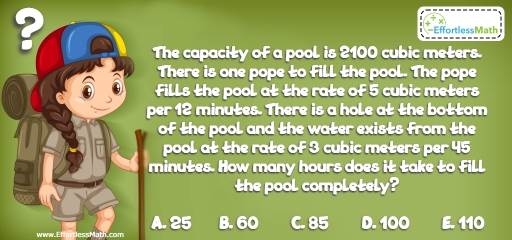
The capacity of a pool is 2100 cubic meters. There is one pope to fill the pool. The pope fills the pool at the rate of 5 cubic meters per 12 minutes. There is a hole at the bottom of the pool and the water exists from the pool at the rate of 3 cubic meters per 45 minutes. How many hours does it take to fill the pool completely?
A- 25
B- 60
C- 85
D- 100
E- 110
The Absolute Best Book to Challenge Your Smart Student!

The correct answer is D.
Original price was: $27.99.$17.99Current price is: $17.99.

The pope fills the pool at the rate of 5 cubic meters per 12 minutes. So, the rate of filling the pool per hour is 5 × 5 = 25 cubic meters.
The water exists from the pool at the rate of 3 cubic meters per 45 minutes or 4 cubic meters per hour. Therefore, the pool will be filled at the rate of 25 cubic meters, 4 cubic meters = 21 cubic meters.
The capacity of a pool is 2100 cubic meters. So, it takes 100 hours (2100 ÷ 21 = 100) to fill the pool completely.The Best Books to Ace Algebra
Frequently Asked Questions
Why convert the rates to per-hour?
To match units. The fill rate is in m^3/12-min and the leak is in m^3/45-min. Converting both to per-hour lets you subtract apples from apples.
How is the fill rate 25 m^3/hr?
5 m^3 every 12 minutes. In 1 hour (60 min) there are 5 of those 12-min intervals, so 5 times 5 = 25 m^3.
How is the leak rate 4 m^3/hr?
3 m^3 every 45 minutes. In 60 min you get 60/45 = 4/3 of those intervals, so 3 times 4/3 = 4 m^3.
What is the net fill rate?
25 – 4 = 21 m^3/hr. The pool gains 21 cubic meters every hour while both pipe and leak are running.
How long to fill the pool?
Time = Volume / Rate = 2100 / 21 = 100 hours.
What if the leak were faster than the pipe?
Then the net rate would be negative and the pool would never fill. Always check the sign of the net rate first.
How do I sanity-check the answer?
100 hours times 21 m^3/hr = 2100 m^3, matching the pool’s capacity.
Where does this kind of problem show up?
Anywhere rates compete: filling a reservoir while irrigation drains it, charging a battery while it discharges, hiring vs attrition in workforce planning.
What math is required to solve this?
Unit conversion, rate arithmetic, subtraction, and one division. Most curricula teach this in middle school (Grade 6-7).
Is there a shortcut?
Yes, with consistent units. Once both rates are in m^3/hr, the subtraction and division are quick. Most error comes from skipping the unit conversion.
Related Lessons You May Like
- How to find the area of rectangles
- How to find the perimeter of rectangles
- How to find the area of triangles
- How to solve systems of equations
- How to solve multi-step word problems
If your student enjoys these puzzles, Geometry for Beginners works the same relationships inside a full curriculum. Pre-Algebra for Beginners covers the algebra foundations.

Related to This Article
More math articles
- Division
- How to Evaluate Variable Expressions for Number Sequences
- The Best Grade 5 ELA Practice Tests for Hawaii Students
- Positive externalities create underconsumption or underproduction
- Lobbying
- Math for Cooking: Scaling Recipes, Conversions, and Baking Ratios for 2026
- Free Grade 4 English Worksheets for Nevada Students
- Second Amendment
- Eclipses and Stellar Life Cycles
- Number Patterns and Sequences for 4th Grade












What people say about "Pool Capacity Word Problem with Solution"?
No one replied yet.