Shop Troubleshooting: Stop, Inspect, Then Decide
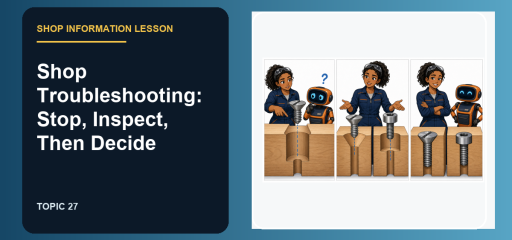
When an operation starts to go wrong, more force is rarely the answer. A slip, wobble, chatter, or rounded edge is information. Pause long enough to decide whether the problem is the tool, the setup, the material, or the technique.
This lesson is less about memorizing a label than about reading the job. When the clue is slipping, wandering, binding, chatter, a rounded fastener, or an unsafe setup, the sound choice is to stop the operation and correct the cause instead of forcing the tool.
What does shop troubleshooting mean?
Shop troubleshooting begins by stopping the unsafe or ineffective operation, observing the symptom, and checking the likely cause before forcing the tool. Slipping, rounded fasteners, wandering drill bits, binding blades, and rough cuts each point to a setup or tool-match problem.
Which clues should you notice first?
A useful way to avoid a close-choice trap is to name the visible condition first. If you can explain why slipping, wandering, binding, chatter, a rounded fastener, or an unsafe setup matters, the correct family becomes much easier to find.
- Working clue: slipping, wandering, binding, chatter, a rounded fastener, or an unsafe setup
- Best next move: stop the operation and correct the cause instead of forcing the tool
- Why it matters: the right setup protects the work, the tool, and the person using it.
How do the close choices differ?
| Tool or idea | What it does |
|---|---|
| Symptom | what you observe, such as a slipping bit |
| Cause | the condition to correct, such as poor workholding or the wrong bit |
A name is only half an answer. Symptom and Cause separate when you ask what each contacts, guides, supports, or changes in the work.
Put the clue into a shop decision
Imagine that a question or illustration gives you slipping, wandering, binding, chatter, a rounded fastener, or an unsafe setup. Before you look for a familiar name, say what the work actually needs: stop the operation and correct the cause instead of forcing the tool. Then test each choice against the physical result. A choice that cannot produce the needed result is out, even if it belongs to the same general family. This is also where the difference between Symptom and Cause becomes useful. One clear reason is enough to reject a close distractor.
Watch the skill in context
How to Use an EXTRACTOR TOOL SET to remove a stripped bolt or nut – Twist Sockets TOOL REVIEW by GearHeads with FinallyHeSleeps is a useful visual companion to this lesson. A helpful way to study the video is to cover its title briefly and predict the tool’s job from the visible features.
Use this four-step routine
- Stop before damage grows.
- Describe the symptom precisely.
- Check fit, workholding, tool condition, and material.
- Correct one cause and test safely.
Try the decision, then check your reasoning
- You see slipping, wandering, binding, chatter, a rounded fastener, or an unsafe setup. What detail should lead your decision? The condition that changes the tool choice or safe setup is the first clue.
- What is the best response when the task calls for slipping, wandering, binding, chatter, a rounded fastener, or an unsafe setup? Stop the operation and correct the cause instead of forcing the tool.
- How is Symptom different from Cause? Symptom what you observe, such as a slipping bit; Cause the condition to correct, such as poor workholding or the wrong bit.
- What should you do if the tool, setup, or workpiece does not match the job? Pause and correct the mismatch before applying more force.
Keep building your shop vocabulary
Use the ASVAB topic archive to move through the lessons in a practical order. Return to this lesson after a practice set and write down any look-alike pair that cost you time. A one-line contrast is easier to remember than a long list.
Related lessons:

Related to This Article
More math articles
- How to Write a Math-Based Analytical Paper Step by Step
- Chemistry Final Review: Fix Mistakes and Plan Practice
- Understanding and Mastering Perpendicular Lines and How to Draw Them
- The Best Grade 2 Reading Worksheets for Virginia Kids
- Seniority
- How to Find Modulus (Absolute Value) and Argument (Angle) of Complex Numbers?
- The Best Grade 8 ELA Practice Tests for North Dakota Students
- Explicit Details
- Government responsiveness
- How to Master Polar Coordinates: A Comprehensive Guide to Calculating Rate of Change in Polar Functions






















What people say about "Shop Troubleshooting: Stop, Inspect, Decide"?
No one replied yet.