Handsaws: Match the Cut to the Grain
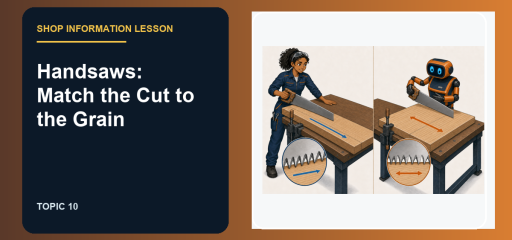
The word cut is never enough. Read what is being cut and which direction the cut travels. Grain direction, stock thickness, and whether the line is straight or curved quickly narrow the choices.
Picture the result before you name the tool. The detail wood grain direction, a curved cutout, or thin metal stock tells you why the next move should be to match the blade and saw motion to the material and planned cut.
What does handsaws mean?
A handsaw is selected by the material, the direction of the cut, and the shape of the opening. A ripsaw follows wood grain, a crosscut saw works across it, a coping saw handles curves, and a hacksaw uses a fine blade for metal or plastic.
Which clues should you notice first?
Look for the feature that would change your next move. With wood grain direction, a curved cutout, or thin metal stock, the question is testing function and safe use, not just whether you recognize a familiar silhouette.
- Working clue: wood grain direction, a curved cutout, or thin metal stock
- Best next move: match the blade and saw motion to the material and planned cut
- Why it matters: the right setup protects the work, the tool, and the person using it.
How do the close choices differ?
| Tool or idea | What it does |
|---|---|
| Ripsaw | cuts with the wood grain |
| Crosscut saw | cuts across the grain |
Use the contrast as an elimination tool. If a choice behaves like Ripsaw when the task clearly calls for Crosscut saw, it is close, but it is still wrong.
Put the clue into a shop decision
Imagine that a question or illustration gives you wood grain direction, a curved cutout, or thin metal stock. Before you look for a familiar name, say what the work actually needs: match the blade and saw motion to the material and planned cut. Then test each choice against the physical result. A choice that cannot produce the needed result is out, even if it belongs to the same general family. This is also where the difference between Ripsaw and Crosscut saw becomes useful. One clear reason is enough to reject a close distractor.
Watch the skill in context
Woodworking 101, Basics of Handsaw Cuts by Wylde Woodworks is a useful visual companion to this lesson. Watch for the moment when the presenter chooses a setup or control. That decision is often the exact distinction a question is testing.
Use this four-step routine
- Identify the material.
- Read the direction and shape of the cut.
- Choose the saw family.
- Secure the work and keep the blade path clear.
Try the decision, then check your reasoning
- You see wood grain direction, a curved cutout, or thin metal stock. What detail should lead your decision? The condition that changes the tool choice or safe setup is the first clue.
- What is the best response when the task calls for wood grain direction, a curved cutout, or thin metal stock? Match the blade and saw motion to the material and planned cut.
- How is Ripsaw different from Crosscut saw? Ripsaw cuts with the wood grain; Crosscut saw cuts across the grain.
- What should you do if the tool, setup, or workpiece does not match the job? Pause and correct the mismatch before applying more force.
Keep building your shop vocabulary
Use the ASVAB topic archive to move through the lessons in a practical order. Keep a short vocabulary note with the tool family on one side and its working action on the other. That is enough to make later review much faster.
Related lessons:

Related to This Article
More math articles
- Comparative Advantage, Specialization, and Trade
- Top 10 PSAT 10 Math Practice Questions
- The Anatomy of a Paragraph
- How Is the ALEKS Test Scored?
- Top 10 4th Grade FSA Math Practice Questions
- Best Laptops for Math Majors in 2026
- The Best Algebra 1 Book for Indiana Students
- Mississippi MAAP Grade 6 Math Free Worksheets: 72 Free Skill-by-Skill PDFs with Answer Keys
- How to Find Missing Angels in Quadrilateral Shapes? (+FREE Worksheet!)
- The Math Expedition: How to Use Theoretical Probability to Predict the Unpredictable






















What people say about "Handsaws: Match the Cut to the Grain"?
No one replied yet.