Vietnam from French Colonial Rule to the Gulf of Tonkin
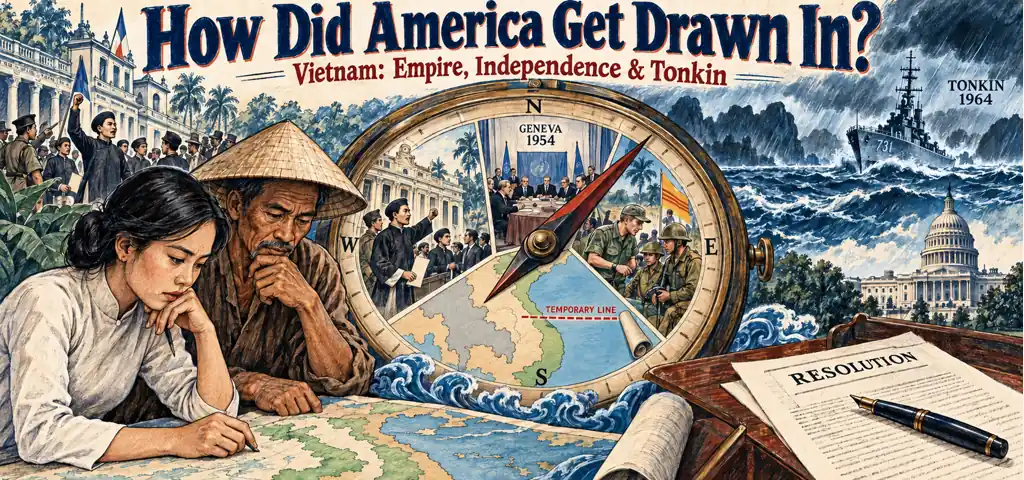
Chapter 14 of the CLEP History of the United States II study guide on Effortless Math covers Vietnam from French Colonial Rule to the Gulf of Tonkin: the key terms, the core ideas, and worked examples showing how this topic is tested on the exam.
CLEP History of the United States II, Chapter 14
Colonial rule shaped the conflict before the United States entered it
France built French Indochina from Vietnam, Laos, and Cambodia and governed through coercive labor, landholding, taxation, and a small collaborating elite. Vietnamese resistance included monarchists, nationalists, and communists. Ho Chi Minh helped found the Indochinese Communist Party, but his appeal also drew on national independence. Reducing the movement to Soviet direction misses its anticolonial base; treating it as only nationalism ignores its communist leadership and program.
Japanese occupation weakened French authority
Japan occupied Indochina during World War II while leaving much of the French colonial administration in place until March 1945. The Viet Minh, organized in 1941, opposed Japanese rule and prepared for independence. After Japan surrendered, Ho Chi Minh declared the Democratic Republic of Vietnam in September 1945. He quoted the American Declaration of Independence, but the Truman administration placed greater weight on restoring a European ally and containing communism than on recognizing his government.
The First Indochina War ended French empire, not the Vietnamese conflict
France tried to restore colonial control, and fighting began in 1946. The United States financed an increasing share of the French effort, especially after the Chinese Communist victory and the Korean War sharpened containment fears. At Dien Bien Phu in 1954, Viet Minh forces under Vo Nguyen Giap surrounded and defeated a French garrison. The battle destroyed France's political will to continue; it did not itself create a permanent North and South Vietnam.
Domino reasoning did not settle the question of intervention
In April 1954, Eisenhower warned that if one Southeast Asian country fell to communism, neighboring countries might follow like a row of dominoes. Yet the administration did not order the proposed American air strikes to rescue Dien Bien Phu. Congressional leaders wanted allied participation, Britain would not join, and a unilateral attack risked a wider war. The episode separates a broad containment theory from the harder decision to use American force in a particular crisis.
The Geneva settlement created a temporary military division
The 1954 Geneva agreements ended fighting and regrouped forces on opposite sides of the seventeenth parallel. The line was not intended as a permanent international boundary. Nationwide elections were discussed for 1956, but the United States and the South Vietnamese government did not accept a process they expected Ho Chi Minh to win. Laos and Cambodia were recognized separately. The distinction between temporary regroupment and permanent partition is essential.
Ngo Dinh Diem built an anticommunist state with narrow support
With American backing, Ngo Dinh Diem displaced Emperor Bao and proclaimed the Republic of Vietnam in 1955. His government promoted anticommunism, favored family and Catholic networks, suppressed opponents, and refused the nationwide election. Land policies and coercive rural administration alienated many peasants. Washington saw Diem as an alternative to communist rule, but aid could not automatically supply his regime with legitimacy.
Insurgency grew through southern grievances and northern support
Former Viet Minh networks, southern opponents of Diem, and later northern personnel and supplies contributed to the insurgency. The National Liberation Front formed in 1960; Americans commonly called its guerrillas the Viet Cong. The Ho Chi Minh Trail moved people and material through Laos and Cambodia. The conflict combined a civil struggle within South Vietnam, a war between northern and southern states, and an international Cold War contest. No single label captures every level.
Kennedy expanded advisers and counterinsurgency
The Kennedy administration increased American military advisers, helicopters, equipment, and support for South Vietnamese forces. The Strategic Hamlet Program attempted to separate rural residents from insurgents by concentrating villages behind defenses. Poor implementation, forced relocation, corruption, and disruption of local life often produced resentment instead of reliable security. Counting hamlets or weapons could therefore exaggerate political control.
The Buddhist crisis exposed Diem's political weakness
In 1963, Diem's government restricted Buddhist flags while permitting a Catholic celebration, and security forces killed protesters in Hue. Buddhist demonstrations and the self-immolation of Thich Quang Duc drew world attention. American officials supported contacts with South Vietnamese generals who overthrew Diem in November. Diem and his brother were killed. The coup removed an unpopular ally but began rapid government turnover rather than stable reform.
Tonkin converted a disputed episode into broad authority
On August 2, 1964, the destroyer USS Maddox exchanged fire with North Vietnamese patrol boats in the Gulf of Tonkin. Reports of a second attack on August 4 were uncertain and later discredited. Congress nonetheless passed the Gulf of Tonkin Resolution, authorizing the president to use necessary measures against aggression in Southeast Asia. It was not a formal declaration of war, but Johnson used it as broad statutory authority for escalation.
separate an event from the authority claimed from it
A document says Congress authorized the president to take "all necessary measures" after reported attacks.
The Geneva settlement postponed rather than completed national unification
The 1954 accords temporarily divided Vietnam near the seventeenth parallel and anticipated elections in 1956. The United States did not sign the agreements but pledged not to disturb them by force. Ngo Dinh Diem's South Vietnamese government, backed by Washington, refused nationwide elections, arguing that conditions in the communist North would not permit a free vote. The resulting states were not simply ancient permanent countries. They emerged from decolonization, competing claims to legitimacy, population movement, and outside support.
Advisory assistance gradually changed the American stake
Eisenhower and Kennedy sent money, equipment, and advisers to strengthen South Vietnam, while Kennedy increased personnel and supported counterinsurgency. Advisers could train and accompany forces without being described publicly as a conventional American war, yet casualties and operational involvement grew. Washington also became entangled in South Vietnamese politics, including the 1963 coup against Diem. Each additional commitment made withdrawal appear to threaten credibility and earlier sacrifice. Escalation can therefore occur through accumulated decisions before a government announces that a qualitatively new war has begun.
Watch the history in motion
This short lesson adds voices, images, and chronology to the ideas you just studied.
Video: The VIETNAM WAR [APUSH Review Unit 8 Topic 8] Period 8: 1945-1980, Heimler's History.
Try four CLEP-style questions
- Why is it misleading to describe the seventeenth parallel in 1954 as a permanent international border?
- Congress had already admitted both Vietnamese zones as American protectorates.
- The line separated French territory from an independent Chinese province.
- Geneva created a temporary military regroupment line and anticipated a later political settlement.
- The Viet Minh accepted the line as a final renunciation of southern claims.
- The United Nations drew the boundary after supervising a national referendum.
- What most directly explains why the Strategic Hamlet Program could strengthen rather than weaken insurgent influence?
- It transferred all American advisers from contested rural villages to secure coastal cities permanently.
- The program prohibited South Vietnamese forces from entering rural districts.
- It ended land disputes by distributing plantation property equally among residents.
- Forced relocation and weak local legitimacy could turn protected villagers against the government.
- It relied on nationwide elections rather than physical security or intelligence.
- Which statement best distinguishes the two reported Gulf of Tonkin incidents?
- The August 2 exchange occurred, while evidence for a second attack on August 4 was deeply uncertain.
- The August 4 attack was confirmed, while the August 2 exchange was later disproved.
- Both were confirmed attacks by North Vietnamese forces on American aircraft carriers anchored inside Haiphong harbor during combat patrols.
- Neither report reached Congress until several years after American ground troops arrived.
- Both incidents followed a formal congressional declaration of war against North Vietnam.
- What did the Gulf of Tonkin Resolution do?
- It prohibited bombing outside the boundaries established at Geneva in 1954.
- It required nationwide Vietnamese elections supervised by American military officers.
- It ended aid to South Vietnam until its generals restored Ngo Dinh Diem.
- It transferred command of the conflict from the president to the United Nations.
- It authorized broad presidential military action without issuing a formal declaration of war.
Check your answers and reasoning
Independent preparation. CLEP is a registered trademark of the College Board, which does not endorse this lesson.

Related to This Article
More math articles
- Indiana Algebra 1 Free Worksheets: Free Skill-Targeted Algebra 1 Worksheets with Answer Keys
- Free Grade 4 English Worksheets for California Students
- How to Solve Problems Using Venn Diagrams
- Top 10 CLEP College Algebra Practice Questions
- Three and A Half Principles of Extraordinary Techniques for Math Teaching
- How to Graph Inverse Functions
- How to Use a Calculator on Standardized Math Tests
- First Amendment Freedom of Speech
- Congestion can change a good’s classification
- FREE HiSET Math Practice Test





















What people say about "Vietnam from Colonial Rule to Tonkin"?
No one replied yet.