Positive externalities create underconsumption or underproduction
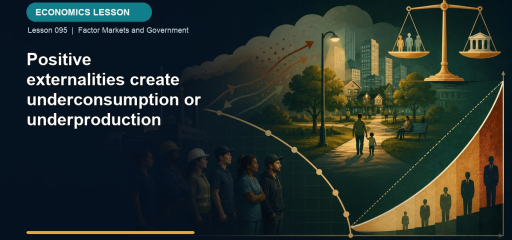
Positive externalities create underconsumption or underproduction: this Effortless Math guide explains the topic in plain language, shows how it works through solved examples, and gives you free practice to try immediately, so the idea sticks instead of staying abstract.
Social marginal benefit exceeds private marginal benefit.
To make a buyer count the spillover benefit created by one more unit, an ideal corrective subsidy equals
- marginal external benefit at efficient output
- the full market price at unregulated output
- total external benefit from all units produced
- the producer’s average fixed cost at efficient output
- consumer surplus earned before the policy
marginal external benefit at efficient output A subsidy equal to the marginal external benefit can align private incentives with the full social benefit.
A positive consumption externality exists when
- buyers pay more for a good than sellers receive
- production becomes more costly as output expands
- the consumed good cannot exclude nonbuyers
- private benefit exceeds the full social benefit
- third parties benefit from the buyer’s consumption
third parties benefit from the buyer’s consumption Vaccination, education, or similar consumption may benefit third parties, making social marginal benefit exceed private marginal benefit.
A vaccination creates benefits for people other than the recipient. Without policy, the competitive market will tend to
- overproduce because private benefit exceeds social benefit
- produce efficiently because the external benefit is included in price
- underproduce because social marginal benefit exceeds private marginal benefit
- set price equal to social marginal benefit automatically
- eliminate the benefit through bargaining in every case
underproduce because social marginal benefit exceeds private marginal benefit Buyers consider private benefit and omit benefits to others, so market demand understates social marginal benefit and quantity is too low.
Watch the idea in action
A focused video lesson from Jacob Clifford.
Education, vaccination, and research may benefit third parties. If private demand reflects only the consumer’s benefit, MSB lies above demand and the market quantity is too low. A corrective subsidy equal to marginal external benefit at the efficient quantity can align private and social incentives.
Choose the missing marginal value
A factory’s private marginal cost at the efficient quantity is $18 and each unit causes $5 of marginal external damage. MSC is $23. A $5 per-unit tax makes the factory face the social marginal cost at that quantity.
A positive externality exists when an action creates a benefit for a third party and the decision maker cannot capture that benefit in the market price. A vaccinated person receives private protection, while people nearby may face lower infection risk. A firm that develops a technique may teach employees or reveal knowledge that other firms later use. Because the buyer or producer is not paid for the entire social gain, the private market provides too little.
For a positive consumption externality, ordinary demand records marginal private benefit. Add the marginal external benefit to obtain social marginal benefit:
MSB=MPB+MEB.
MSB lies above private demand, and the efficient quantity where MSB meets marginal social cost exceeds the market quantity. For a positive production spillover, social marginal cost may instead lie below private marginal cost. The same underproduction conclusion can arise through a different curve, so the source of the spillover still matters.
| Spillover | Missing marginal value | Basic quantity error |
|---|---|---|
| Factory pollution | External cost in MSC | Market quantity too high |
| Vaccination benefit to others | External benefit in MSB | Market quantity too low |
| Research knowledge spillover | Social return beyond private return | Research too low |
Calculate the subsidy benchmark
A training course gives a student $700 of marginal private benefit and nearby employers $200 of marginal benefit through a more skilled labor pool. At that enrollment level, MSB=$900. If marginal cost is $900, the unit is socially efficient even though the student would not buy it at a $900 price. A $200 subsidy can bridge the private-social gap at that quantity.
A subsidy is a means, not a free gain. Raising public revenue can create administrative and incentive costs, and a poorly targeted subsidy can pay for activity that would have occurred anyway. Patents take another approach to knowledge spillovers by granting temporary exclusion so innovators can capture more benefit. That can encourage research but also creates temporary market power. Public provision, prizes, and grants represent other tradeoffs.
Do not say that a positive externality shifts market demand by itself. The observed private demand curve is precisely what omits the external benefit. Analysts construct an additional social-benefit curve to evaluate efficiency. Also distinguish a third-party spillover from ordinary consumer surplus: the buyer’s own benefit above price is internal to the transaction, not an externality.
The reliable sequence is: identify the outsider, determine whether the effect is a benefit or cost, place it on the correct side of the market, compare Q_m with Q^*, and only then choose a policy. That reasoning is more dependable than memorizing “positive means subsidy.”

Reza is an experienced Math instructor and a test-prep expert who has been tutoring students since 2008. He has helped many students raise their standardized test scores--and attend the colleges of their dreams. He works with students individually and in group settings, he tutors both live and online Math courses and the Math portion of standardized tests. He provides an individualized custom learning plan and the personalized attention that makes a difference in how students view math.
Related to This Article
More math articles
- Multiplication Models: Area Models and Partial Products
- Calculating Water Potential
- Algebra Puzzle – Challenge 51
- Number Properties Puzzle – Challenge 8
- Full-Length 8th Grade Common Core Math Practice Test
- Discover the Gateway: “CBEST Math for Beginners” Full Solution Handbook
- How to Use Graphs to Solve Equation Systems: Word Problems
- Maintenance, Alarms, Feed Lines, Drains, and Outlets
- Grade 6 Math Free Worksheets: 72 Free Printable PDFs with Step-by-Step Answer Keys
- Presidential veto



















What people say about "Positive Externalities and Underconsumption"?
No one replied yet.