Separate description from judgment
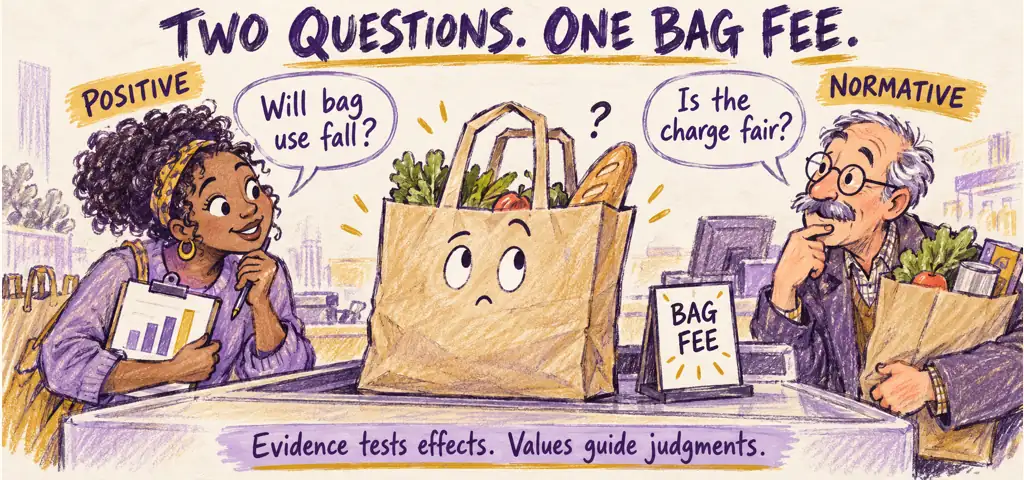
A town proposes a charge for disposable shopping bags. One resident predicts it will reduce bag use, while another calls the proposal unfair to shoppers with tight budgets, even if it does reduce waste. They raise different questions.
Evidence can investigate the prediction. Judging fairness also requires a value standard, which is why economists call the prediction a positive statement and the fairness claim a normative statement. The labels describe the kind of claim.
Positive does not mean correct
A positive statement describes a condition, reports an observation, or predicts a relationship. 'Doubling the bag charge will halve bag use' is positive because evidence can test it, including evidence that might show the prediction is wrong. Positive claims can be false.
Normative statements express judgments about what ought to happen or which outcomes deserve priority. 'The town should put convenience ahead of reducing waste' expresses a value judgment, and identifying it as normative leaves the merits of that judgment open to discussion. Calling it normative does not reject it.
Set aside the everyday meanings of these words. Positive does not mean cheerful or beneficial, and normative does not mean typical, so neither label tells you whether to support the proposed bag charge.
Separate the parts of a policy recommendation
Consider the sentence 'The charge will reduce litter, so the town should adopt it.' Its prediction about litter can be tested, but the recommendation also assumes that this reduction is worth the costs and distributional effects the policy creates. That evaluation needs a standard.
Evidence helps inform it. The town could measure bag use, litter collection costs, and household spending, including whether shoppers substitute other kinds of bags whose production also consumes resources. These measurements describe the consequences.
People may agree on those findings yet disagree about the weight to give convenience, environmental effects, or the spending burdens borne by households with low incomes. Additional measurements cannot choose those priorities by themselves.
Fairness questions still need facts
Suppose one proposal returns the revenue equally to residents, while another spends it on waste collection. Comparing them involves values as well as testable consequences, including who receives payments, what administration costs, and which neighborhoods receive improved service under the second proposal. Facts and values both contribute.
Before assuming two speakers have different priorities, ask which factual prediction they dispute. They may agree on the goal of reducing litter but have different expectations about the effect of a charge, making evidence relevant to that disagreement.
Try marking the claims in 'Bus fares should be lower because a fare cut will increase ridership.' The ridership prediction can be investigated, while the recommendation also depends on funding, service quality, and whose benefits and costs receive priority in the evaluation. Ask which of those claims the speaker is defending.
Watch the idea in action
A related lesson from Khan Academy. Read the examples above alongside the video.
Open the video on YouTube · Educator lesson and source

Reza is an experienced Math instructor and a test-prep expert who has been tutoring students since 2008. He has helped many students raise their standardized test scores--and attend the colleges of their dreams. He works with students individually and in group settings, he tutors both live and online Math courses and the Math portion of standardized tests. He provides an individualized custom learning plan and the personalized attention that makes a difference in how students view math.
Related to This Article
More math articles
- Number Properties Puzzle -Critical Thinking 4
- How to Write Equation of Parallel and Perpendicular Lines?
- The Best Grade 4 ELA Practice Tests for Delaware Students
- How to Motivate Anyone to Start Learning Algebra and Geometry
- How to Solve Rational Numbers Word Problems
- How to Select the Right Tool for the Job
- Free Grade 3 English Worksheets for Mississippi Students
- Where to Find Reliable Gambling Site Rankings
- Speedy and public trial
- The Best Scientific Calculator to Buy for School and Work





















What people say about "Separate Description From Judgment"?
No one replied yet.