Signals and screens build trust differently
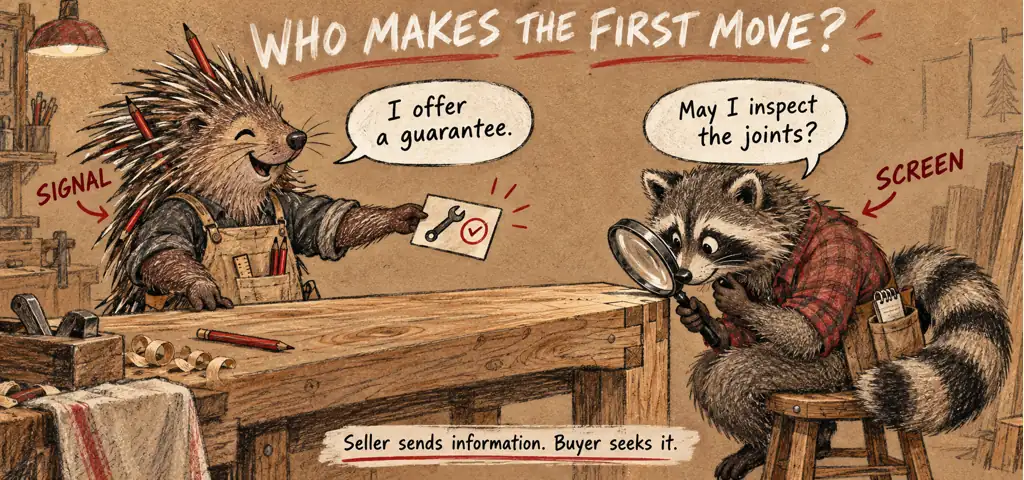
A carpenter offers a repair guarantee with a table. Before paying, the buyer asks to inspect the joints, hoping to find out whether the workmanship justifies the price the carpenter is asking.
Who started each action? The informed carpenter offers a promise that can signal quality, while the less-informed buyer designs a check to obtain information. The buyer is screening.
Work out why someone would send the signal
Signaling conveys information through the informed party's action. An applicant may present a certificate, for example, but the observer still needs a reason to believe it tells them something about the quality they care about.
Try the carpenter's guarantee. Suppose honoring it costs a careful carpenter an expected $10 in repairs but costs a careless carpenter $70, and buyers pay an extra $40 for it. The promise must also be enforceable. Under these assumptions, offering it is attractive to the careful carpenter and unattractive to the careless one, giving the buyer a reason to interpret it as evidence of quality.
A badge that anyone can buy cheaply without meeting a relevant standard provides little reason to revise a belief about craftsmanship, however impressive the badge looks.
Ask the less-informed side to design a check
An employer can request a work sample. A buyer might instead hire an independent inspector, while an insurer can offer a menu of contracts and learn something from the options customers select. Each begins on the less-informed side.
Interpret the response cautiously. Choosing a high deductible could reflect low expected claims, the ability to absorb a loss or a preference for a lower premium, so the choice does not reveal a person's entire risk profile.
Screening has costs too. A lengthy unpaid hiring task can discourage capable applicants with little spare time, making the information collected a poor guide to the people who declined to participate. Check whether the effort required serves the actual hiring decision.
Keep information and incentives in view after hiring
A homeowner verifies a contractor's qualifications. That helps with selection, but the contractor may still have an incentive to finish quickly at the expense of work the homeowner cannot inspect until much later.
Contracts can affect that behavior. Staged payments, inspections and enforceable obligations can give the contractor reasons to take care, while some of those same arrangements also provide information about competence.
For any proposed signal or screen, identify who has the private information before deciding what to call the action. A seller offering a warranty sends a signal. When the buyer requires a test, the buyer is screening, and the next question is whether the test distinguishes the qualities that matter for this purchase.
Watch the idea in action
A related lesson from Marginal Revolution University. Read the examples above alongside the video.

Reza is an experienced Math instructor and a test-prep expert who has been tutoring students since 2008. He has helped many students raise their standardized test scores--and attend the colleges of their dreams. He works with students individually and in group settings, he tutors both live and online Math courses and the Math portion of standardized tests. He provides an individualized custom learning plan and the personalized attention that makes a difference in how students view math.
Related to This Article
More math articles
- South Carolina EOC Algebra 1 Free Worksheets: 64 Free Printable EOC-Ready Algebra 1 Worksheets with Keys
- FREE 5th Grade PSSA Math Practice Test
- Free Grade 4 English Worksheets for Wyoming Students
- 6th Grade WY-TOPP Math Worksheets: FREE & Printable
- How to Multiply Monomials? (+FREE Worksheet!)
- 6th Grade WVGSA Math Worksheets: FREE & Printable
- Crowds, Publics, and Masses
- The Ultimate 6th Grade CMAS Math Course (+FREE Worksheets)
- 10 Most Common 7th Grade OST Math Questions
- Third-Grade Math in Nebraska (NSCAS): 49 Free Printable Worksheets, One Concept Per Page


















What people say about "Signals and Screens Build Trust Differently"?
No one replied yet.