Present bias creates conflict between today’s self and tomorrow’s self
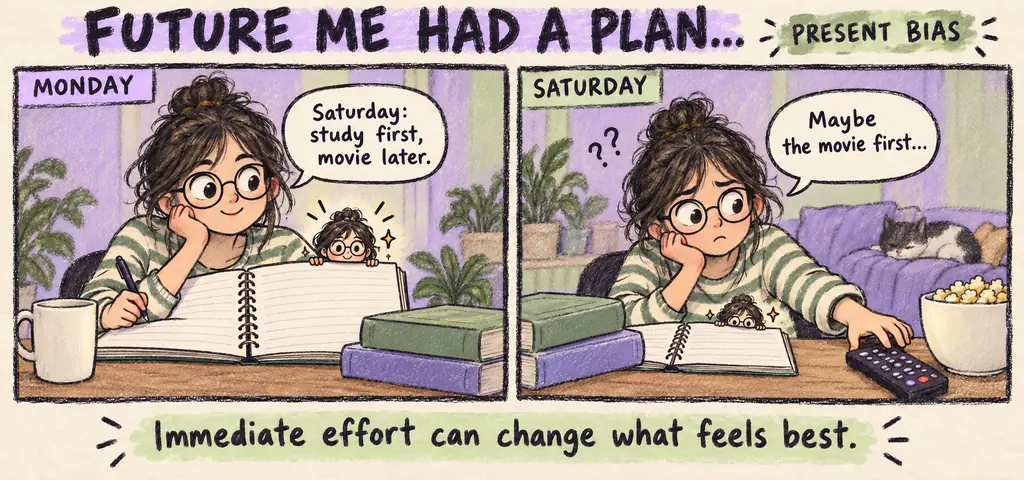
On Monday, you plan to study on Saturday morning and watch a film afterward. Saturday arrives. With the workload and available time just as you expected, the effort of studying now feels pressing enough that you decide to watch the film first.
Present bias gives disproportionate weight to immediate costs and benefits. An option that looks appealing from a distance can lose its appeal when the effort moves into the present, even though the circumstances match what you had anticipated.
Look for a reversal
Suppose you prefer $110 in thirty-one days to $100 in thirty days. But offered $110 tomorrow or $100 today, you choose the $100, despite unchanged payment certainty and other conditions relevant to the comparison.
Both choices involve another day's wait. Ordinary impatience can explain valuing earlier payment, but a constant discount rate applied consistently across time does not by itself produce this reversal in the preference between the two payments.
Check the circumstances carefully. A bill due today could make immediate money especially useful, or you might trust an immediate payment while doubting a promise of payment tomorrow. Those changes provide other explanations. A single choice gives too little information to diagnose present bias without examining the alternatives and constraints that the person faced when choosing.
Use commitment when it fits the obstacle
A student puts a phone in a timed lockbox before studying. Someone else chooses an account with withdrawal restrictions to make an impulsive purchase harder, accepting a limit now on choices they could otherwise make later. These are commitment devices.
The restriction can support a goal the person still endorses. It also carries a risk: a deadline set during a quiet week may become burdensome, or restricted savings may be needed for an emergency.
Consider an exit before committing. A short lock period might fit one study session, while an emergency route to funds can protect against needs the saver could not have anticipated when choosing the restriction.
Distinguish a restriction from convenience
An automatic transfer reduces the effort of saving. If it can be canceled immediately at no cost, it may work primarily as a default or a convenience rather than a binding restriction on future choices.
A reminder works differently again. It brings a task to your attention, which can help with forgetting but leave the temptation to postpone an unpleasant task unchanged. The tools address different obstacles.
For something you repeatedly postpone, compare the plan you make when the task is distant with the choice you make when it becomes immediate. Check for changed information or constraints. Then evaluate the particular tool's costs, including what would happen if your circumstances changed after you chose it.
Watch the idea in action
A related lesson from Shlomo Benartzi / TED. Read the examples above alongside the video.

Reza is an experienced Math instructor and a test-prep expert who has been tutoring students since 2008. He has helped many students raise their standardized test scores--and attend the colleges of their dreams. He works with students individually and in group settings, he tutors both live and online Math courses and the Math portion of standardized tests. He provides an individualized custom learning plan and the personalized attention that makes a difference in how students view math.
Related to This Article
More math articles
- The Best Grade 6 ELA Practice Tests for Maryland Students
- Can You Cheat on the ALEKS Test?
- Top 10 TSI Math Practice Questions
- The Best Grade 8 Math Book for Oklahoma Students
- Endosymbiotic Theory: Organelles, Evidence and Gene Transfer
- AP Business with Personal Finance: Compare APR and APY (2027 Prep)
- South Dakota SBAC Grade 6 Math Free Worksheets: Printable Standards-Aligned Practice PDFs, Free
- Scarcity creates tradeoffs
- How to Find the Volume and Surface Area of a Triangular Pyramid?
- The Best Grade 8 ELA Practice Tests for Arkansas Students


















What people say about "Present Bias: Today's Self vs Tomorrow's"?
No one replied yet.