How limited attention and framing affect choices
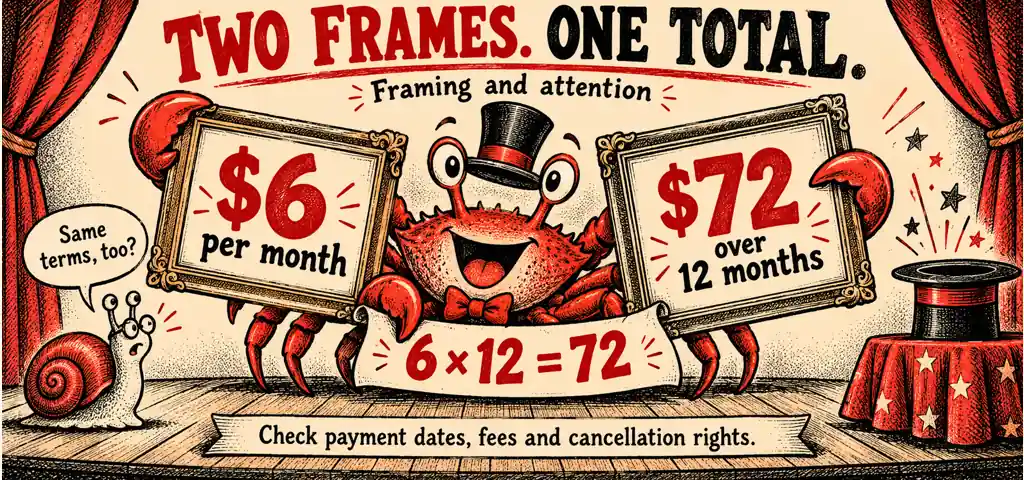
A subscription advertises $6 a month. Another describes the same schedule as $72 over twelve months, drawing your attention to a different number even though the annual payments are equal.
Check the terms first. Different cancellation rights, payment dates or fees would change what you are buying, making the difference in the offers substantive rather than simply a change in presentation.
Account for the work of deciding
A shopper could compare every washing machine in a store. That takes time. Using a familiar brand or a short list of requirements can save effort, although a shortcut can also cause the shopper to overlook a feature that would affect the choice.
Bounded rationality recognizes these limits on information, attention and calculation. To judge a shortcut, compare the work it saves with the consequences of overlooking relevant information, including what a feasible alternative method of choosing would require.
A unit-price label can help. Displaying a cereal's price per ounce removes a calculation the shopper would otherwise have to perform, while leaving the choice of cereal with the person buying it.
Hold outcomes fixed to identify framing
Consider '90 out of 100 survive' and '10 out of 100 die.' For the same patients, period and definition of survival, the statements convey equivalent information even though the presentation can affect a decision. That is a framing effect.
Change the period, though, and the comparison changes. Survival after one month and survival after five years describe different outcomes, so responding differently to those figures can reflect a change in information.
Return to the subscription. Showing an annual total alongside the monthly amount can help someone notice the expense, provided the display also preserves the payment schedule and explains any right to cancel early. The total alone might conceal that flexibility.
Find the reference point
You expected a particular payment. Receiving $20 less than expected can feel different from receiving a $20 bonus, with the expectation serving as a reference point for judging the two outcomes.
Loss aversion describes a pattern in which a loss relative to a reference point receives greater weight than an equal-sized gain. It differs from diminishing marginal utility. The latter concerns how additional units change satisfaction, and by itself does not establish an asymmetry between gains and losses around a reference point.
People respond differently across settings. Reluctance to sell a possession could reflect attachment, transaction costs or uncertainty as well as loss aversion, so ownership alone does not settle the explanation. Compare the actual options before attributing a changed choice to its frame.
Watch the idea in action
A related lesson from tutor2u. Read the examples above alongside the video.

Reza is an experienced Math instructor and a test-prep expert who has been tutoring students since 2008. He has helped many students raise their standardized test scores--and attend the colleges of their dreams. He works with students individually and in group settings, he tutors both live and online Math courses and the Math portion of standardized tests. He provides an individualized custom learning plan and the personalized attention that makes a difference in how students view math.
Related to This Article
More math articles
- How to Graph the Tangent Function?
- How to Complete the Table of Division Big Numbers By One-digit Numbers
- 5 Best Laptops For Teachers
- Advanced Vocabulary Words: Deplore to Embonpoint
- Full-Length 7th Grade MCAS Math Practice Test
- Social and factor graphs require the correct marginal curves
- Free Grade 6 English Worksheets for Iowa Students
- Exponents and Powers: Rules You’ll Use for Life
- Voter Turnout: Who Votes and Why
- WEST-B Math Flashcards



















What people say about "How Limited Attention and Framing Affect Choices"?
No one replied yet.