How to Graph the Tangent Function?



Understanding the Tangent Function Properties
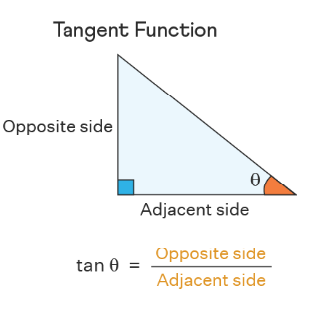
The tangent function, \(f(x) = \tan(x)\), is defined as \(\frac{\sin(x)}{\cos(x)}\). Unlike sine and cosine, which are continuous everywhere, tangent has vertical asymptotes wherever cosine equals zero. Understanding these discontinuities is essential for graphing tangent correctly.
Graph the Tangent Function: what to notice and how to work it
What to notice first
Common student mistake
Key formulas and cues
A reliable path
- Choose the modelUse a right triangle, the unit circle, or a transformed graph.
- Track unitsConvert degrees and radians when needed.
- Use identitiesReplace complicated trig expressions with equivalent simpler ones.
Worked examples
Read a tangent graph rule
- The vertical stretch is 2.
- The period is pi/3.
- The midline is y = 1.
Find parent tangent asymptotes
- Place asymptotes at x = -pi/2 and x = pi/2.
- Plot the center point (0, 0).
- Draw an increasing branch between the asymptotes.
Try one before moving on
Graph the Tangent Function: pop-up practice
The tangent function is odd, meaning \(\tan(-x) = -\tan(x)\), so its graph is symmetric about the origin. This symmetry helps you sketch the curve efficiently.
The Period of Tangent
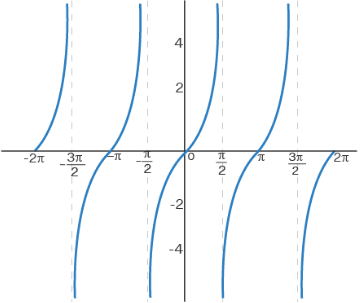
The tangent function has period \(π\) (not \(2π\) like sine and cosine). This means the graph repeats every \(π\) units: \(\tan(x + π) = \tan(x)\). In degrees, the period is 180°.
Why is the period different? Because \(\tan(x) = \frac{\sin(x)}{\cos(x)}\), and both sine and cosine have period \(2π\), but the fraction creates a pattern that repeats every \(π\). If you shift both numerator and denominator by \(π\), they both change sign, making the fraction return to its original value.
Vertical Asymptotes of Tangent
Vertical asymptotes occur where the denominator (cosine) equals zero. Since \(\cos(x) = 0\) when \(x = \frac{π}{2} + nπ\) (where n is any integer), the vertical asymptotes are at:
- \(x = …, -\frac{3π}{2}, -\frac{π}{2}, \frac{π}{2}, \frac{3π}{2}, \frac{5π}{2}, …\)
- In degrees: \(x = …, -90°, 90°, 270°, …\)
Between any two consecutive asymptotes, the tangent curve rises from \(-∞\) to \(+∞\), creating a characteristic S-shape repeated with period \(π\).
Key Points on the Tangent Curve
Within one period from \(-\frac{π}{2}\) to \(\frac{π}{2}\), identify these key points:
- At \(x = -\frac{π}{4}\): \(\tan(-\frac{π}{4}) = -1\), point is \((-\frac{π}{4}, -1)\)
- At \(x = 0\): \(\tan(0) = 0\), point is (0, 0), the origin is on the curve
- At \(x = \frac{π}{4}\): \(\tan(\frac{π}{4}) = 1\), point is \((\frac{π}{4}, 1)\)
- At \(x = \frac{π}{6}\): \(\tan(\frac{π}{6}) = \frac{1}{\sqrt{3}} = \frac{\sqrt{3}}{3} ≈ 0.577\)
- At \(x = \frac{π}{3}\): \(\tan(\frac{π}{3}) = \sqrt{3} ≈ 1.732\)
Worked Example: Graphing \(y = \tan(x)\)
Step 1: Identify asymptotes in your window. For the interval \([-π, π]\), asymptotes are at \(x = -\frac{π}{2}\) and \(x = \frac{π}{2}\).
Step 2: Plot key points
- \((-\frac{π}{4}, -1)\)
- (0, 0)
- \((\frac{π}{4}, 1)\)
Step 3: Sketch the curve From left to right:
- As x approaches \(-\frac{π}{2}\) from the right, the curve rises to \(+∞\)
- The curve passes through \((-\frac{π}{4}, -1)\) and (0, 0)
- At \((\frac{π}{4}, 1)\), the curve continues upward
- As x approaches \(\frac{π}{2}\) from the left, the curve approaches \(+∞\)
Step 4: Extend the pattern Repeat this S-shape to the left and right with period \(π\).
Graphing Transformations of Tangent
Graphing functions principles apply to transformations:
- \(f(x) = \tan(x) + 2\): Shifts vertically up 2 units (asymptotes don’t move)
- \(f(x) = \tan(x – \frac{π}{4})\): Shifts horizontally right \(\frac{π}{4}\) units
- \(f(x) = 2\tan(x)\): Stretches vertically by factor 2 (steeper curve)
- \(f(x) = \tan(2x)\): Compresses horizontally, period becomes \(\frac{π}{2}\)
- \(f(x) = -\tan(x)\): Reflects across x-axis
For \(f(x) = \tan(Bx)\), the period is \(\frac{π}{B}\). So \(\tan(3x)\) has period \(\frac{π}{3}\), making it complete 3 cycles where \(\tan(x)\) completes 1.
Relationship to Sine and Cosine
Since \(\tan(x) = \frac{\sin(x)}{\cos(x)}\), understanding this relationship helps graph transformations. Where sine is zero, tangent is zero. Where cosine is zero, tangent has asymptotes. Where sine and cosine have the same sign, tangent is positive; when they differ in sign, tangent is negative.
Tangent in Different Quadrants
Tangent is positive in quadrants I and III (where sin and cos have the same sign) and negative in quadrants II and IV (where they differ). Reference angles help evaluate tangent at non-acute angles.
Real-World Applications
The tangent function models slope and angle relationships in surveying, engineering, and physics. The slope of a line equals the tangent of the angle it makes with the horizontal. See The Ultimate Trigonometry Course for advanced applications.
Common Mistakes When Graphing Tangent
Students often forget that tangent has period \(π\), not \(2π\), leading to asymptotes in the wrong places. Another error is trying to connect the curve across asymptotes, the function is undefined there, so never draw a continuous line across them. Forgetting the origin (0, 0) is on the curve is also common. Also, students sometimes confuse cotangent with tangent; remember that cotangent = 1/tangent.
Frequently Asked Questions
Q: Why doesn’t tangent have horizontal asymptotes? Because as x moves left and right indefinitely, tangent oscillates between \(-∞\) and \(+∞\), never approaching a fixed value.
Q: Can I use a graphing calculator? Yes, calculators are useful for checking your sketch. Ensure your calculator is in radian or degree mode as appropriate.
Q: What is the difference between \(\tan(x)\) and \(\cot(x)\)? Cotangent is the reciprocal: \(\cot(x) = \frac{1}{\tan(x)} = \frac{\cos(x)}{\sin(x)}\).
Practice Problems
- Graph \(y = \tan(x)\) on the interval \([-π, π]\) and identify all asymptotes.
- Sketch \(y = 2\tan(x – \frac{π}{3})\) and find its asymptotes.
- Find the period of \(f(x) = \tan(\frac{x}{2})\).
- Evaluate \(\tan(\frac{5π}{6})\).
- Graph \(y = -\tan(x) + 1\) on \([-\frac{π}{2}, \frac{π}{2}]\).
For more trigonometric graphing, explore The Ultimate Precalculus Course.
Complete Guide to Tangent Function Graphing
The tangent function, written f(x) = tan(x), is defined as sin(x)/cos(x). Unlike sine and cosine which are continuous everywhere, tangent has vertical asymptotes wherever cosine equals zero, creating a fundamentally different graphing situation. Understanding these discontinuities and the function’s periodic behavior is essential for correctly sketching the tangent curve.
The tangent function is odd, meaning tan(-x) = -tan(x). This creates perfect symmetry about the origin, allowing you to sketch one side and reflect for the other. The characteristic S-shaped curve between asymptotes repeats with period π (180 degrees), not the 2π period of sine and cosine.
Period and Vertical Asymptotes
The tangent function has period π (not 2π like sine and cosine). This fundamental property means the graph repeats every π units: tan(x + π) = tan(x) for all x in the domain. Why is the period π instead of 2π? Because tan(x) = sin(x)/cos(x). When you add π to both x-terms, sin(x + π) = -sin(x) and cos(x + π) = -cos(x). The negative signs cancel in division: -sin(x)/(-cos(x)) = sin(x)/cos(x). This property causes the repetition every π rather than 2π.
Vertical asymptotes occur where the denominator (cosine) equals zero. Since cos(x) = 0 when x = π/2 + nπ for any integer n, vertical asymptotes are at:.., -3π/2, -π/2, π/2, 3π/2, 5π/2.. In degrees:.., -90°, 90°, 270°.. Between any two consecutive asymptotes, the tangent curve rises continuously from -∞ to +∞, creating the characteristic S-shape repeated with period π.
Key Points within One Period
Within one complete period from -π/2 to π/2, identify these critical points: At x = -π/4: tan(-π/4) = -1, point is (-π/4, -1). At x = 0: tan(0) = 0, point is (0, 0). At x = π/4: tan(π/4) = 1, point is (π/4, 1). At x = π/6: tan(π/6) = 1/√3 = √3/3 ≈ 0.577. At x = π/3: tan(π/3) = √3 ≈ 1.732. These key points establish the curve’s shape within the fundamental period.
Step-by-Step Graphing Process
Step 1: Identify asymptotes in your window. For the interval [-π, π], asymptotes are at x = -π/2 and x = π/2. Draw these as vertical dashed lines. Step 2: Plot key points within the period from -π/2 to π/2: (-π/4, -1), (0, 0), (π/4, 1). Step 3: Sketch the curve. As x approaches -π/2 from the right, the curve rises to +∞. The curve passes through (-π/4, -1) and (0, 0). At (π/4, 1), the curve continues upward. As x approaches π/2 from the left, the curve approaches +∞. Step 4: Extend the pattern. Repeat this S-shape to the left and right with period π, creating asymptotes every π units.
Transformations of Tangent Functions
Function f(x) = tan(x) + 2: Shifts vertically up 2 units. The asymptotes remain at the same x-values since they’re determined by where cosine equals zero. Function f(x) = tan(x – π/4): Shifts horizontally right by π/4 units. Asymptotes move accordingly. Function f(x) = 2·tan(x): Stretches vertically by factor 2, making the curve steeper and reaching extreme values faster. Function f(x) = tan(2x): Compresses horizontally. The period becomes π/2 instead of π. Function f(x) = -tan(x): Reflects across the x-axis, reversing the direction of increase.
Period Changes with Horizontal Compression
For f(x) = tan(Bx), the period is π/|B|. If B = 1, period is π. If B = 2, period is π/2 (function completes one cycle in half the usual distance). If B = 3, period is π/3. If B = 1/2, period is 2π (function takes twice the usual distance to complete one cycle). Asymptotes occur where Bx = π/2 + nπ, or x = π/(2B) + nπ/B. Understanding these relationships helps you quickly sketch transformed tangent functions.
Relationship to Sine and Cosine
Since tan(x) = sin(x)/cos(x), understanding this relationship helps visualize transformations. Where sin(x) = 0, tan(x) = 0 (the function crosses the x-axis). Where cos(x) = 0, tan(x) is undefined (asymptotes occur). Where sin and cos have the same sign (both positive or both negative), tan is positive. Where they differ in sign (one positive, one negative), tan is negative. In quadrants I and III, tangent is positive. In quadrants II and IV, tangent is negative.
Real-World Applications
The tangent function models slope and angle relationships in surveying, engineering, and physics. In construction, slope = rise/run = tan(angle). In navigation, angles of elevation and depression use arctangent. In physics, tangent appears in projectile motion analysis and wave behavior. Engineers use tangent relationships for load calculations and stress analysis. Pilots use angles calculated with tangent for flight paths.
Common Mistakes and Solutions
Mistake 1: Forgetting tangent has period π, not 2π. Solution: Remember tan(x + π) = tan(x), and asymptotes repeat every π units, not 2π. Mistake 2: Trying to connect curves across asymptotes. Solution: The function is undefined at asymptotes; never draw a continuous line through them. Mistake 3: Forgetting the origin (0, 0) is on the curve. Solution: Always plot this point and verify your graph passes through it. Mistake 4: Confusing tangent with cotangent. Solution: Cotangent = 1/tangent, with different asymptotes and behavior. Mistake 5: Wrong asymptote locations. Solution: Vertical asymptotes occur at x = π/2 + nπ, not at multiples of π.
Verification Checklist
- Does your graph pass through (0, 0)?
- Are asymptotes correctly placed at π/2 + nπ?
- Does the curve rise from -∞ to +∞ between consecutive asymptotes?
- Is the period π (not 2π)?
- Are key points (±π/4, ±1) correctly plotted?
Understanding the Tangent Function Properties
The tangent function, \(f(x) = \tan(x)\), is defined as \(\frac{\sin(x)}{\cos(x)}\). Unlike sine and cosine, which are continuous everywhere, tangent has vertical asymptotes wherever cosine equals zero. Understanding these discontinuities is essential for graphing tangent correctly.
The tangent function is odd, meaning \(\tan(-x) = -\tan(x)\), so its graph is symmetric about the origin. This symmetry helps you sketch the curve efficiently.
The Period of Tangent
The tangent function has period \(π\) (not \(2π\) like sine and cosine). This means the graph repeats every \(π\) units: \(\tan(x + π) = \tan(x)\). In degrees, the period is 180°.
Why is the period different? Because \(\tan(x) = \frac{\sin(x)}{\cos(x)}\), and both sine and cosine have period \(2π\), but the fraction creates a pattern that repeats every \(π\). If you shift both numerator and denominator by \(π\), they both change sign, making the fraction return to its original value.
Vertical Asymptotes of Tangent
Vertical asymptotes occur where the denominator (cosine) equals zero. Since \(\cos(x) = 0\) when \(x = \frac{π}{2} + nπ\) (where n is any integer), the vertical asymptotes are at:
- \(x = …, -\frac{3π}{2}, -\frac{π}{2}, \frac{π}{2}, \frac{3π}{2}, \frac{5π}{2}, …\)
- In degrees: \(x = …, -90°, 90°, 270°, …\)
Between any two consecutive asymptotes, the tangent curve rises from \(-∞\) to \(+∞\), creating a characteristic S-shape repeated with period \(π\).
Key Points on the Tangent Curve
Within one period from \(-\frac{π}{2}\) to \(\frac{π}{2}\), identify these key points:
- At \(x = -\frac{π}{4}\): \(\tan(-\frac{π}{4}) = -1\), point is \((-\frac{π}{4}, -1)\)
- At \(x = 0\): \(\tan(0) = 0\), point is (0, 0), the origin is on the curve
- At \(x = \frac{π}{4}\): \(\tan(\frac{π}{4}) = 1\), point is \((\frac{π}{4}, 1)\)
- At \(x = \frac{π}{6}\): \(\tan(\frac{π}{6}) = \frac{1}{\sqrt{3}} = \frac{\sqrt{3}}{3} ≈ 0.577\)
- At \(x = \frac{π}{3}\): \(\tan(\frac{π}{3}) = \sqrt{3} ≈ 1.732\)
Worked Example: Graphing \(y = \tan(x)\)
Step 1: Identify asymptotes in your window. For the interval \([-π, π]\), asymptotes are at \(x = -\frac{π}{2}\) and \(x = \frac{π}{2}\).
Step 2: Plot key points
- \((-\frac{π}{4}, -1)\)
- (0, 0)
- \((\frac{π}{4}, 1)\)
Step 3: Sketch the curve From left to right:
- As x approaches \(-\frac{π}{2}\) from the right, the curve rises to \(+∞\)
- The curve passes through \((-\frac{π}{4}, -1)\) and (0, 0)
- At \((\frac{π}{4}, 1)\), the curve continues upward
- As x approaches \(\frac{π}{2}\) from the left, the curve approaches \(+∞\)
Step 4: Extend the pattern Repeat this S-shape to the left and right with period \(π\).
Graphing Transformations of Tangent
Graphing functions principles apply to transformations:
- \(f(x) = \tan(x) + 2\): Shifts vertically up 2 units (asymptotes don’t move)
- \(f(x) = \tan(x – \frac{π}{4})\): Shifts horizontally right \(\frac{π}{4}\) units
- \(f(x) = 2\tan(x)\): Stretches vertically by factor 2 (steeper curve)
- \(f(x) = \tan(2x)\): Compresses horizontally, period becomes \(\frac{π}{2}\)
- \(f(x) = -\tan(x)\): Reflects across x-axis
For \(f(x) = \tan(Bx)\), the period is \(\frac{π}{B}\). So \(\tan(3x)\) has period \(\frac{π}{3}\), making it complete 3 cycles where \(\tan(x)\) completes 1.
Relationship to Sine and Cosine
Since \(\tan(x) = \frac{\sin(x)}{\cos(x)}\), understanding this relationship helps graph transformations. Where sine is zero, tangent is zero. Where cosine is zero, tangent has asymptotes. Where sine and cosine have the same sign, tangent is positive; when they differ in sign, tangent is negative.
Tangent in Different Quadrants
Tangent is positive in quadrants I and III (where sin and cos have the same sign) and negative in quadrants II and IV (where they differ). Reference angles help evaluate tangent at non-acute angles.
Real-World Applications
The tangent function models slope and angle relationships in surveying, engineering, and physics. The slope of a line equals the tangent of the angle it makes with the horizontal. See The Ultimate Trigonometry Course for advanced applications.
Common Mistakes When Graphing Tangent
Students often forget that tangent has period \(π\), not \(2π\), leading to asymptotes in the wrong places. Another error is trying to connect the curve across asymptotes, the function is undefined there, so never draw a continuous line across them. Forgetting the origin (0, 0) is on the curve is also common. Also, students sometimes confuse cotangent with tangent; remember that cotangent = 1/tangent.
Frequently Asked Questions
Q: Why doesn’t tangent have horizontal asymptotes? Because as x moves left and right indefinitely, tangent oscillates between \(-∞\) and \(+∞\), never approaching a fixed value.
Q: Can I use a graphing calculator? Yes, calculators are useful for checking your sketch. Ensure your calculator is in radian or degree mode as appropriate.
Q: What is the difference between \(\tan(x)\) and \(\cot(x)\)? Cotangent is the reciprocal: \(\cot(x) = \frac{1}{\tan(x)} = \frac{\cos(x)}{\sin(x)}\).
Practice Problems
- Graph \(y = \tan(x)\) on the interval \([-π, π]\) and identify all asymptotes.
- Sketch \(y = 2\tan(x – \frac{π}{3})\) and find its asymptotes.
- Find the period of \(f(x) = \tan(\frac{x}{2})\).
- Evaluate \(\tan(\frac{5π}{6})\).
- Graph \(y = -\tan(x) + 1\) on \([-\frac{π}{2}, \frac{π}{2}]\).
For more trigonometric graphing, explore The Ultimate Precalculus Course.

Related to This Article
More math articles
- Oklahoma OSTP Grade 7 Math Worksheets: 95 Free Printable PDFs Aligned to Every Skill
- How to Ace the GRE Quant Section?
- Dark money
- The Ultimate FTCE General Knowledge Math Course (+FREE Worksheets & Tests)
- PSAT Math Practice Test Questions
- CHSPE Math FREE Sample Practice Questions
- ATI TEAS 7 Math Practice Test PDF with Answers (2026 Guide)
- 10 Most Common 5th Grade Georgia Milestones Assessment System Math Questions
- Your Coach’s Playbook: How to Understand Percent of Change
- How to Convert Fractions to Decimals (and Back Again)


What people say about "How to Graph the Tangent Function"?
No one replied yet.