Voter Turnout: Who Votes and Why
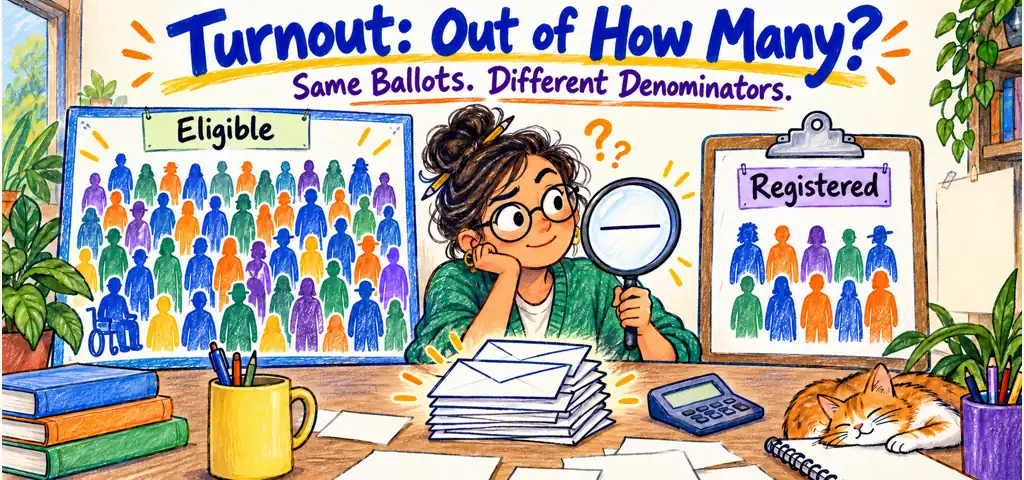
Turnout is a rate, so its meaning depends on the denominator. The voting-age population includes residents age eighteen or older. It is readily estimated from census data but includes noncitizens and some people ineligible under state law. The voting-eligible population attempts to remove ineligible residents and provide a closer measure of the people legally entitled to vote. Its construction requires estimates and legal judgments, especially because felony disenfranchisement and restoration rules vary by state and time. Voter rolls are administrative records of registrations, not a perfect census of eligible citizens. Most current records should correspond to eligible voters, but a roll can retain obsolete or erroneous entries, and it omits eligible citizens who never registered. Registration is therefore a gateway to voting rather than a synonym for eligibility. The voting population consists of people who cast ballots in the election. Official ballots counted, survey self-reports, and voter-file validation are different measures and may not produce identical totals.
Lake County reports registered-voter turnout using its election-night roll, while River County divides ballots by a registration file downloaded three months earlier. River added same-day registrants and removed outdated records after that download. Even if both reports display the same percentage, they are not measuring against comparable registration populations. The apparent difference(or similarity)may partly reflect timing rather than behavior. The comparison becomes sounder when both counties use registration totals defined at the same point in the election process. Voting-eligible population is often preferable across places with different noncitizen populations or disenfranchisement rules. Registered-voter turnout helps evaluate activation of the roll used for that election. Voting-age turnout remains useful in historical or demographic series where eligibility estimates are unavailable. No denominator is universally correct. Each answers a different question.
A practical reading of voter turnout: who votes and why
Measurement timing matters. Population estimates may refer to a survey period, registration totals to a cutoff date, and ballots to certified election returns. Same-day registration can add voters after a pre-election roll snapshot. Inactive registrations and provisional ballots complicate administrative totals. Researchers should align dates, jurisdictions, and administrative definitions before dividing one quantity by another. Survey turnout is often overstated because voters are more willing to answer political surveys and respondents may report a socially approved behavior they did not perform. Weighting a survey to demographics does not necessarily eliminate this bias. Validating self-reports against records under privacy protections improves behavioral measurement but can face name matching and data-access limits.
Voter Turnout: Who Votes and Why: a common mistake
Turnout and vote choice require different denominators. Turnout asks how many eligible or registered people voted. Candidate support among ballots asks how voters divided their choices. Candidate votes divided by all eligible people blends participation and preference, which may be analytically useful but is not the ordinary candidate vote share. Before comparing elections, verify the population, eligibility rules, registration date, ballot definition, and certification status. A higher registered-voter turnout rate can coexist with fewer total voters if the registration denominator shrinks. The safest habit is simple: write the numerator and denominator in words before calculating the percentage.
Apply the lesson on voter turnout: who votes and why
A county reports 60,000 ballots, 100,000 eligible voters, and 80,000 registered voters. What are its two turnout rates, and why are they different?
Check your reasoning
Turnout is 60 percent of the voting-eligible population and 75 percent of registered voters. Neither figure is automatically wrong. Each answers a different question. Always name the numerator and denominator before comparing places or years, and keep turnout separate from the candidates’ shares among ballots cast.
Video lesson: Voter Turnout: Who Votes and Why
Khan Academy gives a focused explanation of this topic in Voter turnout | Political participation | US government and civics | Khan Academy.
If the player does not load, watch this lesson directly on YouTube.
Connect this lesson to the larger course
For a broader map connecting voter turnout: who votes and why to participation, parties, elections, interest groups, and media, use the AP U.S. Government and Politics learning hub.

Related to This Article
More math articles
- Hyperbola in Standard Form and Vertices, Co– Vertices, Foci, and Asymptotes of a Hyperbola
- Free Grade 7 English Worksheets for Utah Students
- Brain Training Apps and How They Help Increase Memory and Focus
- 4th Grade MEAP Math FREE Sample Practice Questions
- Grade 8 Math Flashcards (Free Online: Formulas, Terms & Concepts)
- Free Grade 7 English Worksheets for Washington Students
- Number Properties Puzzle – Challenge 16
- Delaware DeSSA Grade 4 Math Free Worksheets: Printable Test-Prep Worksheets with Answer Keys
- Free Grade 5 English Worksheets for Tennessee Students
- 10 Most Common 8th Grade PSSA Math Questions
















What people say about "Voter Turnout: Who Votes and Why"?
No one replied yet.