A zero money price is not a zero economic cost
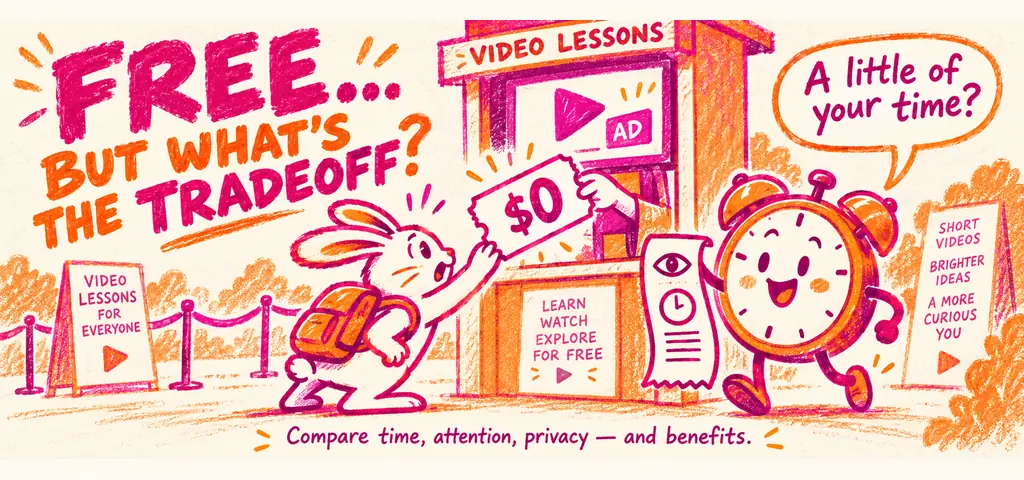
A video service has no subscription fee. Before each lesson, an advertisement takes up time that you could have used for studying, talking to a friend or doing something else you value.
Your time remains scarce. A comparison of services needs to include the benefits received and the opportunities given up, even when a price of zero makes an offer sound costless.
Name the burden before valuing it
Advertising uses attention. A long sign-up process uses time, while sharing personal information can expose a user to privacy risks that the person may find difficult to evaluate. Restrictions on exporting saved work can create switching costs.
Investigate what happens to the information. A platform may use data to personalize a service without selling the data itself, so the phrase 'paying with data' needs an explanation of collection, use and control. People's concerns can differ. Uncertain privacy consequences should be described openly instead of assigned an invented, precise dollar value that suggests the risks have been measured when they have not.
Watch for double counting. An opportunity-cost estimate for ten minutes of advertising may already capture the value of the activity forgone, making a second charge for that same lost activity an exaggeration.
Compare the costs with what you receive
A learning app saves twenty minutes of searching for an explanation. Its ads take three minutes. The time spent on advertising alone cannot establish that using the app is harmful, because the app also saves time and provides instruction the user values.
The alternatives matter too. Someone who wants uninterrupted study may choose a paid subscription, while a user with a tight budget can reasonably prefer advertisements to a payment they cannot comfortably afford. Both time and privacy can still matter to either person.
Make the comparison specific. Ask what the paid option would cost, what the free service supplies and which alternatives are genuinely available, allowing users to value the same tradeoffs differently.
Include the resources behind the screen
Software needs people to build and maintain it. Protecting accounts, moderating content and running servers require resources, even if sending one more digital copy to a user adds very little to total cost.
Some costs rise with use. Customer support or computing-intensive requests can add work directly, so low reproduction cost does not establish that every additional user or action is costless to serve.
Funding can change the design. Advertising, subscriptions, donations and payments from another group support different arrangements, and additional advertisements may raise revenue over one range while reducing the service's value to users.
When comparing services, check the advertising time and data permissions alongside deletion controls, portability and the quality of the instruction you receive.
Watch the idea in action
A related lesson from Tim Wu / Penguin Random House Speakers Bureau. Read the examples above alongside the video.

Reza is an experienced Math instructor and a test-prep expert who has been tutoring students since 2008. He has helped many students raise their standardized test scores--and attend the colleges of their dreams. He works with students individually and in group settings, he tutors both live and online Math courses and the Math portion of standardized tests. He provides an individualized custom learning plan and the personalized attention that makes a difference in how students view math.
Related to This Article
More math articles
- CLEP U.S. History I 029: Military Turning Points and the French Alliance
- The Reproductive Systems
- Subtraction of Amounts of Money
- PSAT 10 Math Practice: Official Tests and 48 Skill Questions
- Market supply adds quantities at each price
- North Dakota NDSA Grade 5 Math Prep, the Calm Way: 49 Free Single-Skill Worksheet PDFs
- District of Columbia Algebra 1 Free Worksheets: 64 Free Printable Algebra 1 Practice PDFs
- What Is the Best Calculator for Geometry?
- Ocean Water Changes with Depth
- How is the TExES Core Subjects Scored?









What people say about "A Zero Money Price Is Not a Zero Cost"?
No one replied yet.