Adverse selection changes who enters the market
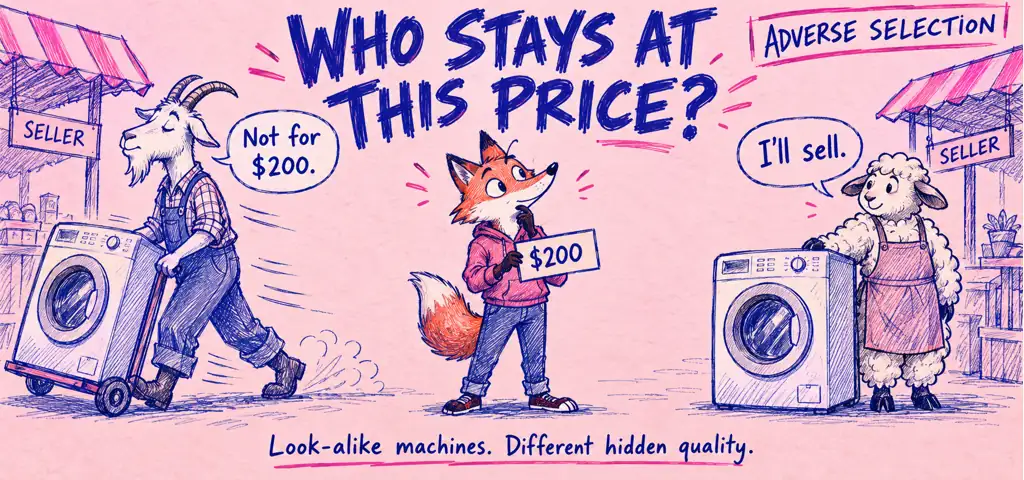
Two secondhand washing machines look alike. One has been carefully maintained, while the other needs repairs that a shopper cannot detect by looking at it. Their owners know the difference.
What should the shopper offer? A price based on the quality of the machines available seems reasonable, until you consider how that price affects which owners agree to sell.
Follow the machines that remain for sale
Imagine buyers believe half the machines offered are dependable. They value a dependable machine at $300 and a faulty one at $100, giving an expected value of $200 if buyers care about expected monetary value.
The owners have limits too. A dependable-machine owner requires $240, but a faulty-machine owner would accept $80. At $200, the dependable owners leave. Buyers who understand this response will revise their expectations because the machines remaining for sale no longer have the original equal mix of qualities.
A worthwhile trade has disappeared. The dependable machine would create $60 of gains from trade: its buyer values it at $300 and its seller at $240. Hidden quality prevents them from realizing those gains.
Look for hidden characteristics before the agreement
Economists call this adverse selection. Hidden characteristics change who enters a transaction or which products are offered, and the resulting change in participation can make the remaining offers less attractive.
Insurance provides another example. People who privately expect high claims may be especially interested in generous coverage, while some lower-risk buyers reject a premium based on the group's average claims. Their departure raises the average expected cost among those remaining.
The market need not collapse. Risk preferences, contract terms and ways to verify information can sustain exchange, so a prediction about participation needs to explain both the hidden characteristic and the available responses. Dishonesty is unnecessary for the mechanism. A dependable seller can simply decline a low offer.
Give the buyer evidence they can use
An inspector could test both washing machines and identify which one needs repairs. If the fee is small enough compared with the gains that inspection makes possible, paying for it can help the buyer and seller complete a worthwhile trade.
A warranty offers another route. Reliable sellers expect fewer repairs and can afford a guarantee at a lower expected cost, provided buyers believe the seller will honor the promise when something fails. A seller who disappears provides little protection.
Repair records, inspections and guarantees use resources. Compare their costs with the exchange they make possible, then check whether the information problem concerns quality before purchase or behavior after an agreement begins. Changed behavior after coverage begins points to moral hazard. Both mechanisms can occur in one market.
Watch the idea in action
A related lesson from Marginal Revolution University. Read the examples above alongside the video.

Reza is an experienced Math instructor and a test-prep expert who has been tutoring students since 2008. He has helped many students raise their standardized test scores--and attend the colleges of their dreams. He works with students individually and in group settings, he tutors both live and online Math courses and the Math portion of standardized tests. He provides an individualized custom learning plan and the personalized attention that makes a difference in how students view math.
Related to This Article
More math articles
- The Best Grade 5 ELA Practice Tests for Iowa Students
- DAT Math Formulas
- CBEST Math Formulas
- How to Graph Single–Variable Inequalities? (+FREE Worksheet!)
- 6th Grade LEAP Math Worksheets: FREE & Printable
- Tips for Preparing Students for Math Competitions
- Civil liberties versus civil rights
- Check Registers: Learn How to Develop the Ability to Organize Transactions
- Top 10 Tips to Overcome HSPT Math Anxiety
- The Best Grade 3 ELA Practice Tests for New Jersey Students














What people say about "Adverse Selection Changes Who Enters a Market"?
No one replied yet.