YOUR GED STUDY COMPANION
GED Calculator Guide: Learn How To Use The TI-30XS
Get comfortable with your calculator before test day. Start with the guidance below and practice each step.
Heads up: some of the links below are affiliate links, so we may earn a small commission if you buy through them. It never costs you anything extra.
The GED math test includes an on-screen TI-30XS MultiView calculator, so knowing how to use it is a real advantage. The best way to learn is to practice on the actual model before test day. This guide covers the GED’s calculator and the best ones to practice with in 2026.
At a glance
| Calculator | Best for | Type | Display | Approved | |
|---|---|---|---|---|---|
| TI-30XS MultiView | The official GED calculator | Scientific | 4-line | SAT, ACT | Check price → |
| TI-36X Pro | Best step up for other tests | Scientific | 4-line | SAT, ACT, AP | Check price → |
| Casio fx-991CW | Best alternative scientific | Scientific | High-res | SAT, ACT, AP | Check price → |
1. TI-30XS MultiView – The official GED calculator
The GED provides an on-screen TI-30XS MultiView during the test, so the smartest move is to buy the real thing and practice on it. Learning where every key and menu lives ahead of time means no surprises on test day, and at a few dollars it’s an easy investment.

What’s good:
- The exact model used on the GED
- Practice matches the real test
- Four-line textbook display
- Inexpensive
Worth knowing:
- No graphing (not needed for the GED)
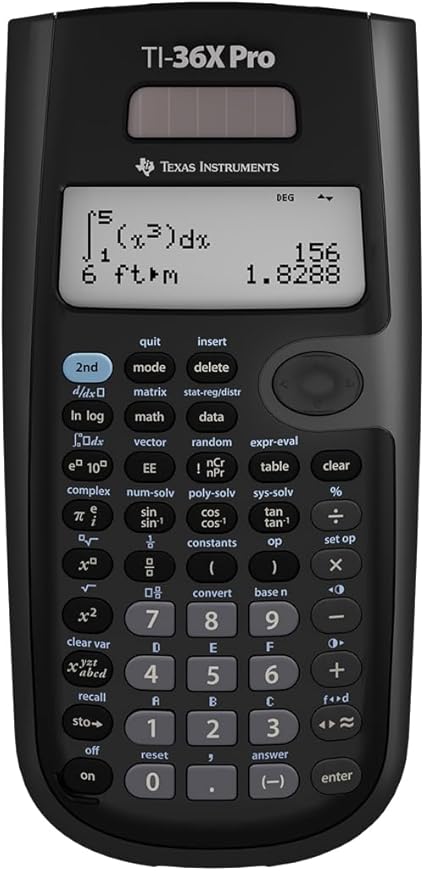
2. TI-36X Pro – Best step up for other tests
If you’ll take other exams after the GED, the TI-36X Pro adds advanced functions while staying allowed where graphing isn’t. It’s a natural next step once you’ve mastered the TI-30XS layout.
What’s good:
- Advanced functions
- Approved on the SAT, ACT, and AP
- Great for engineering and the FE exam
- Solar powered
Worth knowing:
- More keys to learn than the TI-30XS
3. Casio fx-991CW – Best alternative scientific
The Casio fx-991CW is a capable, low-cost scientific with a sharp screen and hundreds of functions, a fine everyday calculator for math beyond the GED, though for GED practice itself stick with the TI-30XS.

What’s good:
- 540+ functions
- Sharp high-resolution screen
- Excellent value
- Solar and battery
Worth knowing:
- Different layout from the GED calculator
How to use the TI-30XS on the GED
On the GED, the TI-30XS appears as an on-screen tool, but the buttons work exactly like the physical calculator. Spend time learning the basics: entering fractions with the dedicated key, using the four-line display to check your work, switching between fraction and decimal answers, and handling exponents and roots. Practicing on a real TI-30XS builds the muscle memory that makes the on-screen version feel effortless during the test.
For GED practice, buy the exact calculator the test uses, the TI-30XS MultiView, and learn its layout inside out. If you’ll take other exams afterward, the TI-36X Pro is a powerful step up, and the Casio fx-991CW is a capable everyday alternative for math beyond the GED.
Frequently asked questions
What calculator does the GED use?
The GED math test provides an on-screen TI-30XS MultiView calculator. You can’t bring your own to the official test, but practicing on a physical TI-30XS beforehand makes the on-screen version far easier to use.
Can I bring my own calculator to the GED?
For the official online GED test, an on-screen TI-30XS is provided, so you don’t bring your own. Buying a physical TI-30XS to practice with is still the best way to prepare.
How do I enter fractions on the TI-30XS?
Use the dedicated fraction key (the n/d button) to type a fraction, then the arrow keys to move between the numerator and denominator. The four-line display shows it just like your textbook, and you can toggle between fraction and decimal answers.
How to use the GED Calculator Guide: Learn How To Use The TI-30XS for homework
The GED Calculator Guide: Learn How To Use The TI-30XS is most useful when you treat it as a learning check, not just a shortcut to the final answer. Start by copying the original problem carefully, including signs, exponents, decimal points, fractions, parentheses, and units. Then enter the values in the same order the problem gives them. A small typing change can completely change the result, especially in algebra, statistics, geometry, and probability problems.
Before you press the button to calculate, make a quick estimate or prediction. The estimate does not need to be exact. Its job is to help you notice impossible answers. If a distance becomes negative, a probability is bigger than 1, an angle looks too large, or a decimal point seems misplaced, go back and check the input before trusting the final result.
Before you enter the problem
- Rewrite the problem in a clean line so every value is easy to see.
- Use parentheses around grouped expressions, especially in fractions and exponents.
- Keep units with the numbers while you work, even if the calculator only asks for the numbers.
- Check whether the problem wants an exact value, a decimal approximation, or a rounded answer.
- Look for restrictions such as positive values only, a chosen interval, or a required domain.
How to read the result
After the calculator gives a result, read more than the final line. If steps, tables, graphs, or intermediate values are shown, use them to understand how the answer was built. That is especially important when you are studying for a quiz or test, because teachers often give more credit for a correct process than for an unsupported number.
Try to identify the main idea behind the result. For example, ask yourself which formula was used, which operation changed the expression, which value controlled the graph, or which assumption made the answer possible. When you can explain that idea in your own words, the tool has helped you learn the skill instead of only checking one problem.
Common mistakes to avoid
| Mistake | How to catch it |
|---|---|
| Typing the wrong sign | Compare each negative sign, subtraction symbol, and exponent with the original problem. |
| Rounding too early | Keep extra decimal places until the final step, then round only as directed. |
| Forgetting parentheses | Group numerators, denominators, powers, and multi-step expressions before calculating. |
| Ignoring units | Write the unit next to the final answer so the result has meaning. |
| Trusting an unreasonable result | Use estimation, a graph, or substitution to check whether the answer makes sense. |
Turn the answer into practice
One good way to study is to solve the problem by hand first, then use the GED Calculator Guide: Learn How To Use The TI-30XS to check your work. If your answer is wrong, do not erase everything immediately. Find the first line where your work stops matching the calculator’s logic. That line is usually where the real misunderstanding happened.
- Work the problem on paper and circle your final answer.
- Use the calculator to check the result.
- If the answers match, write one sentence explaining the method.
- If they do not match, compare each step until you find the first difference.
- Redo a similar problem without the tool to make sure the correction sticks.
When to use a calculator and when to work by hand
Use the GED Calculator Guide: Learn How To Use The TI-30XS when you want to check a long calculation, explore a pattern, test a graph, or confirm a result after practicing. Work by hand when the assignment asks for steps, when you are learning a new method, or when the test will not allow a digital tool. The strongest students use both: hand work to build understanding and calculators to check accuracy.
If you are preparing for a timed test, practice some problems without the tool and some with it. That balance helps you build speed while still understanding the math. Over time, the goal is to need the calculator less often for routine steps and use it more strategically for checking, exploring, and confirming your reasoning.
Quick accuracy checklist
Before you leave the page, use the GED Calculator Guide: Learn How To Use The TI-30XS result to answer three quick questions: What was the input? What rule, formula, or method connects the input to the result? What would change if one number in the problem changed? These questions turn a single calculator answer into a reusable math skill.
For homework, write the original problem, the calculator’s result, and one short explanation of the method in your notebook. For test review, cover the result and try to reproduce the setup on your own. If you can set up a similar problem without looking back at the calculator, you are much closer to owning the skill.

Related to This Article
More math articles
- A Comprehensive Collection of Free AFOQT Math Practice Tests
- 10 Most Common 4th Grade OST Math Questions
- The Best Grade 3 Math Book for Ohio Students
- Bicameral Congress: House and Senate
- Race as a Social Construction
- How to Support Grade 3 Reading at Home: 10 Strategies That Actually Work
- FREE 7th Grade MCAS Math Practice Test
- Top 10 3rd Grade NYSE Math Practice Questions
- Full-Length 7th Grade Common Core Math Practice Test-Answers and Explanations
- How to Find Scalar Multiplication of Vectors?










What people say about "GED Calculator Guide: How to Use the TI-30XS"?
No one replied yet.