The Election of 1912, New Freedom, Labor Law, and Progressivism’s Limits
Chapter 6 of the CLEP History of the United States II study guide on Effortless Math covers The Election of 1912, New Freedom, Labor Law, and Progressivism’s Limits: the key terms, the core ideas, and worked examples showing how this topic is tested on the exam.
CLEP History of the United States II, Chapter 6
A Republican rupture opened the election
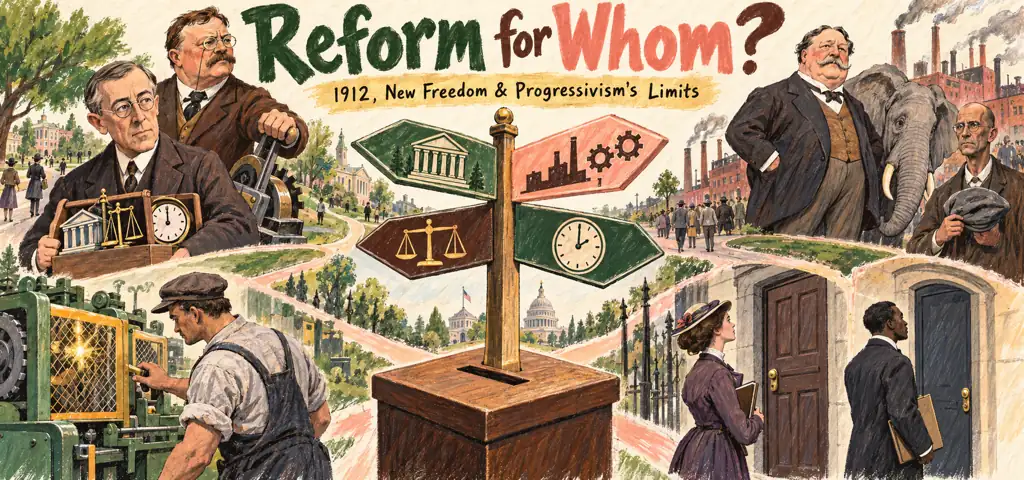
The Ballinger-Pinchot dispute, tariff disappointment, and clashes over party control separated Theodore Roosevelt from President William Howard Taft. Roosevelt challenged Taft for the 1912 Republican nomination, but convention delegates chose the incumbent. Roosevelt's supporters formed the Progressive, or Bull Moose, Party. The usual Republican electorate split, allowing Democrat Woodrow Wilson to carry forty states with only 41.8 percent of the popular vote. Socialist Eugene V. Debs received about six percent. Wilson's landslide in electoral votes did not represent a popular majority.
New Nationalism accepted regulated scale
Roosevelt's New Nationalism drew on Herbert Croly's The Promise of American Life. Large corporations were efficient and permanent; democratic purposes therefore required a national government strong enough to supervise them, protect labor and consumers, and provide social insurance. The platform endorsed woman suffrage, minimum standards, and stronger administrative power. This was not laissez-faire trust dissolution. It accepted concentrated economic scale while trying to build comparable public scale.
New Freedom initially favored restored competition
Wilson and Louis Brandeis warned that concentrated finance and interlocking directorates threatened individual opportunity. New Freedom promised tariff reduction, banking reform, and stronger antitrust rules to restore competition. It initially contrasted with Roosevelt's willingness to recognize regulated monopolies. In office, Wilson moved toward permanent administrative regulation through the Federal Reserve and Federal Trade Commission, narrowing the practical distance between programs. Campaign philosophies should be distinguished, but policy development did not stop in November 1912.
The Federal Reserve combined regional and national control
The panic of 1907 had been checked when J. P. Morgan assembled private funds to support New York trusts, exposing dependence on one financier and an inelastic banking system. The Federal Reserve Act of 1913 created twelve regional reserve banks owned by member banks, supervised by a Federal Reserve Board in Washington. The compromise balanced regional distrust of Wall Street with national coordination. Reserve banks could rediscount eligible paper and issue currency, making the supply more responsive to demand. It was neither one private central bank nor twelve independent state treasuries.
Trade regulation added an administrative instrument
The Sherman Act announced a broad judicial rule against restraint of trade; the Interstate Commerce Act created a specialized railroad commission. Wilson's Federal Trade Commission Act of 1914 created a commission to investigate business practices and issue cease-and-desist orders against unfair methods of competition. The Clayton Act specified practices such as certain tying arrangements and interlocking directorates and strengthened merger controls. Administrative investigation and more specific statutory rules supplemented, rather than erased, antitrust litigation.
Clayton promised labor a protected identity
Courts had sometimes treated strikes and boycotts as restraints of trade and issued sweeping injunctions. The Clayton Act declared that labor was not a commodity and that unions were not illegal combinations merely because they existed; it also sought to limit injunctions in labor disputes. Samuel Gompers called it labor's Magna Carta. Courts later interpreted protections narrowly, so the phrase describes labor's expectation and statutory language more than complete immunity. The Adamson Act of 1916 established an eight-hour standard for interstate railroad workers after a threatened nationwide strike, using federal power to avert transport paralysis.
States redesigned industrial risk
Workers traditionally had to prove employer fault and overcome defenses such as assumption of risk. State workers' compensation laws, beginning with Wisconsin's durable 1911 system, paid scheduled benefits for job injuries without requiring proof of negligence. The arrangement traded uncertain lawsuits for predictable insurance-like compensation. It did not eliminate workplace danger or guarantee full wages. It shifted injury from an individualized fault dispute toward a recognized cost of industrial production.
Child welfare joined investigation and law
Congress created the Children's Bureau in 1912 and appointed Julia Lathrop as its first chief. The bureau studied infant and maternal mortality, birth registration, child labor, and juvenile courts. Mothers' pension laws beginning with Illinois in 1911 used public funds to help women without husbands' support keep children at home rather than surrender them to institutions. Congress barred interstate shipment of goods made by specified child labor in 1916 and later imposed a tax on offending firms in 1919. The Supreme Court invalidated both approaches, revealing limits on federal power before the constitutional shift of the New Deal era.
Triangle exposed regulatory failure
The Triangle Shirtwaist factory fire of 1911 killed 146 workers, mostly young immigrant women. Locked exits, inadequate fire escapes, crowded floors, and weak enforcement turned a workplace fire into mass death. Frances Perkins witnessed the disaster; New York investigations produced extensive factory, fire, and labor laws. The episode demonstrates Progressive interaction among tragedy, expert investigation, labor organizing, and state legislation. Reform followed political mobilization, not automatic learning from catastrophe.
Lochner protected contractual liberty
In Lochner v. New York (1905), the Supreme Court struck down a state limit on bakery hours, treating liberty of contract as protected by the Fourteenth Amendment's Due Process Clause and finding insufficient health justification. The decision did not say the Fourteenth Amendment never protected economic liberty or that states could regulate no workplace. It applied substantive due process to invalidate this regulation. Critics argued judges were constitutionalizing laissez-faire assumptions.
Muller accepted a gendered police-power claim
In Muller v. Oregon (1908), the Court upheld a ten-hour limit for women working in laundries. Louis Brandeis's brief assembled social-science evidence about health and working conditions. The opinion emphasized women's maternal and family roles, finding a state interest strong enough to outweigh contractual liberty. The ruling preserved protective legislation but reinforced gender difference that could restrict women's economic opportunity. Comparing Lochner and Muller requires both outcome and rationale.
Citizenship did not automatically confer suffrage
Virginia Minor argued that as a citizen she possessed a constitutional right to vote. In Minor v. Happersett (1875), the Supreme Court held unanimously that citizenship did not itself include suffrage and that states could define the electorate subject to specific constitutional limits. The Court did not deny that women were citizens. The ruling closed a Fourteenth Amendment litigation path and directed activists toward state campaigns and a federal suffrage amendment.
National citizenship did not control state bar admission
Myra Bradwell met Illinois qualifications but was denied a law license because she was a married woman. In Bradwell v. Illinois (1873), the Court held that practicing law in a state court was not a privilege of national citizenship protected against state restriction by the Fourteenth Amendment. A concurrence invoked women's domestic role. The case concerned professional admission, not voting. Together with Minor, it showed how narrowly the Court read national citizenship claims; Lochner later used due process, a different Fourteenth Amendment clause, to protect contract liberty.
Suffrage strategy moved through courts, states, and Congress
Susan B. Anthony voted in Rochester in 1872 and was prosecuted under the Enforcement Act of 1870 for voting without a lawful right. Kansas voters rejected separate Black male and woman suffrage propositions in 1867, fracturing an alliance. Wyoming Territory granted women full voting and officeholding rights in 1869; Utah followed in 1870 but Congress's Edmunds-Tucker Act removed Utah women's territorial vote in 1887. Senator Aaron Sargent introduced a federal woman-suffrage amendment in 1878; the Senate rejected it sixteen to thirty-four in 1887, and it did not return to a floor vote for decades.
State victories accelerated in the West
Wyoming entered statehood with full suffrage in 1890. Colorado's male electorate approved it in 1893, and Utah and Idaho followed in 1896. By 1912, nine western states offered women the same ballot as men. Illinois's 1913 statute instead granted presidential and local voting for offices not governed by the state constitution, a significant but partial franchise. Activists used referendums, lobbying, party pressure, parades, and local organization. State success built evidence and electoral constituencies for a federal amendment.
Arguments shifted from rights toward social housekeeping
After 1890, many suffragists supplemented natural-rights claims with an expediency argument: women's experience managing households and children would improve sanitation, schools, food safety, and labor laws. The claim attracted Progressive allies but could define women through maternal roles and marginalize women whose lives did not fit the ideal. Black suffragists also confronted organizations willing to accommodate white supremacy. A successful coalition argument could therefore reinforce limits even while expanding the electorate.
Moral regulation could restrict information
The federal Comstock Act of 1873 criminalized mailing obscene materials and information or devices related to contraception and abortion. Anti-vice campaigners treated control of sexuality and print as public morality. Women including Margaret Sanger later challenged contraceptive restrictions. Progressive reform did not always enlarge personal liberty; some reformers used state and postal power to police behavior. The relevant comparison is between protection and autonomy, not between reform and no government.
Campaign and labor administration expanded
The Tillman Act of 1907 prohibited corporations and national banks from contributing money to federal candidates after investigations revealed insurance-company campaign funds. Enforcement was weak, but the statute announced a federal boundary between corporate treasuries and elections. Congress created a separate Department of Labor in 1913, giving it the Bureau of Labor Statistics and a conciliation service to mediate employer-worker disputes. Both measures built public capacity around organized private power.
Progressivism preserved the color line
Wilson's administration segregated federal offices and displaced Black appointees. Southern disfranchisement remained largely untouched, and many Progressive organizations excluded Black members or ignored lynching. Colonial government denied equal consent overseas. Even reforms benefiting workers often omitted agricultural and domestic labor where Black workers and women were concentrated. The movement's language of democracy and expertise therefore coexisted with racial hierarchy. Limits were institutional choices, not merely the absence of future knowledge.
distinguish three Fourteenth Amendment claims
A citizen claims the vote; a qualified woman claims entry to a state profession; a bakery owner attacks an hours law.
New Freedom became a broader regulatory state
Wilson's first term reduced tariffs, implemented the income tax, reorganized banking, created trade regulation, supported labor measures, and expanded administration. These achievements moved beyond a simple restoration of small-business competition. Yet courts struck child-labor laws, protective legislation rested on gender hierarchy, suffrage remained incomplete, and racial segregation deepened. Progressive state capacity was real. So were the boundaries around who controlled it and whom it protected.
Watch the history in motion
This short lesson adds voices, images, and chronology to the ideas you just studied.
Video: The American Presidential Election of 1912, Mr. Beat.
Try four CLEP-style questions
- What structural similarity joins the Federal Reserve and the Federal Trade Commission despite their different tasks?
- Each was designed as a temporary investigating commission that would dissolve after the immediate crisis.
- The Reserve coordinated nationally, whereas the FTC could act only through state enforcement agencies.
- Each created continuing national oversight instead of relying only on emergency bargains or occasional lawsuits.
- Both operated as Article III courts that issued final judgments but wrote no administrative rules.
- Both placed the banking system and interstate corporations under direct federal ownership.
- A state gives cash aid to widowed mothers so their children can remain at home rather than enter an institution. What broader change does the policy represent?
- It recognizes family maintenance as a public concern while still organizing assistance around a maternal caregiving role.
- It treats the absence of a husband's support as proof that a mother is ineligible to direct a household.
- It converts child welfare into a negligence lawsuit against the mother's former employer.
- It funds children's factory wages while leaving household income outside public policy.
- It replaces family care with compulsory residence in a publicly operated orphanage.
- Why can enforcement of the Comstock Act be classified as reform while also being understood as a restriction on autonomy?
- It used postal authority to regulate campaign circulars while expanding private access to medical mail.
- It created a federal health exemption for physicians who distributed contraceptive information.
- It protected sealed correspondence from inspection but left obscenity prosecutions solely to states.
- It used national postal power to enforce a moral-protection program while restricting access to sexual and reproductive information.
- It treated regulation of mailed material as a state police power administered through federal post offices.
- A reform creates a child-welfare bureau but leaves southern disfranchisement and federal workplace segregation intact. Which interpretation is strongest?
- Child-welfare administration supplied a direct instrument for reforming registration.
- Administrative growth tended to carry equal-citizenship rules into unrelated institutions.
- Expert investigation made racial policy less dependent on official choices.
- Progressive capacity could expand in one field while institutions maintained exclusion in another.
- Workplace segregation followed from the bureau's research rather than a separate political decision.
Check your answers and reasoning
Independent preparation. CLEP is a registered trademark of the College Board, which does not endorse this lesson.

Related to This Article
More math articles
- The Best Grade 3 ELA Practice Tests for Tennessee Students
- Subtraction of Amounts of Money
- A Comprehensive Collection of Free CHSPE Math Practice Tests
- Capitalism, Socialism, Mixed Economies, and Postindustrial Change
- How to Write an Equation from a Graph?
- Free Grade 5 English Worksheets for ACT Aspire Students
- 5 Essential Strategies in Teaching Math
- Market power puts demand and MR on the same firm graph
- Top 10 HiSET Math Practice Questions
- The Complete List of Teachers’ Favorite 10 Math Websites




















What people say about "The Election of 1912 and New Freedom"?
No one replied yet.