Free Grade 7 English Worksheets for Wisconsin Students
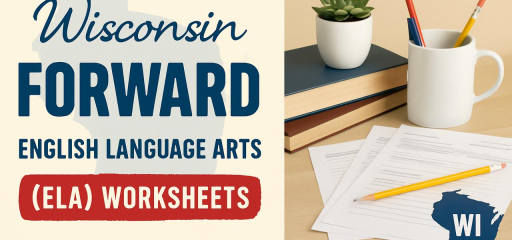
A 4-H meeting at the Vilas County fairgrounds runs every other Wednesday evening from October through May, and the seventh grader who is the youngest member of the dairy-project group rides the forty minutes there and back in the passenger seat of her mother’s pickup truck. The pickup smells faintly of the alfalfa hay her mother loaded in earlier. Highway 45 cuts through pines and across the corners of three small lakes, Plum, Wildwood, and a third one her father grew up fishing, and the seventh grader uses the round-trip drive to do exactly one printed Grade 7 ELA worksheet on the way home, after the meeting, after the cookies and the dairy-records review and the project leader’s reminder about spring weigh-ins. The page is clipped to a binder she holds in her lap. The headlights catch the white tails of deer at the road edges. She finishes the worksheet about three miles before the truck turns into her family’s driveway.
That round-trip 4-H pickup-seat habit fits the Wisconsin Forward Exam the way no rushed week-before-the-test cramming ever could. Wisconsin administers the Forward Exam in the spring at Grade 7, and the ELA portion is built on the Wisconsin Academic Standards for English Language Arts. Forward Exam ELA includes a writing prompt at Grade 7, scored on a multi-trait rubric, alongside the reading and language items. The Vilas County seventh grader who does one printed page on her 4-H pickup ride is rehearsing the exact analytic-move-per-page work the Forward Exam ELA writing prompt rewards.
The Wisconsin Academic Standards organize Grade 7 ELA across reading literature, reading informational text, writing, speaking and listening, and language. The Forward Exam samples across all of those strands and includes a writing prompt scored separately on a multi-trait rubric.
This page gathers forty-three free printable Grade 7 ELA worksheets, every one mapped to a Grade 7 strand in the Wisconsin Academic Standards for ELA, every one printable at home, no signup.
What’s on this page
Each PDF opens with a Quick Review a seventh grader can read alone. The practice items mirror Forward Exam on-screen formats, multiple choice, multi-select, evidence-based selected response, drag-and-drop, hot-text highlighting, table completion, and short text-entry, and several PDFs are tuned for the writing prompt scored on a multi-trait rubric. The answer keys explain every right answer and the trap behind every distractor.
Use the menu below to match the strand the ELA teacher is on this week. For the Forward Exam, the W.7.1 argument PDF, the W.7.5 planning-and-revising PDF, and one literature or informational PDF run together as a forty-minute timed block come closest to the live writing prompt.
Reading: Literature
- Citing Several Pieces of Textual Evidence, [RL.7.1] stack two or three converging quotes behind one inference
- Theme and Its Development Over the Text, [RL.7.2] theme as a sentence the whole text earns
- How Setting, Character, and Plot Interact, [RL.7.3] setting bends character, character moves plot
- Word Choice, Figurative Language, and Tone, [RL.7.4] denotation, connotation, and the tone they build together
- How Form Shapes Meaning in Drama and Poetry, [RL.7.5] sonnet, soliloquy, stage direction, stanza
- Developing and Contrasting Points of View, [RL.7.6] two perspectives in deliberate tension
- Comparing a Story to Its Audio, Film, or Stage Version, [RL.7.7] what each medium can and cannot do
- Comparing Fictional and Historical Portrayals, [RL.7.9] sort real history from authorial invention
Reading: Informational Text
- Citing Several Pieces of Evidence in Nonfiction, [RI.7.1] pull several article details toward one conclusion
- Two or More Central Ideas and Their Development, [RI.7.2] track an article teaching two things at once
- How Individuals, Events, and Ideas Interact, [RI.7.3] a person shapes an idea, an idea reshapes a person
- Word Meaning in Nonfiction: Figurative, Connotative, Technical, [RI.7.4] three jobs one nonfiction word does
- How Text Structure Develops the Author’s Ideas, [RI.7.5] problem-solution, compare-contrast, chronological
- Author’s Point of View and How They Distinguish It, [RI.7.6] find the position and the moves that mark it
- Comparing a Text to Its Audio or Video Version, [RI.7.7] what print emphasizes vs. What broadcast emphasizes
- Evaluating an Argument: Reasoning and Evidence, [RI.7.8] strong evidence vs. Filler, and the logic in between
- How Two Authors Shape Their Presentation of the Same Topic, [RI.7.9] same subject, different facts emphasized
Writing
- Argument Writing: Claims, Reasons, Evidence, and Counterclaims, [W.7.1] the counterclaim move the Forward writing prompt rewards
- Informative and Explanatory Writing, [W.7.2] thesis, ordered sections, transitions
- Narrative Writing, [W.7.3] pacing, dialogue, sensory description, an ending that lands
- Coherent Writing for Task, Purpose, and Audience, [W.7.4] one idea, three audiences, three versions
- Planning, Revising, and Editing, [W.7.5] the move at the heart of the Forward writing prompt
- Short Research Projects: Question and Refocus, [W.7.7] let early findings rewrite the question
- Gathering, Evaluating, and Citing Sources, [W.7.8] author, date, publisher, citation the Wisconsin teacher expects
Speaking & Listening
- Collaborative Discussions, [SL.7.1] come prepared, listen first, disagree without dismissing
- Analyzing Information in Diverse Media, [SL.7.2] chart, clip, photo as one combined argument
- Evaluating a Speaker’s Argument, [SL.7.3] claim, reasons, evidence, gaps
- Presenting Claims with Focus and Coherence, [SL.7.4] open with the point, preview the order, hold to it
- Adapting Speech to Context, [SL.7.6] friend-talk and presentation-talk are different registers
Grammar
- Phrases and Clauses: Placement and Function, [L.7.1a] what each piece is doing, where it belongs
- Sentence Structures: Simple, Compound, Complex, Compound-Complex, [L.7.1b] count clauses, name the structure
- Avoiding Dangling and Misplaced Modifiers, [L.7.1c] the small error that makes a paragraph absurd
Conventions: Punctuation, Spelling
- Commas with Coordinate Adjectives, [L.7.2a] when two adjectives need a comma and when they do not
- Spelling Grade-Appropriate Words, [L.7.2b] homophones, doubled letters, common Grade 7 misses
Knowledge of Language and Style
- Precise and Concise Language, [L.7.3a] cut wordiness, replace vague verbs, pick the exact noun
Vocabulary and Word Study
- Using Context Clues, [L.7.4a] name the kind of clue and use it on purpose
- Greek and Latin Roots and Affixes, [L.7.4b] one root unlocks ten unrelated words
- Using Reference Materials Effectively, [L.7.4c] match the tool to the question
- Verifying Word Meaning, [L.7.4d] confirm the guess before committing
- Allusions and Figures of Speech, [L.7.5a] myth, Bible, literary references the Grade 7 reader now catches
- Word Relationships: Synonyms, Antonyms, Analogies, [L.7.5b] name the relationship before picking the answer
- Connotation and Denotation, [L.7.5c] same fact, different feeling, different word
- Academic and Domain-Specific Vocabulary, [L.7.6] words that travel across subjects and words tied to one field
How to use these worksheets at home
Wisconsin families work around dairy chores, sports, scouting, and small-town schedules. A Milwaukee family on the south side might run a Sunday-evening session at the kitchen table after Mass. A Madison family might fit fifteen minutes between school pickup and a sibling’s robotics club. A Green Bay family might do practice on a sunporch in late fall after the maple-and-birch leaves have turned and dropped. An Eau Claire family might use the half hour before a youth-hockey practice. A La Crosse family on the Mississippi might run Saturday work after a morning by the river. A Northwoods family might do the page on the pickup-truck ride home from 4-H. The unit is one PDF, the work is twelve to fifteen minutes, and the page travels, to a pickup passenger seat on Highway 45, to the kitchen counter, to a folding chair at a youth hockey rink.
The Forward Exam writing prompt rewards the same analytic move the pickup-seat fifteen minutes is built on. Once a week run a forty-minute timed block. Hand the seventh grader a passage (one of the literature or informational PDFs) plus the W.7.1 and W.7.5 PDFs, and have her write a focused response that introduces a claim, supports it with two pieces of cited evidence, acknowledges a counterclaim, and closes with a one-sentence conclusion. Forty minutes is comfortable; the live test window is closer.
For the rest of the week, rotate one literature PDF, one informational PDF, and one vocabulary PDF. The L.7.5a allusions PDF and the L.7.3a precise-and-concise PDF deserve extra reps, the Forward Exam writing rubric rewards exact diction and recognizable references.
A note about the Forward Exam in ELA
The Wisconsin Forward Exam in Grade 7 ELA is administered in the spring on a computer (with paper accommodations available). The Grade 7 ELA test is built on the Wisconsin Academic Standards for English Language Arts and is administered as the state’s annual ELA assessment alongside the math, science (at certain grades), and social studies (at certain grades) Forward Exams. The Grade 7 ELA test is organized into a reading-and-language section (multiple choice, evidence-based selected response, multi-select, hot-text, table completion, and short constructed response) plus a writing prompt.
The writing prompt presents a passage (or paired passages), a focused prompt, and a fixed window. The seventh grader is asked to plan, draft, and revise a response that introduces a claim or controlling idea, supports it with specific, cited evidence from the text, and maintains organization and command of conventions throughout. The prompt may be argumentative, informative, or analytical, depending on the year and form. The response is scored on a multi-trait rubric.
Forward Exam Grade 7 ELA reporting categories cover key ideas and details, craft and structure, integration of knowledge and ideas, vocabulary acquisition and use, and writing, with the writing prompt scored separately. Two pre-window weeks of one weekly timed writing prompt, paired with daily short reading and language work, cover most of the rehearsal a Grade 7 student needs.
Want everything in one bundle?
Some Wisconsin families prefer one organized book to a list of standalone PDFs. The Grade 7 ELA Preparation Bundle organizes practice across the Forward Exam reading-and-language section and the writing prompt, short reading drills, focused language work, and timed writing rehearsals, with full-length practice tests and answer keys that explain every choice.
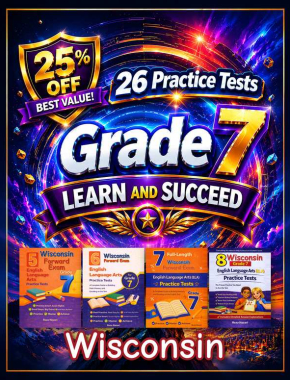
Wisconsin Grade 7 ELA Preparation Bundle, four practice-test books, 26 unique full-length tests, complete answer keys with explanations.
A short closing
The Wednesday 4-H meeting will keep running every other week at the Vilas County fairgrounds, the pickup truck will keep covering Highway 45 in both directions, and the seventh grader who does one printed Grade 7 ELA page on the way home will arrive at the Forward Exam window already in the habit of one focused analytic move per page. Bookmark this page, print one PDF before the next 4-H Wednesday, and let the small pickup-seat dairy-meeting discipline carry a Wisconsin seventh grader cleanly into the spring Forward Exam window.
Best Bundle to Ace the Wisconsin Forward Grade 7 ELA
Looking for the best resource to help your kid ace the Wisconsin Forward? Try this bundle, four full practice-test books (5 + 6 + 7 + 8 tests) covering the same Grade 7 reading, writing, and language skills your child is already learning. Instant PDF download, answer keys included.

Related to This Article
More math articles
- How to Find Standard Deviation
- Stratification, Life Chances, and Unequal Dimensions
- AI Learning and the Data Behind Better Math Test Prep
- ALEKS Math FREE Sample Practice Questions
- A 96% RTP Slot Over a Million Spins: The Distribution, Not the Average
- 8th Grade NSCAS Math Worksheets: FREE & Printable
- List Of the Best Middle School Math Supply for Learning
- How to Sketch Trigonometric Graphs?
- The Ultimate 7th Grade OAA Math Course (+FREE Worksheets)
- Number Properties Puzzle – Challenge 23





What people say about "Free Grade 7 English Worksheets for Wisconsin"?
No one replied yet.