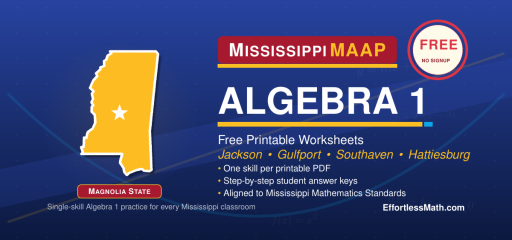
Mississippi MAAP Algebra 1 Free Worksheets: 72 Free Skill-by-Skill Algebra 1 PDFs with Answer Keys
There is a particular moment, somewhere in the first weeks of Algebra 1, when a student notices that the x in an equation is not really mysterious. It is just a number sitting quietly behind a curtain, waiting for the right steps to pull it forward. That moment is the whole point of the year. Before this, math has mostly been about getting the right answer. Now it is about understanding the structure that makes the answer inevitable.
Algebra 1 trains a new habit of mind. A student starts to read a line on a graph and hear it as a sentence: this is what changes, this is how fast, and this is where it crosses zero. They learn that a quadratic is not a different kind of math but the same kind of math told with one more factor in it. Whether your student walks to class in Jackson, drives in from a neighborhood near Gulfport, or studies between work shifts in Southaven or Hattiesburg, that shift in thinking is what the whole course is building toward.
These 72 worksheets give a high schooler one step of that shift at a time. Each one names a skill, walks through it, and lets the student practice until it is theirs.
What’s on this page
Seventy-two single-skill PDFs, each aligned to the Mississippi Algebra 1 standards. The work is divided into small, recognizable jobs, solving a literal equation, graphing from slope-intercept form, factoring a difference of squares, so a student can pick up exactly the piece that has been wobbly and leave the rest alone for the moment.
Every PDF opens with a short Quick Review: the skill written in plain words and one full worked example to model the reasoning. After that, twelve practice problems climb from gentle to genuinely challenging, so the page ends a little harder than it began. The last page is a student-facing answer key with friendly, tutoring-tone explanations, short enough to read in a minute, complete enough to teach.
Foundations of Algebra
Foundations come first, writing and evaluating expressions, honoring the order of operations, and stretching the ideas into everyday money math. It is worth the extra reps for Mississippi learners aiming for a strong score on the MAAP.
- Variables, Expressions, and Properties
- Order of Operations and Evaluating Expressions
- Simplifying Algebraic Expressions
- Introduction to Equations and Solutions
- Personal Financial Literacy
Solving Linear Equations
Solving linear equations takes center stage, progressing from quick solves to multi-step reasoning and formula rearrangement. Jackson families can use these pages to lock the skill in before it’s tested.
- Solving One-Step Equations
- Solving Two-Step Equations
- Solving Multi-Step Equations
- Equations with Variables on Both Sides
- Literal Equations and Formulas
Inequalities and Absolute Value
Inequalities behave like equations but answer with a range, and absolute value adds the idea of distance from zero. In Jackson classrooms it tends to separate confident students from hesitant ones.
- Solving One-Step Inequalities
- Solving Multi-Step Inequalities
- Compound Inequalities
- Absolute Value Equations
Relations, Functions, and Sequences
Students formalize relations and functions, read domain and range, and meet arithmetic and geometric sequences. Steady practice now makes the MAAP feel far more manageable later.
- Relations and Functions
- Function Notation and Evaluating Functions
- Domain and Range
- Graphing Functions and Transformations
- Arithmetic Sequences as Linear Functions
- Geometric Sequences
- Comparing Functions
- Piecewise Functions
- Combining Functions
- Inverse Functions
Linear Functions and Their Graphs
Students graph and write linear functions, connect slope to rate of change, and explore direct and inverse variation. Master it early and the rest of the Mississippi course leans on it with ease.
- Slope and Rate of Change
- Slope-Intercept Form
- Point-Slope Form
- Standard Form of a Linear Equation
- Writing Linear Equations from Graphs and Tables
- Parallel and Perpendicular Lines
- Inverse Variation
- Understanding Graphs as Solution Sets
Systems of Equations and Inequalities
Systems of equations, and inequalities, anchor this unit, with three solution methods and applied problems. It’s a frequent early hurdle for learners in Jackson and across the state.
- Solving Systems by Graphing
- Solving Systems by Substitution
- Solving Systems by Elimination
- Applications of Systems of Equations
- Systems of Linear Inequalities
- Solving Linear-Quadratic Systems
Exponents, Polynomials, and Real Numbers
Exponent laws and polynomial work drive the unit, with special products and the real-number system rounding it out. These worksheets give Mississippi students focused, low-pressure practice.
- Properties of Exponents
- Adding and Subtracting Polynomials
- Multiplying Polynomials
- Special Products of Polynomials
- Rational and Irrational Numbers
Factoring
Factoring runs multiplication in reverse, pulling out common factors, factoring trinomials, and spotting special patterns. For Mississippi students, fluency here shows up directly on the MAAP.
- Greatest Common Factor and GCF Factoring
- Factoring Trinomials: \(x^2 + bx + c\)
- Factoring Trinomials: \(ax^2 + bx + c\)
- Factoring Special Products
Quadratic Functions and Equations
Students explore quadratic functions and solve them several ways, with the discriminant predicting the number of solutions. Getting comfortable here pays off all the way through the MAAP.
- Graphing Quadratic Functions
- Characteristics of Quadratic Functions
- Solving Quadratics by Factoring
- Solving Quadratics by Completing the Square
- Solving Quadratics by Square Roots
- The Discriminant
- The Quadratic Formula
- Quadratic Applications and Modeling
Statistics and Probability
The chapter turns to data and chance, measures of center and spread, graphical displays, and counting and probability. Time spent here is time saved when the MAAP rolls around.
- Measures of Center and Spread
- Scatter Plots and Correlation
- Lines of Best Fit and Predictions
- Counting Principles
- Probability
- Two-Way Frequency Tables
Exponential Functions and Modeling
Exponential functions round out the course, modeling rapid growth or decay and contrasting model types. Across Mississippi, this is one of the skills that rewards regular reps.
- Graphing Exponential Functions
- Comparing Linear, Quadratic, and Exponential Models
- Exponential Growth
- Interpreting Functions and Parameters
More Topics
- Absolute Value Inequalities
- Direct Variation
- Displaying Data with Box Plots
- Displaying Data with Histograms
- Exponential Decay
- Graphing Cube Root Functions
- Graphing Square Root Functions
How to use these worksheets at home
The most useful thing you can do with this set is to pair related skills back-to-back. Algebra 1 is built like a staircase, and each step assumes the one below it. Print “Solving Two-Step Equations” and “Solving Multi-Step Equations” together, the second one is the first one with one more move. Pair “Slope and Rate of Change” with “Slope-Intercept Form,” and the slope a student just computed becomes the m in y = mx + b. Put “Factoring Trinomials” right before “Solving Quadratics by Factoring,” and the second worksheet feels like the natural next sentence in a paragraph.
Treat the answer key as the second half of the worksheet, not as an afterthought. After your student has worked the page, hand them the key and let them grade themselves. The skill of reading a worked solution, noticing where your reasoning split from the model’s, and learning to say why, is one of the most valuable habits a Mississippi ninth or tenth grader can build. It also keeps you out of the awkward role of being your teen’s first line of correction, which lets the math stay between them and the page.
A note on independence: these are 14- and 15-year-olds, and they want to feel like the work is theirs. Print the page, hand it over, and step back. Twenty focused minutes alone usually does more than an hour at a kitchen table being watched. If a worksheet stalls completely, that is information. It tells you the prerequisite skill is the next page to print, not that the student needs harder problems.
A note about MAAP at Algebra 1
In Mississippi, students take the Mississippi Academic Assessment Program (MAAP) Algebra I end-of-course test in the spring of the year they complete the course. MAAP Algebra I is built on Mississippi’s Algebra 1 standards, which are aligned with the Common Core framework, so the skills these worksheets cover come from the same place the test draws from. The exam asks students to solve linear equations and inequalities, work with systems, interpret functions from tables, graphs, and equations, manipulate expressions with exponents, factor and solve quadratics, and reason about data, the exact list of standards these PDFs walk through one at a time.
Because each worksheet isolates a single skill, you can use the set as a personal checklist during the weeks before MAAP. Print “Interpreting Linear Functions” and see if it is solid. If it is, move on. If it is not, the next worksheet to print is the one whose name describes what just went wrong, and that is a much shorter path than reviewing the entire course. By the spring window, your student should be running into the same vocabulary on the test screen that has been on their kitchen table for months.
A short closing
Algebra 1 is the year math becomes a language a student can speak back. Bookmark this page, print one PDF tonight, and let your Mississippi student start with a single skill. The next one will follow more easily than you think, and the one after that even more so. That is how a year of algebra actually gets built, one quiet, finished page at a time.
New to Algebra? Start with the basics


Related to This Article
More math articles
- ASVAB Math FREE Sample Practice Questions
- Symbolic Interactionism
- Full-Length HiSET Math Practice Test
- Do You Need to Pass the CBEST to be a Substitute Teacher?
- The Best Grade 6 ELA Practice Tests for West Virginia Students
- Top 5 Free Websites for ASTB-E Math Preparation
- Estimate Differences for 4th Grade
- Mean, Median, Mode, and Range (Introduction) for 4th Grade
- How to Solve Systems of Equations with Substitution?
- Two-Way Tables for Categorical Data: Complete Guide with Video and Examples











What people say about "Mississippi MAAP Algebra 1: Free Worksheets"?
No one replied yet.