Geometry Puzzle – Challenge 70
A cubical wood block weighs 5 kg. How much does a cube of the same wood weigh if its sides are three times as long? Weight is proportional to volume, and cube volume scales by the cube of the linear factor. So the new cube has 3^3 = 27 times the volume, and 27 times the weight: 27 times 5 = 135 kg.
Key takeaways:
- Weight (of uniform material) is proportional to volume.
- Cube volume = (side)^3.
- Scaling each side by factor k scales volume by k^3.
- Tripling the side multiplies volume (and weight) by 27.
- New weight = 27 times 5 = 135 kg.
A great Math puzzle to help students develop critical thinking and logic skills in a fun way. Let’s challenge your brain! For additional educational resources
Challenge:
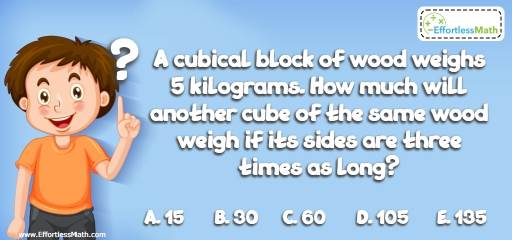
A cubical block of wood weighs 5 kilograms. How much will another cube of the same wood weigh if its sides are three times as long?
A- 15
B- 30
C- 60
D- 105
E- 135
The Absolute Best Book to Challenge Your Smart Student!

The correct answer is E.
Original price was: $27.99.$17.99Current price is: $17.99.
Weight is proportional to volume.
Volume of a cube = (one side)\(^3\)
Let x be the side of the first cube. So:
Volume \(= x^3\)
The sides of the second cube are three times as long. So:
Volume \(= (3x)^3 = 27x^3\)
The ratio of the volumes of the old and new cubes will be 1: 27. So, if the first weighs 5 kilograms, the second weighs 27 × 5 kilograms =135 kilogram.The Best Books to Ace Algebra
Frequently Asked Questions
Why is weight proportional to volume?
For a uniform material, weight = density times volume. The density (mass per unit volume) is the same throughout the material, so weight scales linearly with volume.
Why does cube volume use side cubed?
A cube has equal length, width, and height (the side s). Volume = length times width times height = s times s times s = s^3.
How does scaling the side affect the volume?
If you scale the side by a factor k, each of the three dimensions scales by k, so the volume scales by k^3. Tripling the side gives 3^3 = 27 times the volume.
Walk through the full calculation.
Let original side = X, original volume = X^3. New side = 3X, new volume = (3X)^3 = 27 X^3. The volume is 27 times larger, so weight is 27 times larger: 27 times 5 = 135 kg.
What if the side doubled instead?
Volume scales by 2^3 = 8. New weight = 8 times 5 = 40 kg.
Does this apply to non-cube shapes?
Yes, for any 3D shape scaled uniformly (same factor in all directions), volume scales by k^3. Spheres, cylinders, prisms, all the same rule.
What if the material density differs?
If the new cube were made of a different material with different density, the proportional reasoning would break, weight would also depend on the density ratio. The puzzle assumes “same wood,” so density is constant.
Why is the answer NOT 15 kg (3 times 5)?
Because tripling the SIDE does not triple the volume. It 27-folds the volume. Linear scaling and volume scaling are very different, and confusing them is one of the most common reasoning errors.
How does this connect to surface area?
Surface area scales by k^2, squares, not cubes. So if the side triples, surface area becomes 9 times bigger. The pattern: linear scales by k, area by k^2, volume by k^3.
Where is this principle used in real life?
Scaling recipes (doubling a cake batter does not double a pan size linearly), industrial design (scaling up a model requires accounting for cube-law weight), biology (large animals need disproportionately strong skeletons).
Related Lessons You May Like
- How to find the area of rectangles
- How to find the perimeter of rectangles
- How to solve angles and angle measure
- How to solve percent of change
- How to find volume and surface area of cubes
If your student enjoys puzzles like this, Geometry for Beginners works the same kinds of relationships inside a full curriculum. Pre-Algebra for Beginners covers the algebraic foundations.

Related to This Article
More math articles
- Top 10 Tips to Overcome ATI TEAS 7 Math Anxiety
- How to Solve Negative Exponents and Negative Bases? (+FREE Worksheet!)
- 6th Grade MEA Math Worksheets: FREE & Printable
- New York NYSTP Grade 7 Math Worksheets: 95 Free Printable PDFs Covering Every Skill
- Free Grade 8 English Worksheets for Maine Students
- Fifth-Grade Math in Texas (STAAR): 49 Free Printable Worksheets, One Concept Per Page
- The Best Grade 4 ELA Practice Tests for Kentucky Students
- CLEP U.S. History I 002: Environment, Agriculture, and Regional Adaptation
- How to Graph Logarithmic Functions?
- AI Learning and the Data Behind Better Math Test Prep






What people say about "Cube Weight Math Puzzle with Full Solution"?
No one replied yet.