CLEP U.S. History I 074: Romantic Nationalism in Art and Literature
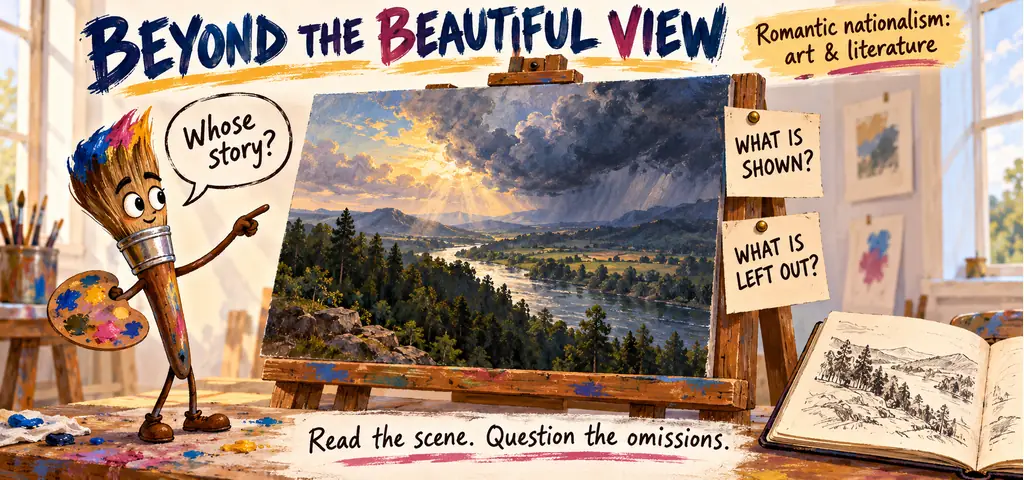
Lesson 14.1 of Chapter 14 of the U.S. History to 1877 study guide on Effortless Math covers CLEP U.S. History I 074: Romantic Nationalism in Art and Literature: the key terms, the core ideas, and worked examples showing how this topic is tested on the exam.
U.S. History to 1877 | Chapter 14 | Lesson 14.1
After independence, many writers worried that political separation from Britain had not produced cultural independence. American publishers still reprinted British books, educated readers measured new writing against European standards, and the nation had few institutions devoted to its own art. Romanticism offered one route out of that anxiety. Romantic artists valued emotion, imagination, individual experience, historical memory, and the power of nature. In the United States, those concerns often became nationalist: the country’s landscapes, Revolution, Indigenous past, and democratic society appeared to offer subjects that Europe could not own.
Washington Irving built stories around the Hudson Valley and the Dutch history of New York. James Fenimore Cooper placed frontier conflict and cultural encounter at the center of popular fiction. His novels could criticize the costs of settlement while still helping readers imagine western expansion as the nation’s story. Painters later grouped under the label Hudson River School used dramatic light, mountains, forests, rivers, and distant human figures to make the American landscape seem sublime. Thomas Cole’s work frequently held celebration and warning together. A wide valley might suggest abundance and national promise, while a tree stump, road, or settlement hinted that development could destroy what viewers admired.
That tension matters. Romantic nationalism did not simply praise wilderness. The word wilderness itself could erase Indigenous land use and sovereignty by presenting occupied homelands as empty space awaiting a nation. Paintings purchased by prosperous eastern patrons also belonged to a market economy that was transforming the landscapes they idealized. Cultural evidence therefore works on two levels: it shows what artists displayed and what assumptions made the display meaningful to its audience.
See the history take shape
This US History with Lennox lesson supplies a second explanation of the same period. Note where chronology, cause, and perspective connect.
Video: APUSH Topic 4.9 – The Development of an American Culture, US History with Lennox.
Check your understanding
- Which feature most clearly connects Hudson River School painting to Romantic nationalism?
- Its use of landscape chiefly for scientific topographic measurement
- Its use of dramatic American landscapes to express national possibility
- Its adaptation of European scenery to celebrate royal patronage
- Its presentation of nature chiefly as a commercial survey
- Its treatment of industrial cities as the principal national sublime
- A painting presents a broad valley as nearly empty even though Native communities lived and traveled there. Which interpretation is most defensible?
- The composition may naturalize settler claims by making inhabited land appear available.
- The absence of Native figures shows that the artist opposed western migration.
- The botanical detail is stronger evidence than the composition’s cultural framing.
- The apparently empty landscape settles the question of regional occupancy.
- The visible farms provide a complete record of land use in the valley.
- Select all developments that encouraged a distinct national literature in the early republic.
- Growing print markets
- Interest in American settings and history
- Nationalist desire for cultural independence
- Dependence on cheaper imported editions that undercut local authors
- Declining circulation of newspapers, magazines, and books
- In two or three sentences, explain why a landscape painting can both celebrate the nation and conceal part of its history.
Write a brief response using a named fact from the lesson.
Open the answers and reasoning
Independent preparation. CLEP is a registered trademark of the College Board, which does not endorse this lesson.

Related to This Article
More math articles
- How to Graph Inverse Trigonometric Functions?
- Distance & Midpoint Calculator (Free, with Graph)
- How to Add and Subtract Polynomials Using Algebra Tiles
- ISEE Upper Level Math Practice Test Questions
- 3rd Grade RISE Math Worksheets: FREE & Printable
- New Jersey NJSLA Grade 6 Math Free Worksheets: Free Printable Worksheets Covering Every Skill
- Direct lobbying
- The Best Grade 5 Math Book for Utah Students
- Best Calculators for Business: Graphing vs Financial Options
- 8th Grade Mathematics Worksheets: FREE & Printable

















What people say about "Romantic Nationalism in Art and Literature"?
No one replied yet.