CLEP U.S. History I 073: Utopian Communities and Changing Family Ideals
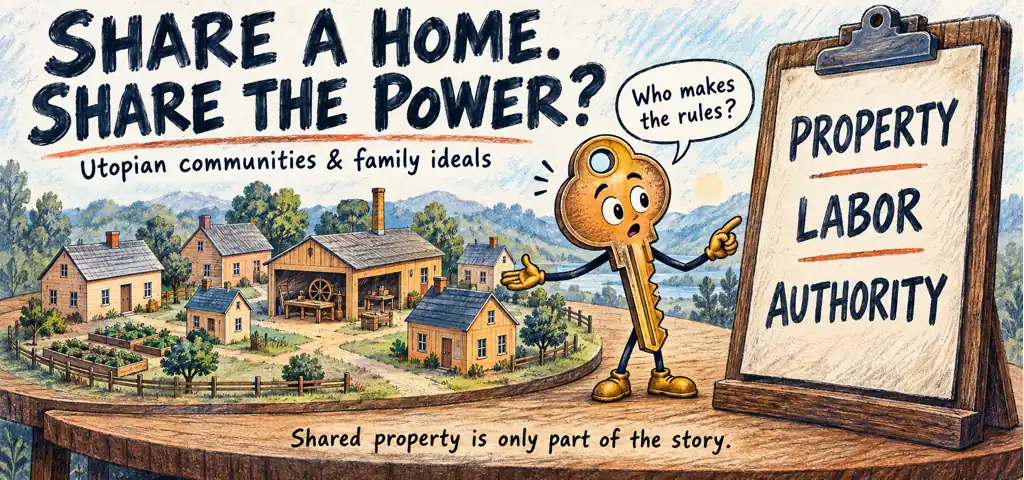
Lesson 13.6 of Chapter 13 of the U.S. History to 1877 study guide on Effortless Math covers CLEP U.S. History I 073: Utopian Communities and Changing Family Ideals: the key terms, the core ideas, and worked examples showing how this topic is tested on the exam.
U.S. History to 1877 | Chapter 13 | Lesson 13.6
Communal experiments tested alternatives to competitive individualism. Shakers held property communally, practiced celibacy, recognized spiritual authority in women, and built orderly villages. Their survival depended on converts rather than biological families. Brook Farm combined intellectual work and shared labor before adopting elements of Fourierist association. New Harmony, purchased by Robert Owen in Indiana, sought cooperative, rational social reform but fractured over governance, labor, and finance.
John Humphrey Noyes’s Oneida Community practiced communal property, “complex marriage,” collective childrearing, and regulated reproduction. Its arrangements challenged monogamous households while concentrating authority in Noyes and community rules. The Latter-day Saints also organized tightly knit settlements and practiced plural marriage under later leadership, but their theology and durable church distinguish them from short-lived secular experiments. Hostility drove their migration from New York to Ohio, Missouri, Illinois, and eventually Utah after Joseph Smith’s death.
These communities responded to market competition, religious perfectionism, gender relations, and insecurity. Shared property could protect members and fund education. Intense oversight could limit privacy and dissent. Many communities assigned women new religious or economic roles, yet male authority often persisted. Longevity varied, and “failure” depends on the measure: a short-lived settlement could influence later cooperation or education.
Outside communes, the middle-class ideal of a male breadwinner and female domestic guardian gained cultural force. Industrialization separated some paid work from the household, but many women still earned wages, took boarders, performed piecework, farmed, or labored in slavery. Ideology described a norm for a particular class more than a universal reality. Families also became emotionally idealized even as law preserved husbands’ authority.
A focused video lesson
Watch this account from Heimler's History with one question in mind: which evidence makes the lesson's strongest claim hold up?
Video: An Age of REFORM [APUSH Review Unit 4 Topic 11] Period 4: 1800-1848, Heimler's History.
Check your understanding
- Because Shaker members practiced celibacy, community continuity depended especially on
- inheritance through children born to Shaker couples
- conversion and recruitment of new members
- population growth within resident nuclear families
- affiliation through neighboring evangelical churches
- assignment of residents by local poor-relief officials
- Which arrangement most clearly distinguished Oneida from Brook Farm and New Harmony?
- cooperative agricultural labor
- criticism of competitive individualism
- shared educational and cultural activity
- centrally regulated complex marriage
- experiments with communal property
- Deep Practice: select all that apply. Communes responded to
- market competition
- religious perfectionism
- gender arrangements
- inequality
- one identical doctrine
- Deep Practice: open response. Why is communal property insufficient evidence of equal power?
Write a brief response using a named fact from the lesson.
Open the answers and reasoning
Independent preparation. CLEP is a registered trademark of the College Board, which does not endorse this lesson.

Related to This Article
More math articles
- How to Do Multiple Ways of Fractions Decomposition
- Free Grade 3 Math Practice for Indiana ILEARN Third Graders: 49 Standards-Aligned Worksheet PDFs
- North Dakota Algebra 1 Free Worksheets: Free Printable Algebra 1 PDFs, No Signup
- The Best Grade 7 ELA Practice Tests for Tennessee Students
- Grade 2 English Worksheets for Washington, D.C. Students
- How to Study Math Like a Pro
- Other Topics Puzzle – Challenge 97
- One-Step Equations Practice — Solve for x (Free)
- The Best ALEKS Math Worksheets: FREE & Printable
- The Best Grade 8 Math Book for Louisiana Students















What people say about "Utopian Communities and Family Ideals"?
No one replied yet.