Tariff Effects: Imports, Revenue and Deadweight Loss
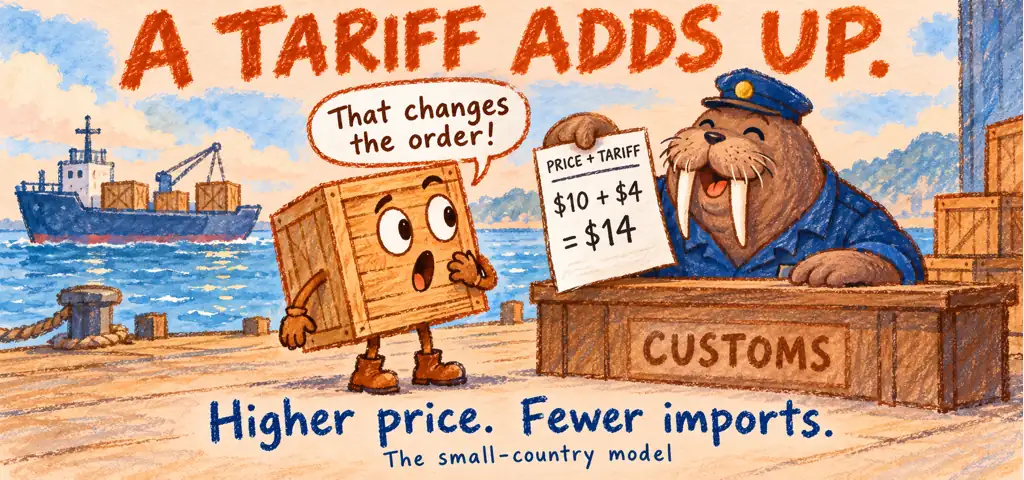
Tariff effects in the small-country model include a higher domestic price, more domestic production, less consumption and fewer imports. The result assumes competitive markets, an unchanged world price and a tariff low enough that imports continue. Use the graph and worked example to separate government revenue from deadweight loss.
A tariff changes domestic production and consumption in opposite directions, so imports shrink from both sides.
A tariff is a tax on imports. In the AP Microeconomics small-country model, a per-unit tariff raises the domestic price from the world price, PW, to PW + t. Domestic firms move along supply and produce more. Domestic buyers move along demand and consume less. Because production rises while consumption falls, the gap filled by imports becomes smaller.
The tariff-inclusive price raises domestic production from QS1 to QS2, lowers consumption from QD1 to QD2, and reduces imports. The middle rectangle is revenue; the left and right triangles show production and consumption deadweight loss. The graph is schematic, not the numerical example below.
Recompute all three quantities
Before the tariff, imports equal QD1 − QS1. After the tariff, imports equal QD2 − QS2. Tariff revenue uses only the imported units that remain:
Tariff revenue = t × (QD2 − QS2)Do not multiply the tariff by domestic quantity demanded or domestic quantity supplied alone. Domestically produced units do not pay an import tariff.
Free trade gives a world price of $10, domestic production of 20, and domestic consumption of 80. Imports are 60. A $4 tariff raises the domestic price to $14. Domestic production rises to 35 and domestic consumption falls to 65, so imports fall to 30. Tariff revenue is $4 × 30 = $120.
Separate transfers from deadweight loss
Consumers lose surplus because they pay a higher price and buy fewer units. Domestic producers gain surplus because they receive the higher price and expand. The government receives tariff revenue. These are not all social losses: some consumer surplus is transferred to producers and the government.
Two triangles remain as deadweight loss. The production-distortion triangle represents units shifted from lower-cost foreign production to higher-cost domestic production. The consumption-distortion triangle represents purchases that disappear even though buyers valued those units more than their world resource cost.
| Outcome | Direction | Reason |
|---|---|---|
| Domestic price | Rises by the tariff in the basic model | The import price becomes PW + t |
| Domestic production | Rises | Firms move up along domestic supply |
| Domestic consumption | Falls | Buyers move up along domestic demand |
| Imports | Fall | The consumption-production gap narrows |
| Government revenue | Rises from zero | The tariff is collected on remaining imports |
| Total surplus | Falls | Production and consumption distortions create deadweight loss |
Check Imports and Tariff Revenue
After a tariff, domestic consumption is 90 units, domestic production is 50 units, and the tariff is $6 per unit. Find imports and tariff revenue.
Check your reasoning
Answer: Imports are 90 − 50 = 40 units. Tariff revenue is $6 × 40 = $240.
A tariff causes movements, not curve shifts
In the standard graph, the tariff changes the horizontal price line faced by the domestic market. It does not shift domestic demand or domestic supply. Production rises through a movement along supply; consumption falls through a movement along demand. Technology, preferences, input prices, or population could shift a curve, but the tariff by itself creates a price wedge.
An import quota can also restrict imports and raise the domestic price. The distributional difference is who receives the scarcity value. A tariff sends revenue to the government. A quota creates quota rents for whoever owns the rights to import, and the question must tell you enough before you assign those rents to domestic or foreign recipients.
Build the graph in a fixed order: domestic demand and supply, no-trade equilibrium, world price, free-trade quantities, tariff-inclusive price, new quantities, post-tariff imports, revenue, and the two deadweight-loss triangles.
Check the Model’s Limits
The world-price-plus-tariff rule applies here while imports remain positive. If the tariff eliminates imports, tariff revenue is zero; do not keep extending the domestic price above the no-trade equilibrium in this basic model. A country large enough to change the world price requires a different analysis.
The welfare comparison assumes competitive markets and no additional distortions such as an externality that the tariff might affect. It describes this model’s changes in total surplus, not every real-world policy consideration.
Sources and Related Lessons
Read OpenStax on tariffs, quotas and protectionism for a supply-and-demand analysis. Practise clear labels and explanations with the AP Microeconomics graph-response guide, or use the AP Microeconomics study hub for related lessons.
Tariffs and trade policy are part of Unit 2 in the AP Microeconomics course framework.
Watch the idea in action
A related lesson from Khan Academy. The article above covers the topic in full.
Open the video on YouTube · Educator lesson and source

Reza is an experienced Math instructor and a test-prep expert who has been tutoring students since 2008. He has helped many students raise their standardized test scores--and attend the colleges of their dreams. He works with students individually and in group settings, he tutors both live and online Math courses and the Math portion of standardized tests. He provides an individualized custom learning plan and the personalized attention that makes a difference in how students view math.
Related to This Article
More math articles
- Functionalist, Conflict, and Interactionist Views of Education
- Social Class, Work, Power, and Mobility
- How to Build a Personal Budget: Step-by-Step (2026)
- Translate areas into dollars
- Registered voters
- The Best Grade 8 Math Book for Massachusetts Students
- The Great Math Tour: Exploring the World of Circle Graphs
- Is the PERT Test Hard?
- 10 Most Common 8th Grade FSA Math Questions
- How to Find The Slope of Roots: Derivative of Radicals












What people say about "Tariff Effects: Imports, Revenue and Deadweight Loss"?
No one replied yet.