Protein Structure: Four Levels, Folding and Function
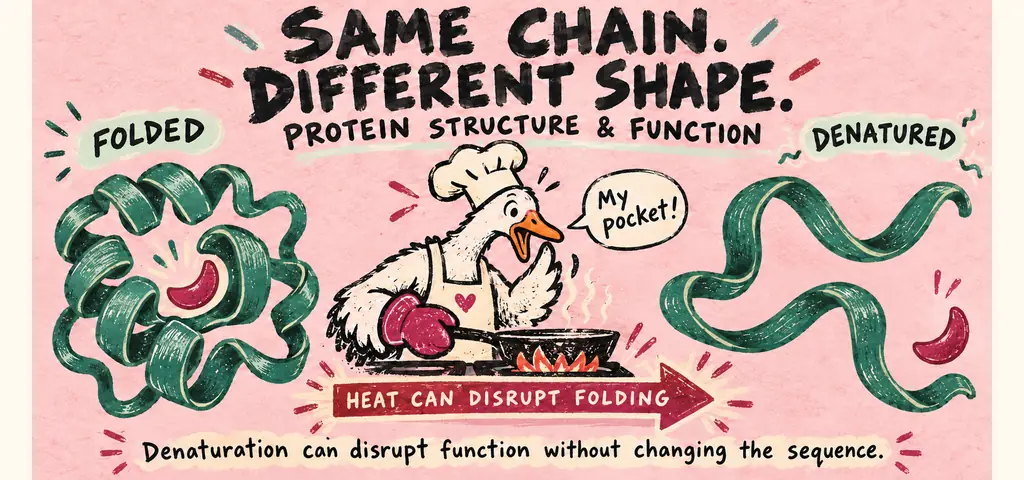
Protein structure has four levels: primary, secondary, tertiary and quaternary. Sequence defines primary structure; local backbone patterns form secondary structure; the full fold of one chain is tertiary structure; multiple assembled chains give quaternary structure. To explain function, identify the changed interaction and distinguish a measured result from a predicted mechanism.
Compare the Four Levels of Protein Structure
| Level | Look for |
|---|---|
| Primary | Amino-acid sequence in a chain |
| Secondary | Local backbone hydrogen-bond patterns, such as helices and sheets |
| Tertiary | The overall three-dimensional fold of one chain |
| Quaternary | Assembly of two or more polypeptide chains |
A protein can have secondary and tertiary structure without having multiple subunits. Several helices in one chain do not establish quaternary structure.
Heat an egg white and it turns opaque and firm. Heating disrupts protein folding and allows the unfolded chains to associate, even though their amino-acid sequences largely remain intact. Cooling does not restore the original structure. This familiar change illustrates why a protein’s sequence and its folded shape need to be considered separately.
Watch the process
Protein Structure and Folding
Proteins do many jobs in cells. Enzymes catalyze reactions, motor proteins move cargo, collagen supports tissues, and hemoglobin carries oxygen. Antibodies bind targets, while receptors detect signals. These different functions arise from amino-acid chains whose sequences, structures, and chemical environments vary.
An amino acid has a central carbon bonded to four things: a hydrogen, an amino group, a carboxyl group, and a variable R group, or side chain. The same basic amino-acid plan is shared by the twenty standard amino acids, with proline’s ring providing a structural variation. Side chains supply much of the chemical diversity, while sequence, length, folding conditions, and modifications also matter.
Side-Chain Chemistry and Substitution Predictions
Side chains are sorted by how they interact with water. Nonpolar side chains are hydrophobic and often lie inside soluble proteins or face membrane lipids in membrane proteins. Polar side chains can form hydrogen bonds and are often exposed to water or positioned in binding sites; their location depends on the overall fold. Acidic and basic side chains carry charge at cell pH and form ionic interactions with one another. Cysteine’s sulfhydryl side chain can form a disulfide bridge.
Sort the twenty into four working groups and you can predict a great deal without memorizing structures. Nonpolar side chains, glycine, alanine, valine, leucine, isoleucine, methionine, phenylalanine, tryptophan, proline, are hydrocarbon or nearly so. Hydrophobic side chains often cluster away from water in soluble proteins or face membrane lipids. This is a useful tendency, not a rule that places every listed residue in the core; glycine’s small hydrogen side chain also affects backbone flexibility. Polar uncharged side chains, serine, threonine, cysteine, tyrosine, asparagine, glutamine, carry hydroxyl, sulfhydryl, or amide groups that hydrogen-bond, so they sit at the surface or line a pocket where they can hold a substrate. Acidic side chains, aspartate and glutamate, carry a carboxyl that is deprotonated and negative at cell pH. Basic side chains, lysine, arginine, and histidine, can carry positive charge. Lysine and arginine are usually positive near cell pH; histidine can gain or lose a proton near this range, making its charge especially sensitive to its local environment. The last two groups attract each other, and those ionic interactions, attractions between oppositely charged side chains, are among the contacts that hold a fold together.
Now use the sorting. If an exam item substitutes one amino acid for another, ask which of the four groups each belongs to. A swap within a group may preserve some interactions, but even a conservative substitution can matter at a tightly packed or catalytic site. A swap across groups, nonpolar for charged, or acidic for basic, changes the local chemistry and is where the consequence comes from. Use that comparison to identify a plausible change, then check the residue’s position and the experimental evidence.
A bond between the carboxyl carbon of one amino acid and the amino nitrogen of the next is a peptide bond. A polypeptide chain has an amino terminus at one end and a carboxyl terminus at the other. The chain has direction, just as a nucleic acid does, and it is synthesized from the amino end toward the carboxyl end.
Four Levels, One Cause
Primary structure is the sequence of amino acids. A gene specifies that sequence; folding also depends on the chemical environment and sometimes on partners or modifications. Secondary structure is local folding held by hydrogen bonds between backbone atoms, not side chains: the alpha helix and the beta pleated sheet. The repeating hydrogen-bond patterns use backbone atoms. Amino-acid sequence still strongly influences where a helix or sheet forms, how stable it is, and whether a segment adopts either structure. Tertiary structure is the overall three-dimensional shape of one polypeptide. Side-chain and backbone contacts contribute, including hydrophobic clustering, hydrogen bonds, ionic interactions and, in some proteins, disulfide bridges. Quaternary structure exists only when two or more polypeptide subunits assemble into one functional protein, as the four subunits of hemoglobin do.
Denaturation is the loss of the higher-order structure while the peptide bonds stay intact. Heat, extreme pH, and certain solutes disrupt the weak interactions holding the fold, so the protein unfolds and loses function. Extreme pH works by changing the protonation of carboxyl and amino side chains, which destroys the ionic interactions that were holding parts of the fold together. Some proteins refold when conditions return; many aggregate instead.
Folding also depends on the cellular environment. A favorable final fold does not guarantee an unobstructed folding path. In a crowded cell, partly folded chains can aggregate. Molecular chaperones can help prevent inappropriate contacts and assist folding; some provide a protected chamber. They support the folding process rather than supplying a replacement amino-acid sequence. Second, the interactions holding tertiary structure are almost all weak and individually reversible, hydrogen bonds, ionic attractions, and hydrophobic clustering, with disulfide bridges as the covalent crosslinks emphasized in this review. A sufficiently disruptive temperature or pH change can alter the fold while leaving the peptide backbone intact; the threshold depends on the protein and conditions.
Denaturation can disrupt the geometry needed for function. An enzyme works because its active site presents a specific arrangement of side chains at specific distances. Move those side chains apart and the substrate no longer makes the contacts that hold it and strain it toward the transition state. Nothing about the sequence has changed; the geometry that the sequence used to produce is gone.
Predicting the Effect of Three Substitutions
An enzyme’s active site contains, among others, a buried leucine at position 84, a surface lysine at position 112 that forms an ionic interaction with a nearby aspartate, and a serine at position 145 that hydrogen-bonds to the substrate. A researcher makes three separate single substitutions: L84I, K112E, and S145A. Predict the consequence of each and say which is likely to be most severe.
Take them one at a time, and for each one name the group the old residue belonged to, the group the new residue belongs to, and the interaction that depends on it.
L84I replaces leucine with isoleucine. Both are nonpolar, both are roughly the same size, and the residue is buried, where its job is to fill hydrophobic space. The side chain remains nonpolar, so hydrophobic contacts may be largely retained. Predict a smaller effect than for a charge reversal, while allowing that altered packing at a sensitive site can matter.
K112E replaces lysine with glutamate. Lysine is basic and positive at cell pH; glutamate is acidic and negative. The residue was forming an ionic attraction to a negative aspartate. Replace positive with negative and that attraction becomes a repulsion between two like charges. Predict a real effect on local structure, but a surface location does not establish that the effect is small. The contact may affect stability, binding or interactions with other subunits.
S145A replaces serine with alanine. Serine’s hydroxyl is what hydrogen-bonds to the substrate; alanine’s methyl side chain cannot replace that hydrogen bond. Its backbone can still participate in hydrogen bonding. The residue is in the active site and its specific interaction with the substrate is eliminated, not merely altered.
Rank by two criteria together: how far the substitution moves across the four groups, and how directly the residue participates in the protein’s function. S145A scores highest on the second criterion and removes a functional contact outright.
Answer
Predict a smaller effect for L84I than for the other changes, disruption of an ionic contact for K112E, and loss of a substrate hydrogen bond for S145A. S145A is a reasonable candidate for the greatest binding effect, but experiments are needed to rank the actual effects.
Review: Proteins: Sequence, Folding, and Structure-to-Function Argument
Sequence and environment influence folding. The resulting structure affects binding, catalysis, and other protein functions.
Change one side chain across chemical groups and you change the interactions available at that spot; change the conditions and you may alter several stabilizing interactions.
Denaturation is a loss of shape, not of sequence. If an item tells you the amino-acid sequence is unchanged, every choice that involves broken peptide bonds is already out.
The Confusion Worth Clearing Up Now
Denaturation and mutation change different things. A mutation changes DNA. It can change a protein’s amino-acid sequence, alter how much protein is made, or have no detectable effect; a synonymous mutation, for example, need not change the encoded amino acid. Denaturation changes nothing about the sequence; it unfolds the chain that already exists. Heat denatures. A base substitution mutates. An egg cooking in a pan illustrates denaturation. A temperature or pH change does not automatically denature every protein; use the conditions and evidence in the question.
Secondary and tertiary structure refer to different levels of folding. Both involve folding and hydrogen bonds, but the interactions occur at different structural levels. Use the atoms involved as the test. Secondary structure, the alpha helix and the beta pleated sheet, is held by hydrogen bonds between backbone atoms, the same atoms in every amino acid. Tertiary structure is held by interactions between side chains, which differ from one amino acid to the next. Regular backbone hydrogen-bond patterns define secondary structure. Tertiary structure describes the overall fold and can include contacts involving both side chains and backbone atoms.
A Structure-to-Function Argument (Science Practice 6)
An enzyme has a valine in the active site. A researcher engineers a variant in which that valine is replaced by glutamate, whose side chain carries a negative charge at pH 7. In this illustrative experiment, a binding assay reports a value 80 percent lower for the variant than for the original under matched conditions. The assay does not directly measure catalytic turnover or overall folding. Make a claim about the cause and support it with evidence and reasoning.
Claim. The substitution is associated with lower measured binding. Changing the active-site side chain from nonpolar to charged is a plausible mechanism.
Evidence. The substrate is nonpolar. Valine has a nonpolar side chain and glutamate has a negatively charged one. The matched binding assay reports an 80 percent decrease, and the engineered sequence differs at this one residue. Whether the overall fold changed was not measured.
Reasoning. Binding specificity depends on complementary interactions between the active site and the substrate. A nonpolar substrate is stabilized in a nonpolar pocket, where hydrophobic interactions are favorable. A charged substitution may change hydrophobic contacts, hydration or pocket geometry. Those are plausible explanations for the lower assay result; the measurement alone does not identify which mechanism dominates. Notice what the argument does not claim: a changed sequence does not establish whether the overall fold was retained, and nothing here shows that the enzyme has lost all activity or that its overall fold collapsed.
Conclusion
A single nonpolar-to-charged substitution in the active site can disrupt favorable substrate contacts and offers a plausible explanation for reduced binding. A structural measurement would help distinguish this local effect from broader unfolding.
To support a functional prediction, name the structural evidence and explain which interaction changes. Then connect that interaction to the observed activity. Keep the claim within what the experiment measured.
Protein structure and denaturation
Practice question 1
A protein is heated until it loses activity. Chemical analysis shows its amino-acid sequence is unchanged. The most accurate description is that
-
the primary structure was hydrolyzed into free amino acids
-
the interactions maintaining tertiary and secondary structure were disrupted while peptide bonds remained
-
the primary structure was rearranged while the folded shape was preserved
-
quaternary structure was gained as separate subunits fused into one chain
Practice question 2
A single amino-acid substitution replaces a surface glutamate with valine in one hemoglobin subunit, and the altered molecules stick to one another and form fibers. This shows that
-
a change in primary structure can alter tertiary and quaternary interactions and therefore function
-
the effect must arise in secondary structure, since backbone hydrogen bonding is what sets a protein’s shape
-
surface side chains affect solubility but not how one protein molecule interacts with another
-
the aggregation indicates that peptide bonds were broken and the subunits released
Practice question 3
Quaternary structure is present in a protein whenever
-
an alpha helix hydrogen-bonds to a beta pleated sheet
-
a disulfide bridge links two distant regions of one chain
-
hydrophobic side chains cluster in the interior of one chain
-
two or more separate polypeptide subunits assemble into one functional unit
Practice answer key
1. B; 2. A; 3. D.
Practice answer explanations
-
Protein structure and denaturation, Question 1. Choice B is correct. Denaturation disrupts the weak interactions maintaining secondary and tertiary structure while the covalent peptide backbone stays intact, which is exactly what an unchanged sequence indicates. Choice A would require hydrolysis of the backbone, which the sequence data rule out. Choice C reverses the correct answer and encodes the denaturation-with-mutation merge: ordinary denaturation does not rearrange the amino-acid sequence. An unchanged overall fold would not by itself rule out loss of activity from another cause. Choice D reverses the direction of change, because the observation does not show a new quaternary assembly. Heat-induced association or aggregation is possible, but association does not fuse subunits into one polypeptide chain.
-
Protein structure and denaturation, Question 2. Choice A is correct. A substitution changes primary structure, and because side-chain interactions build the higher levels, tertiary and quaternary behavior can change with it. Choice B claims that secondary structure must explain the effect. Sequence changes can affect secondary structure, but the given observation specifically supports altered interactions between protein molecules; no change to a helix or sheet is demonstrated. Choice C states the surface misconception backward, since surface residues are precisely the ones exposed to solvent and to neighboring molecules, which is why a surface change can drive association. Choice D confuses aggregation with backbone cleavage; the chains here stay intact and simply stick to one another.
-
Protein structure and denaturation, Question 3. Choice D is correct. Quaternary structure is by definition the assembly of two or more separate polypeptides into one functional protein. Choices A and C describe secondary and tertiary features within a single chain. Choice B names a disulfide bridge inside one chain, which stabilizes tertiary structure rather than creating a new level.
Continue your review at the AP Biology study hub.
Connect Structure to Molecules and Reactions
Compare protein chain direction with DNA strand direction and complementary sequences. Then use enzyme kinetics and inhibition to separate substrate binding from reaction rate.
Sources for Further Study
OpenStax reviews protein structure levels and amino acids. Molecular Biology of the Cell explains protein shape, folding and molecular chaperones.

Related to This Article
More math articles
- SSAT Middle-Level Math Worksheets: FREE & Printable
- Full-Length ASVAB Math Practice Test
- PSAT Math FREE Sample Practice Questions
- How to Choose the Right Calculator for High School
- The Best Grade 5 ELA Practice Tests for Michigan Students
- Load Configuration and Prioritization
- Top 10 Tips to ACE the ISEE Math Test
- The Wonderful World of the Triangle Inequality Theorem
- Formal Organizations, Bureaucracy, and Concentrated Power
- Full-Length CLEP College Mathematics Practice Test









What people say about "Protein Structure: Four Levels, Folding and Function"?
No one replied yet.