DNA Strand Direction: Complement and Reverse Complement
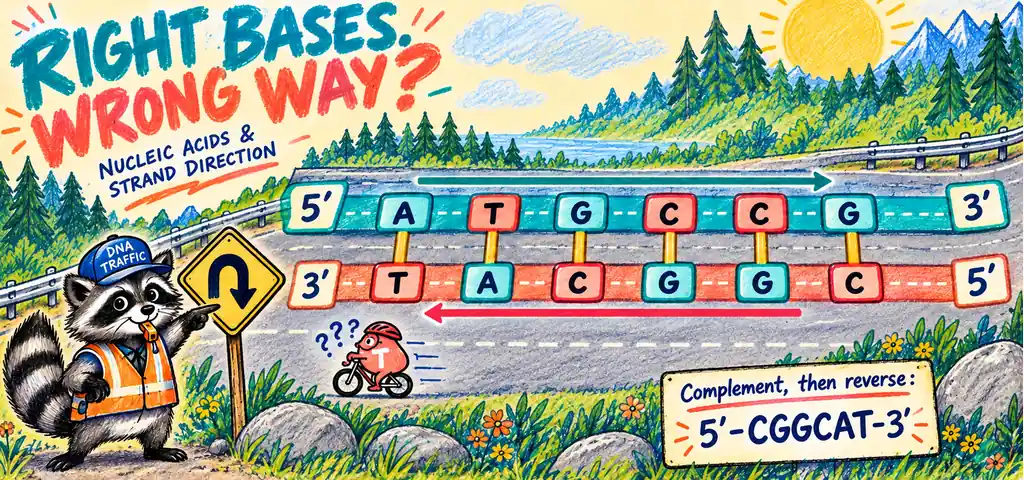
DNA strand direction identifies the 5′ and 3′ ends. Complementary strands run antiparallel. Pair A with T and G with C, label the opposite ends, then check which direction the answer asks for. An aligned complement is written 3′ to 5′ beneath a 5′ to 3′ strand; its reverse complement gives the partner in conventional 5′ to 3′ notation.
Read DNA Strand Direction in Three Steps
- Keep the given strand and both end labels visible.
- Write matching bases beneath it, with the partner’s end labels reversed.
- If the answer must run 5′ to 3′, read that partner from its 5′ end.
Given: 5′-ATGCCG-3′
Aligned partner: 3′-TACGGC-5′
Partner written 5′ to 3′: 5′-CGGCAT-3′. Both partner notations describe the same strand.
Reading CAT from the opposite end gives TAC. Direction also matters when you read a DNA sequence, but DNA’s two ends are chemically different: one is called 5′ and the other 3′. Labeling those ends lets you identify how a strand is oriented and write its complementary strand correctly.
Watch the process
Nucleic Acids
Nucleotide Structure and Base Pairing
A nucleotide has exactly three parts: a five-carbon sugar, one or more phosphate groups attached to the sugar’s 5’ carbon, and a nitrogenous base attached to the 1’ carbon. This is the standard nucleotide structure used in nucleic-acid synthesis; phosphate can occupy other positions in some cellular nucleotides. Read those small marks before going further. The five carbons of the sugar are numbered 1 through 5, and each number carries a prime mark, read aloud as “five prime” or “three prime,” only so that the sugar’s carbons are never confused with the separately numbered atoms of the base. The labels 5’ phosphate, 3’ hydroxyl, and 2’ hydroxyl identify positions on the sugar. In DNA the sugar is deoxyribose, which lacks the hydroxyl at the 2’ position that ribose carries in RNA. The 2’ hydroxyl makes RNA chemically more reactive and less stable, which contributes to differences in stability between RNA and DNA.
The bases divide into two-ring purines, adenine and guanine, and one-ring pyrimidines, cytosine plus thymine in DNA or uracil in RNA. In double-stranded DNA, adenine pairs with thymine through two hydrogen bonds and guanine pairs with cytosine through three. In standard Watson-Crick pairing, a purine pairs with a pyrimidine, which keeps the width of the double helix constant along its length. The two strands are antiparallel: they run in opposite directions.
The pairing rules have a measurable consequence that Erwin Chargaff found before anyone knew the structure. For fully complementary double-stranded DNA with standard A–T and G–C pairing, counting both strands gives equal amounts of adenine and thymine, and equal amounts of guanine and cytosine. These equalities need not hold within either individual strand. Those equalities are now called Chargaff’s rules, and they are not arbitrary bookkeeping: every A on one strand is opposite a T on the other, so the totals must match. Notice what the rules do not say. They do not require A to equal G, and the ratio of A-T pairs to G-C pairs varies widely between species. Use the pairing relationships to calculate an unknown base percentage from a supplied one.
Notice also the energy difference built into the pairing. An A-T pair holds with two hydrogen bonds; a G-C pair holds with three. A region of DNA rich in G and C is generally harder to separate under otherwise matched conditions. Base stacking also contributes to stability, which is why such regions have higher melting temperatures and why the origins of replication in many genomes are A-T rich. Compare melting temperatures only under otherwise matched conditions.
The Backbone Has a Direction, and That Is the Point
Polymerases join activated nucleotides through a phosphodiester bond that links the phosphate on the 5’ carbon of one nucleotide to the hydroxyl on the 3’ carbon of the next. Run that linkage down a strand and a typical unmodified strand has a 5’ end and a 3’ hydroxyl end. A 5’ end may carry a phosphate or hydroxyl, and some RNAs have additional end modifications; the sugar-carbon numbering still defines the direction. That asymmetry is 5’ to 3’ directionality, and it is the structural fact underneath the entire Information Storage and Transmission big idea.
Label the ends before comparing sequences. Writing the same strand from opposite ends reverses the written order; writing its partner also requires complementary bases. End labels prevent those two operations from being confused. The DNA and RNA polymerases studied here add new nucleotides only to a free 3’ hydroxyl, so their growing DNA or RNA strand extends in the 5’ to 3’ direction while the template is read 3’ to 5’. This directionality helps explain leading and lagging strands, Okazaki fragments, and the direction of transcription along a template.
RNA differs from DNA on four counts worth holding together: ribose instead of deoxyribose, uracil instead of thymine, typically single-stranded instead of double-stranded, and often shorter-lived, although lifetimes vary among RNA types. Being single-stranded lets an RNA fold back on itself through internal base pairing, which is how transfer RNA gets its shape and how ribozymes get catalytic activity. A single-stranded molecule that folds into a working shape is behaving the way a protein does, and that overlap is why RNA can both carry information and do chemical work.
Reading a Strand Correctly
A single DNA strand is written \(5’\text{-ATGCCG-}3’\). Give the sequence of the complementary strand, written in the conventional direction.
Pair each base first, keeping the strands aligned: A pairs with T, T with A, G with C, C with G, C with G, G with C. Reading the complement in the same left-to-right order as the original gives TACGGC, but that reading runs \(3’\) to \(5’\) because the strands are antiparallel. Convention writes sequences \(5’\) to \(3’\), so reverse it.
Answer
\(5’\text{-CGGCAT-}3’\). The aligned complement is correct as 3′-TACGGC-5′. Reverse its written order only because this question requests the answer in the 5′ to 3′ direction.
Using Chargaff’s Rules on Real Numbers
A double-stranded DNA sample is 22 percent guanine by base count. A second sample, single-stranded, is 22 percent guanine and 31 percent cytosine. For each sample, determine what can be concluded about the adenine content, and explain why the two samples must be handled differently.
Start with the double-stranded sample, where the pairing rules apply. Guanine pairs with cytosine, so cytosine is also 22 percent, and the two together account for \[22 + 22 = 44 \text{ percent}.\] The remaining bases must be adenine and thymine: \[100-44 = 56 \text{ percent}.\] Because adenine pairs with thymine, that 56 percent divides equally, so adenine is 28 percent and thymine is 28 percent.
Now the single-stranded sample, and here the reasoning has to stop short. Chargaff’s rules follow from base pairing between two strands. A single strand has no partner, so nothing forces its adenine content to match its thymine content, and the given numbers confirm it, since guanine at 22 percent and cytosine at 31 percent are already unequal. All you can say is that adenine plus thymine together make up \(100-22-31 = 47\) percent, split in some unknown ratio.
Answer
The double-stranded sample is 28 percent adenine. The single-stranded sample allows only the combined figure of 47 percent adenine plus thymine, because the pairing rules require a complementary partner strand to hold.
Review: Nucleic Acids and Directionality
A nucleotide sequence records base order. Its 5′ and 3′ labels specify the direction in which that order is written.
Sugar chemistry affects stability, and base sequence affects information and folding. Reversing how you write a strand changes its notation; it does not chemically alter the molecule.
When writing a complement, pair the bases and label the opposite ends. Reverse the written order only when needed to give the requested 5′ to 3′ orientation.
The Confusion Worth Clearing Up Now
A nucleotide, a nucleoside, and a base contain different components. A nitrogenous base is one of adenine, guanine, cytosine, thymine, or uracil. A base plus a sugar is a nucleoside. A base plus a sugar plus at least one phosphate is a nucleotide, and that is the monomer. When a question says the monomer of a nucleic acid, it means all three parts.
Distinguish the bonds between paired bases from the bonds along the backbone. Within one strand, neighboring nucleotides are held by phosphodiester bonds, which are covalent and strong. Between the two strands, paired bases are held by hydrogen bonds, which are weak and individually easy to break. That difference is exactly why the double helix can be unzipped for replication and transcription without the strands themselves falling apart. Heating can disrupt hydrogen bonding and base-stacking interactions while leaving each strand’s covalent phosphodiester backbone intact. Strand separation does not require cutting that backbone.
Nucleotides and directionality
Practice question 1
The phosphodiester bond in a nucleic acid strand joins
-
the nitrogenous base of one nucleotide to the base of the next
-
the 5’ phosphate of one nucleotide to the 5’ phosphate of the next
-
the phosphate group on the 5’ carbon of one nucleotide to the hydroxyl on the 3’ carbon of the adjacent sugar
-
two sugars directly with no phosphate between them
Practice question 2
Which set of differences correctly separates RNA from DNA?
-
RNA uses deoxyribose and thymine and is typically double-stranded; DNA uses ribose and uracil and is typically single-stranded
-
RNA uses ribose and uracil and is typically single-stranded; DNA uses deoxyribose and thymine and is typically double-stranded
-
RNA uses ribose and thymine and is typically single-stranded; DNA uses deoxyribose and uracil and is typically double-stranded
-
RNA pairs adenine with guanine and DNA pairs adenine with thymine, though both are built on the same sugar
Practice question 3
A DNA polymerase adds nucleotides only to a free 3’ hydroxyl. It follows that
-
the new strand is built 5’ to 3’ while its template is read 3’ to 5’
-
the new strand and its template are built in the same direction
-
the enzyme can begin synthesis at either end of the new strand
-
directionality applies to DNA replication but not to transcription
Practice answer key
1. C; 2. B; 3. A.
Practice answer explanations
-
Nucleotides and directionality, Question 1. Choice C is correct. A phosphodiester bond joins the 5’ phosphate of one nucleotide to the 3’ hydroxyl of the neighboring sugar, which is what makes the backbone directional. Choice A incorrectly joins neighboring bases; the backbone links sugars through phosphate groups. Choice B names a phosphate-to-phosphate linkage rather than the sugar-phosphate-sugar connection of the nucleic-acid backbone. Choice D removes the phosphate that gives the backbone its name and its charge.
-
Nucleotides and directionality, Question 2. Choice B is correct. RNA carries ribose and uracil and is typically single-stranded, while DNA carries deoxyribose and thymine and is typically double-stranded. Choice A swaps every feature between the two molecules. Choice C swaps only the bases, keeping the sugars right, which is the halfway error to watch for: uracil belongs to RNA and thymine to DNA. Choice D misstates standard complementary pairing, in which A pairs with T or U rather than G, and also denies the sugar difference that names the two molecules.
-
Nucleotides and directionality, Question 3. Choice A is correct. Adding only to a free 3’ hydroxyl forces synthesis in the 5’ to 3’ direction, and because the strands are antiparallel the template is necessarily read 3’ to 5’. Choice B ignores the antiparallel arrangement. Choice C contradicts the stated restriction on where nucleotides can be added. Choice D limits directionality to replication, but RNA polymerase obeys the same 3’ hydroxyl requirement.
Continue your review at the AP Biology study hub.
Connect DNA Structure to Cell Biology
Review organelle genomes and endosymbiotic evidence to connect DNA with mitochondria and chloroplasts.
Sources for Further Study
The National Human Genome Research Institute defines the components of a nucleotide. OpenStax explains nucleic acid structure and antiparallel DNA strands.

Related to This Article
More math articles
- A Comprehensive Collection of Free CBEST Math Practice Tests
- The Best Algebra 1 Book for Michigan Students
- Ecosystems: Producers, Consumers, and Decomposers
- How to Multiply Binomials? (+FREE Worksheet!)
- Signals and screens build trust differently
- Commander in chief
- How to Use Basic Techniques for Solving Trigonometric Equations
- Skip Counting & Number Line Game — Click the Right Number
- Praxis Core Math Practice Test Questions
- Printable Algebra 1 Worksheets with Answers (Free PDFs)





What people say about "DNA Strand Direction: Complement and Reverse Complement"?
No one replied yet.