Redox and Electron Carriers: NADH, FADH2 and NADPH
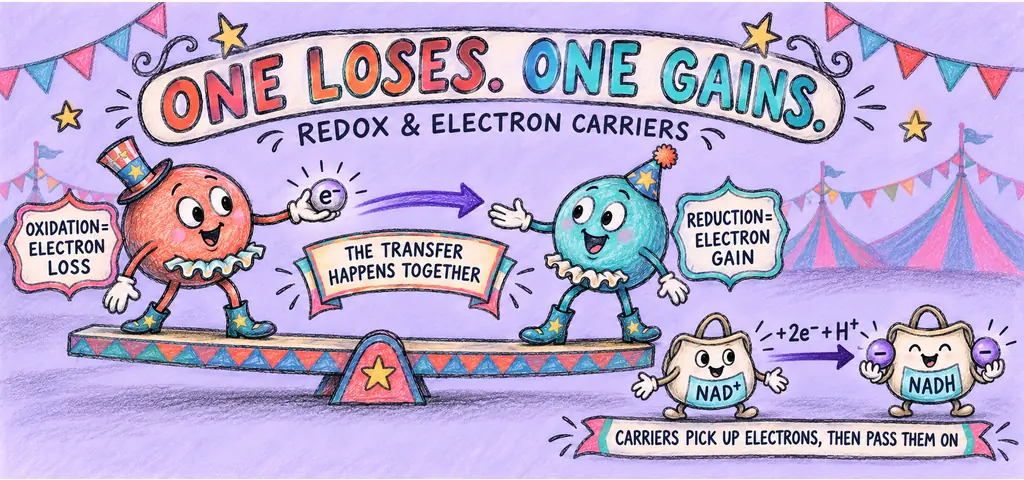
In redox reactions, oxidation loses electrons and reduction gains them. NADH, FADH2 and NADPH are reduced carrier forms; NAD+, FAD and NADP+ are their oxidized counterparts. Follow both the electron donor and the acceptor, then identify the pathway in which the carrier is used.
A piece of wood can burn because its reduced carbon compounds react with oxygen to form lower-free-energy products. Carbon dioxide is already highly oxidized and cannot supply the same energy through further carbon oxidation. Charcoal, by contrast, still contains reduced carbon and can burn; do not confuse charcoal with the mineral ash left after complete combustion. The useful comparison is fuel carbon versus carbon dioxide.
Watch the process
Cellular Respiration (UPDATED)
During food oxidation, electrons move to acceptors through reactions that release free energy overall. Cells capture part of that free-energy change for work. Breaking a bond requires energy; the net release depends on the full set of bonds broken and formed.
Oxidation, Reduction, and Which One Is Which
Oxidation is the loss of electrons by a substance; reduction is the gain of electrons by a substance. A reduced substance has gained electrons. The term refers to a decrease in oxidation state; it does not mean that the molecule necessarily loses mass or acquires a net negative charge. The standard memory line is OIL RIG, oxidation is loss, reduction is gain, which can help you keep the direction of electron transfer straight.
Biological redox reactions transfer electrons in several ways, often together with hydrogen. Hydrogen transfer can accompany electron transfer, so a useful clue in many carbon-metabolism reactions is that a molecule that gains hydrogens has been reduced, and a molecule that loses hydrogens has been oxidized. Compare \(\text{C}_6\text{H}_{12}\text{O}_6\) with \(6\,\text{CO}_2\). Glucose is loaded with hydrogen; carbon dioxide has none. Glucose is therefore the reduced, energy-rich form, and carbon dioxide is the oxidized, energy-poor form.
The two halves always happen together, which is why the pair is called a redox reaction, a coupled transfer in which one substance is oxidized exactly as another is reduced. Nothing loses electrons into empty space. When a molecule is oxidized, identify the electron acceptor that is reduced in the coupled redox reaction.
Counting the Oxidation State of Carbon Across Respiration
Explain, using oxidation states rather than vocabulary, why the complete oxidation of glucose releases a large amount of free energy while the fixation of carbon dioxide into glucose requires a large input.
Set the counting rule. An atom is assigned a share of each bonding pair according to which partner pulls harder. Oxygen pulls harder than carbon, so a carbon-oxygen bond counts \(+1\) for the carbon. Hydrogen pulls less than carbon, so a carbon-hydrogen bond counts \(-1\) for the carbon. Carbon-carbon bonds count zero, since neither atom wins.
Apply it to glucose. Do the bookkeeping for the whole molecule rather than atom by atom, because the molecule is neutral overall and that gives you a check. The same bond rule, read from the other atom’s side, gives each hydrogen a count of \(+1\) and each oxygen a count of \(-2\), since hydrogen loses one bonding pair and oxygen wins two. In \(\text{C}_6\text{H}_{12}\text{O}_6\), then, the twelve hydrogens contribute \(+12\) and the six oxygens contribute \(-12\). Those cancel, so the six carbons together must contribute \(0\): \[6 \times (\text{average carbon}) + 12-12 = 0 .\] The average oxidation state of carbon in glucose is therefore \(0\).
Apply it to carbon dioxide. In \(\text{CO}_2\) each carbon is double-bonded to two oxygens, four bonds to oxygen in all, so the carbon counts \(+4\).
Read the result. Carbon changes from an average oxidation state of 0 in glucose to +4 in carbon dioxide, accounting for 24 electrons transferred per glucose. The individual carbons in glucose do not all have oxidation state 0. Oxygen accepts the electrons and is reduced to water. Oxidation-state bookkeeping tracks electron transfer; the reaction partners and conditions determine the free-energy change, and coupling determines how much is captured in ATP.
Now consider carbon fixation. Reducing six carbons from +4 in carbon dioxide to an average of 0 in carbohydrate requires 24 electrons. In oxygenic photosynthesis, water supplies electrons, light drives the light reactions, and ATP and NADPH support carbon fixation. This reverses the net carbon oxidation-state change; it does not mean that photosynthesis runs the respiration mechanism backward.
Answer
Carbon runs from an average oxidation state of \(0\) in glucose to \(+4\) in \(\text{CO}_2\). Respiration lets that change happen and captures part of the release; photosynthesis forces it backward and pays for it with light.
The Carriers: \(\text{NAD}^+\), FAD, and \(\text{NADP}^+\)
Electrons stripped from food cannot be left loose in the cytosol. They are handed to electron carriers, small organic molecules that pick up electrons at one place in the cell and drop them off at another. Track the oxidized and reduced forms of three major electron carriers.
\(\text{NAD}^+\), nicotinamide adenine dinucleotide, is the workhorse of catabolism. It accepts two electrons and one proton and becomes NADH. The oxidized form carries the plus sign; the reduced form carries the H. Use the conventional notation: \(\text{NADH}^+\) is not the conventional symbol for this reduced carrier.
FAD, flavin adenine dinucleotide, accepts two electrons and two protons when reduced to FADH2. It often functions as an enzyme-bound cofactor. In the mitochondrial succinate-dehydrogenase route, its electrons enter the respiratory chain downstream of complex I, so that route supports less proton pumping than entry through NADH at complex I. ATP yield depends on the route and coupling conditions, rather than a universal energy label for every FAD-containing enzyme.
\(\text{NADP}^+\) differs from \(\text{NAD}^+\) by a single extra phosphate group and becomes NADPH when reduced. The extra phosphate helps enzymes distinguish the carriers, allowing cells to maintain different redox pools, using \(\text{NAD}^+\)/NADH for tearing molecules down and \(\text{NADP}^+\)/NADPH for building them up. Photosynthesis, which builds, uses NADPH.
These carriers are regenerated within their reaction cycles rather than consumed as a net product of each cycle. Each cycles between its oxidized and reduced form thousands of times, and their pools are finite on the short timescale of many experiments, although cells can change total pool size over time. That constraint will drive the entire logic of fermentation: if the oxidized form cannot be regenerated, it becomes limiting for reactions that require it. The timescale depends on pool size, reaction rate and other available pathways.
Compare Oxidized and Reduced Electron Carriers
| Oxidized | Reduced | Typical context |
|---|---|---|
| NAD+ | NADH | Fuel oxidation and respiratory electron transfer |
| FAD | FADH2 | Enzyme-associated redox reactions |
| NADP+ | NADPH | Photosynthetic reduction and biosynthesis |
Connect carrier recycling to the stages and ATP accounting of cellular respiration. For the photosynthetic source of reducing power, review the light reactions and NADPH production.
Catabolic and Anabolic Pathways
Metabolism is the total set of chemical reactions in a cell, and it sorts into two directions. A catabolic pathway breaks larger molecules into smaller ones, releases free energy, and often includes oxidation; respiration is the model case. An anabolic pathway builds larger molecules from smaller ones, requires free energy, and often includes reduction; photosynthesis and protein synthesis are model cases. Cells run both at once, funding the second out of the first.
Both kinds are organized as pathways rather than single reactions, and the reason is control. A metabolic pathway is an ordered series of reactions in which the product of each step is the substrate of the next and each step has its own enzyme. Splitting a large energy change into many small ones lets a cell capture the release in usable portions instead of losing it as a single burst of heat, and it gives the cell a separate control point at every step. Regulation often targets the enzyme catalyzing the first committed step, because slowing that one stops the whole line without letting intermediates pile up.
Watching a Reduction Happen: The DPIP Assay
DPIP is a blue dye that becomes colorless when it is reduced. Added to a suspension of isolated chloroplasts, it can intercept electrons from the light reactions in place of \(\text{NADP}^+\). A student measures percent transmittance of light through three tubes and records this data.
Separate two words before reading the table, because beginners merge them and then read the numbers backward. Transmittance is the percentage of light that passes through the tube; absorbance is a measure of the light the tube holds back. They run in opposite directions. As blue dye is reduced and loses its color, less light is absorbed and more gets through, so transmittance rises while absorbance falls. This table reports transmittance, so a rising number means less oxidized blue dye remains; the dye is chemically reduced rather than disappearing from the tube.
| Tube | Transmittance at 0 min (%) | Transmittance at 15 min (%) |
|---|---|---|
| Illuminated chloroplasts | 28 | 62 |
| Chloroplasts in the dark | 28 | 30 |
| Boiled chloroplasts, illuminated | 27 | 29 |
Interpret the result, calculate rates, and state what the dye is reporting.
Claim. Illuminated, intact chloroplasts reduce DPIP, which means the light reactions are transferring electrons to an acceptor, and neither light alone nor chloroplasts alone is sufficient.
Evidence. Convert each tube to a rate of change in transmittance per minute so the three can be compared on one scale. \[\text{illuminated: } \frac{62-28}{15} = 2.3\ \text{percentage points/min}, \qquad \text{dark: } \frac{30-28}{15} = 0.13\ \text{percentage points/min},\] \[\text{boiled: } \frac{29-27}{15} = 0.13\ \text{percentage points/min}.\] The illuminated tube changes about seventeen times as fast as either control. Compare the raw changes over the same 15 minutes rather than the rounded rates: the illuminated tube gained 34 percentage points while each control gained 2, and \(34 \div 2 = 17\).
Reasoning. The dark tube holds chloroplasts constant and removes light, so it isolates light as the necessary input. The boiled tube holds light constant and denatures the proteins, so it tests the need for a heat-sensitive chloroplast preparation; boiling affects membranes and many proteins, photosystems. Only the tube with both changes appreciably, so both are required. In the intended dye assay, reduction removes the blue color and increases transmittance. Interpret that change with matched blanks, controlled pH and comparable chloroplast suspensions; transmittance is not itself a linear dye-concentration scale. In the standard oxygenic light-reaction model, water is the original electron source. The assay measures electron transfer to an acceptor; it does not directly measure sugar production.
Limit of the claim. The dye reports electron transfer to an artificial acceptor. These transmittance readings do not measure carbon fixation or sugar production, and they do not establish that the Calvin cycle was completely absent. A separate carbon-fixation measurement would be needed to address that question.
Conclusion
The illuminated, unboiled preparation gains 34 transmittance percentage points in 15 minutes; each control gains 2. Their average transmittance-change ratio is 17. Under the assay assumptions, this supports light-dependent dye reduction by a functioning chloroplast preparation. It is not a calibrated ratio of electron-transfer rates or evidence of sugar production.
Distinctions to keep clear
Reduction is a gain of electrons, and the reduced fuel or carrier forms discussed here can donate electrons in energy-releasing reactions: NADH, not \(\text{NAD}^+\); glucose, not carbon dioxide. NADH and NADPH are different molecules. They differ by one phosphate, they belong to separate pools, and they commonly serve different pathway roles. NADH carries electrons stripped from fuel toward oxygen and pays for ATP. NADPH carries electrons toward carbon and pays for construction. Use the specific pathway: the Calvin cycle uses NADPH rather than NADH. Do not infer that mitochondria contain no NADPH; they also use it in other reactions.
Review: Redox, Electron Carriers, and the Shape of a Metabolic Pathway
Energy comes from electrons falling from atoms that hold them weakly to atoms that hold them tightly, not from bonds being broken.
Every oxidation is paired with a reduction in the same reaction, and carriers shuttle the electrons between distant parts of the cell.
Do not swap the terms. Reduced means gained electrons; whether a redox transfer releases energy depends on both partners, and the carrier pools are small, so the oxidized form must be regenerated or the pathway stalls.
Redox and electron carriers
Practice question 1
During the reaction in which glucose is oxidized to carbon dioxide and oxygen is converted to water,
-
glucose is reduced and oxygen is oxidized
-
glucose is oxidized and oxygen is reduced
-
both glucose and oxygen are oxidized
-
neither molecule changes oxidation state, since only bonds are broken
Practice question 2
A cell is supplied with an inhibitor that prevents \(\text{NAD}^+\) from being regenerated from NADH. The most direct consequence is that
-
ATP synthase runs in reverse and hydrolyzes ATP
-
oxidative reactions that require \(\text{NAD}^+\) as an electron acceptor stop once the small pool is used up
-
the cell begins reducing \(\text{NADP}^+\) instead, with no loss of function
-
carbon dioxide production increases because carbon must leave by another route
Practice question 3
\(\text{NADP}^+\) and \(\text{NAD}^+\) differ chemically by one phosphate group. The functional consequence for the cell is that
-
NADPH carries more electrons per molecule
-
the two pools can be used for different purposes, reduction for biosynthesis and oxidation for fuel breakdown
-
\(\text{NADP}^+\) cannot be reduced
-
\(\text{NAD}^+\) works only in chloroplasts
Practice answer key
1. B; 2. B; 3. B.
Practice answer explanations
-
Redox and electron carriers, Question 1. Choice B is correct. Glucose loses electrons as its carbons go from an average oxidation state of \(0\) to \(+4\) in carbon dioxide, and those electrons end up on oxygen, which is reduced to water. Choice A reverses both halves of the transfer. Choice C is impossible, because electrons lost by one substance must be gained by another in the same reaction. Choice D repeats the false idea that energy comes from bond breaking rather than from electron transfer.
-
Redox and electron carriers, Question 2. Choice B is correct. The \(\text{NAD}^+\) pool is finite over this short experiment, so if it cannot be regenerated its oxidized form becomes limiting and every oxidation that requires it as an electron acceptor stops. Choice A describes a response to a collapsed gradient, not to a carrier shortage. Choice C ignores that many enzymes distinguish the carriers, so NADP\(^+\) cannot automatically substitute for NAD\(^+\) in the inhibited pathway. Choice D predicts more carbon dioxide from stages that have themselves stopped for lack of an acceptor.
-
Redox and electron carriers, Question 3. Choice B is correct. The extra phosphate is a label that lets the cell maintain two independent pools, using NADPH for reductive biosynthesis and \(\text{NAD}^+\) for oxidative fuel breakdown. Choice A invents a difference in electron capacity that does not exist, since both carry two electrons. Choice C contradicts the existence of NADPH. Choice D reverses the locations, since \(\text{NAD}^+\) works throughout the cytosol and mitochondrion.
Continue your review at the AP Biology study hub.
Sources for further study
Review OpenStax on redox and electron carriers and light-driven electron transfer. Practical Biology provides an investigation using a redox dye and chloroplasts.

Related to This Article
More math articles
- How to Use Number Lines for Multiplication by a Negative Integer?
- 6th Grade SOL Math Worksheets: FREE & Printable
- How to Master Probability Density Functions
- GRE Math Worksheets: FREE & Printable – Your Ultimate Preparation Tool!
- 4 Best Keyboards for Online Teaching
- Top 10 Tips to Overcome ACT Math Anxiety
- A Guided, Timed Response
- The Best Grade 8 Math Book for Vermont Students
- Aviator Crash Game Math: The Multiplier Distribution Explained
- FTCE Math FREE Sample Practice Questions






What people say about "Redox and Electron Carriers: NADH, FADH2 and NADPH"?
No one replied yet.