Photosynthetic Light Reactions: ATP, NADPH and Oxygen
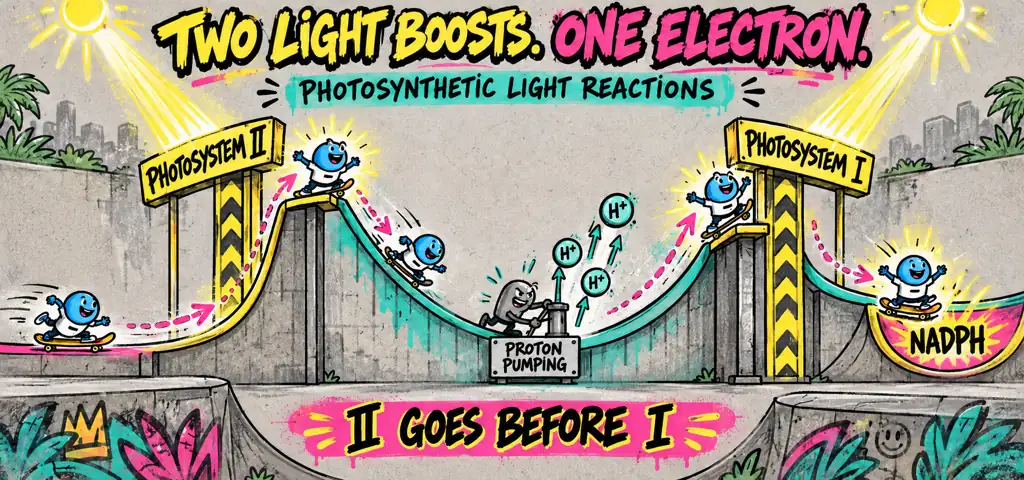
Photosynthetic light reactions occur in the thylakoid membrane. Linear electron flow uses light at photosystem II and photosystem I to transfer electrons from water toward NADPH. Water splitting releases oxygen, and a proton gradient powers ATP production on the stromal side.
A leaf appears green because it reflects and transmits a larger fraction of green light than of much of the red and blue light it receives. That does not mean green light is unused. Some green light is absorbed and can drive photosynthesis, including in deeper leaf layers. Distinguish a lower absorption value from zero absorption, and a leaf’s visible color from its full action spectrum.
Watch the process
Photosynthesis
The light reactions produce ATP and NADPH for the Calvin cycle. Follow the electrons through the two photosystems and keep track of the thylakoid membrane, lumen, and stroma; those locations determine where protons accumulate and where ATP is made.
Photosynthesis converts light energy into chemical energy stored in carbohydrate: \[6\,\text{CO}_2 + 6\,\text{H}_2\text{O} \xrightarrow{\ \text{light}\ } \text{C}_6\text{H}_{12}\text{O}_6 + 6\,\text{O}_2 .\] It is not respiration run backward: the two pathways use different enzymes, intermediates, and compartments. What they share is that both build a proton gradient across a membrane and let it drive ATP synthase.
The chloroplast has two compartments that matter here. The thylakoids are flattened membrane sacs stacked into grana, enclosing the thylakoid lumen; the stroma is the fluid around them. Light reactions occur in the thylakoid membrane, the Calvin cycle in the stroma, so locate each process relative to the thylakoid membrane.
Notice the parallel with the mitochondrion and, more usefully, the offset. The thylakoid lumen is the small enclosed space where protons are concentrated, so it plays the role the intermembrane space plays in respiration. The stroma is the large compartment where the synthesizing enzymes sit, so it plays the role of the matrix. Protons are pumped into the small space and flow back out into the large one through ATP synthase in both organelles. The chloroplast simply has an extra membrane layer around its small space.
Pigments and the Absorption Spectrum
A pigment is a molecule that absorbs some wavelengths of visible light and reflects or transmits the rest. Chlorophyll a is the pigment that sits in the reaction center and actually gives up the excited electron; every other pigment feeds energy to it. Chlorophyll b and the carotenoids, which absorb in the blue and blue-green and appear yellow or orange, are accessory pigments: they absorb wavelengths chlorophyll a handles poorly and pass the energy along, widening the slice of the spectrum a leaf can use. Carotenoids do second duty by absorbing excess light energy that would otherwise damage the chloroplast.
Compare an absorption spectrum with an action spectrum to connect light capture to photosynthesis. An absorption spectrum plots how strongly a pigment absorbs each wavelength. An action spectrum plots how fast photosynthesis proceeds at each wavelength, usually measured as oxygen release. When the action spectrum tracks the absorption spectrum of chlorophyll, with peaks in the blue and red and a trough in the green, the inference is that the pigment absorbing the light is the pigment driving the reaction. The mismatch matters too: the action spectrum is broader than chlorophyll a’s absorption spectrum alone, and that gap is the evidence for accessory pigments.
Reading a Chromatogram and Calculating \(R_f\)
A student separates leaf pigments by paper chromatography using polar paper and a largely nonpolar solvent. The solvent front travels 8.0 cm from the origin. Four bands appear, at 7.2 cm, 5.6 cm, 3.8 cm, and 3.0 cm. Calculate the retention factor for each band and explain what the values mean.
Step 1: state the quantity. The retention factor is \[R_f = \frac{d_{\text{pigment}}}{d_{\text{front}}} ,\] Here, dpigment and dfront are distances measured from the same origin. The ratio has no units. For a band measured from the same origin that remains behind the solvent front, it lies between 0 and 1.
Step 2: divide each distance by 8.0 cm. \[\begin{aligned}\frac{7.2}{8.0} &= 0.90, &\frac{5.6}{8.0} &= 0.70, \\ \frac{3.8}{8.0} &= 0.48, &\frac{3.0}{8.0} &= 0.38.\end{aligned}\]
Step 3: interpret the ordering. A pigment travels far when it is more soluble in the nonpolar solvent and less attracted to the polar paper. Carotenes, which are hydrocarbons with no polar groups, run near the front and give the highest values. Chlorophylls carry polar groups, cling to the paper, and lag behind, with chlorophyll b more polar than chlorophyll a and therefore lower. This makes the high band consistent with a carotene and the low band consistent with chlorophyll b. Confirm identities against known standards run with the same paper and solvent.
Step 4: note why the ratio and not the distance. If a second student runs the same extract but stops the solvent at 6.0 cm, distances are shorter and ratios should be similar if solvent, paper, temperature, and other conditions are matched. The ratio helps compare matched runs of different lengths, but it is not a unique pigment identifier. Compare with known standards under the same conditions.
Answer
\(R_f\) values of 0.90, 0.70, 0.48, and 0.38; higher values indicate less polar pigments such as carotenes, and the ratio is comparable across runs of different lengths in a way that raw distances are not.
The Light Reactions and the Z-Scheme
Chlorophyll and accessory pigments are organized into photosystems, protein-pigment complexes with a reaction-center chlorophyll pair at the middle of a light-harvesting antenna. There are two, and they were numbered in the order they were discovered, not the order they act. Photosystem II works first.
Follow one electron through linear electron flow. Light energy funnels through the antenna to the reaction center of photosystem II and excites an electron to a higher energy level, where a primary acceptor captures it. Photosystem II is now electron-deficient, and it replaces the loss by photolysis, splitting water into electrons, protons, and oxygen. That is where the oxygen you breathe comes from: water, never carbon dioxide. The excited electron then travels down a short transport chain, releasing energy that pumps protons from the stroma into the thylakoid lumen. The electron arrives at photosystem I depleted, a second photon re-excites it, and it is finally passed to \(\text{NADP}^+\), which is reduced to NADPH.
Plot electron energy against position along that path and you get two uphill jumps, each from a photon, separated by downhill runs. The shape gives the scheme its name: the Z-scheme. In the oxygenic Z-scheme, each electron undergoes light-driven excitation in both photosystems, with energy also captured for proton pumping between them. This describes the biological mechanism, not a universal claim about every possible photon wavelength.
Protons accumulate in the lumen from pumping by the transport chain, from photolysis inside the lumen, and from the consumption of stromal protons when \(\text{NADP}^+\) is reduced. The gradient drives protons back into the stroma through ATP synthase, and because it was built with light energy the process is called photophosphorylation. Both organelles use chemiosmosis: protons move down an electrochemical gradient through ATP synthase. In chloroplasts they flow from the thylakoid lumen to the stroma; in mitochondria they flow from the intermembrane space to the matrix.
One optional route is worth knowing because it explains a data pattern. In cyclic electron flow, electrons leaving photosystem I are sent back into the transport chain instead of onward to \(\text{NADP}^+\). Protons are still pumped and ATP is still made, but that cyclic route produces no net NADPH and does not itself split water or release oxygen. Linear electron flow can operate alongside it. A chloroplast switches partly to this route when the Calvin cycle needs more ATP than NADPH, and C4 metabolism can increase that ATP requirement. Continued ATP synthesis with reduced NADPH production and oxygen release can support cyclic electron flow; interpret that pattern using the conditions supplied.
Why One Photon Is Not Enough
Explain why the light reactions need two photosystems acting in series on the same electron, rather than one photosystem lifting an electron from water directly to \(\text{NADP}^+\).
Set up the picture. On an energy diagram, the electron starts very low, held tightly by the oxygen in water, and must finish very high, held loosely on NADPH. A photon’s energy depends on its wavelength. This illustrative model assigns a specified energy input to each excitation; those numbers are not measured universal photosystem energies.
Follow the first lift, in relative units. In this deliberately simplified energy-level model, suppose the photon absorbed by photosystem II raises the electron 100 units. That is enough to put it above the first carrier of the transport chain, but not enough to reach \(\text{NADP}^+\), which sits about 140 units above the starting point.
Account for what the cell spends on the way. The electron does not glide across to photosystem I at full height. It falls through the transport chain, and the cell deliberately spends that fall pumping protons into the lumen, which is where the ATP comes from. Say 60 units are spent this way. The electron arrives at photosystem I only 40 units above where it began.
Add the second lift. A second photon at photosystem I raises it another 100 units, to 140, which is now high enough to be handed to \(\text{NADP}^+\).
Interpret the supplied model. Two photons are required because the pathway insists on both products. A single lift could in principle deliver an electron somewhere useful, but it could not both pay for proton pumping and still arrive high enough to reduce \(\text{NADP}^+\). The Z-scheme is what it looks like when a cell takes an energy drop in the middle of a climb.
Answer
Part of the energy from the first photon is deliberately spent pumping protons as the electron falls to photosystem I, so a second photon is needed to raise it high enough to reduce \(\text{NADP}^+\), and the two lifts with a drop between them give the Z-scheme its shape.
Distinctions to keep clear
Photosystem numbering differs from the order of linear electron flow. Photosystem II acts first and photosystem I acts second, because they were named in order of discovery rather than in order of operation. Follow II before I in linear electron flow.
The oxygen gas released in photosynthesis comes from splitting water, not carbon dioxide. The carbon dioxide contributes carbon and oxygen to sugar, not to the gas released. An isotope-labeling item that puts the heavy label on water and asks where it appears first is asking whether you know this.
When a photon is absorbed, its energy raises an electron to a higher energy level; the photon does not enter the molecule and is not stored. Excitation is followed by charge separation and electron transfer; reduced carriers and the proton gradient provide forms of energy that later reactions can use.
Review: Photosynthesis: Pigments, Light, and the Thylakoid Reactions
The light reactions use photons to push electrons from water up to \(\text{NADP}^+\), pumping protons on the way and using their return to make ATP.
Water is split at photosystem II, oxygen is released as a by-product, and the outputs handed to the stroma are ATP and NADPH.
Photosystem II acts before photosystem I, and the released oxygen comes from water, not from carbon dioxide.
Light reactions and the Z-scheme
Practice question 1
The oxygen released during photosynthesis originates from
-
carbon dioxide
-
glucose
-
water
-
NADPH
Practice question 2
Photosystem II is described as acting before photosystem I even though it has the higher number. In the Z-scheme, photosystem II is the complex that
-
reduces \(\text{NADP}^+\) to NADPH using a second photon
-
splits water and delivers electrons into the transport chain that pumps protons
-
synthesizes ATP directly from the energy of a single photon
-
fixes carbon dioxide onto RuBP in the thylakoid lumen
Practice question 3
An inhibitor blocks the reduction of \(\text{NADP}^+\) to NADPH while leaving photosystem II intact. The most direct consequence in the chloroplast is that
-
water is no longer split, so oxygen release stops immediately
-
ATP synthesis in the thylakoid stops at once, because NADPH is the substrate ATP synthase phosphorylates
-
the stroma runs out of NADPH, so the Calvin cycle loses the electron donor its reduction step requires
-
rubisco is denatured by the accumulating electrons
Practice answer key
1. C; 2. B; 3. C.
Practice answer explanations
-
Light reactions and the Z-scheme, Question 1. Choice C is correct. Photolysis splits water to replace the electrons photosystem II loses, and the oxygen released is a by-product of that split. Choice A names the source of the carbon in sugar, not of the oxygen gas. Choice B reverses the pathway, since glucose is a product. Choice D names a reduced carrier that contains no released oxygen.
-
Light reactions and the Z-scheme, Question 2. Choice B is correct. Photosystem II splits water, sends electrons down the chain that pumps protons into the lumen, and hands them to photosystem I. Choice A describes photosystem I’s job at the end of the Z-scheme. Choice C credits a single photon with ATP synthesis, skipping the proton gradient. Choice D puts carbon fixation in the wrong compartment and the wrong complex entirely.
-
Light reactions and the Z-scheme, Question 3. Choice C is correct. NADPH supplies reducing power in the conversion of 1,3-bisphosphoglycerate to G3P after ATP-dependent phosphorylation of 3-PGA. Blocking NADPH formation therefore limits the Calvin cycle’s reduction phase. Choice A is wrong because photosystem II is intact and continues splitting water, at least until the electron carriers back up. Choice B misidentifies what ATP synthase uses, since it uses the proton gradient to make ATP from ADP and inorganic phosphate; NADPH is not its substrate. Choice D invents denaturation by electrons, which is not a mechanism.
Continue your review at the AP Biology study hub.
Source and further review
For diagrams and an explanation of photosystems, electron transport and chemiosmosis, see OpenStax Biology 2e: light-dependent reactions. Connect these products to carbon fixation in our Calvin cycle lesson.

Related to This Article
More math articles
- FREE SSAT Lower Level Math Practice Test
- How to Pass the ATI TEAS 7 Math Section (2026 Guide)
- What Kind of Math Is on the PSAT/NMSQT Test?
- What are the Undefined Limits: Defining from Tables and Graphs
- 6th Grade NSCAS Math Worksheets: FREE & Printable
- Competing interpretations of equality and freedom
- Social Interaction, Groups, and Organizations
- Individual contributions
- Hyperbola in Standard Form and Vertices, Co– Vertices, Foci, and Asymptotes of a Hyperbola
- Free Grade 6 English Worksheets for Delaware Students







What people say about "Photosynthetic Light Reactions: ATP, NADPH and Oxygen"?
No one replied yet.