Balancing Individual Freedom and Public Safety
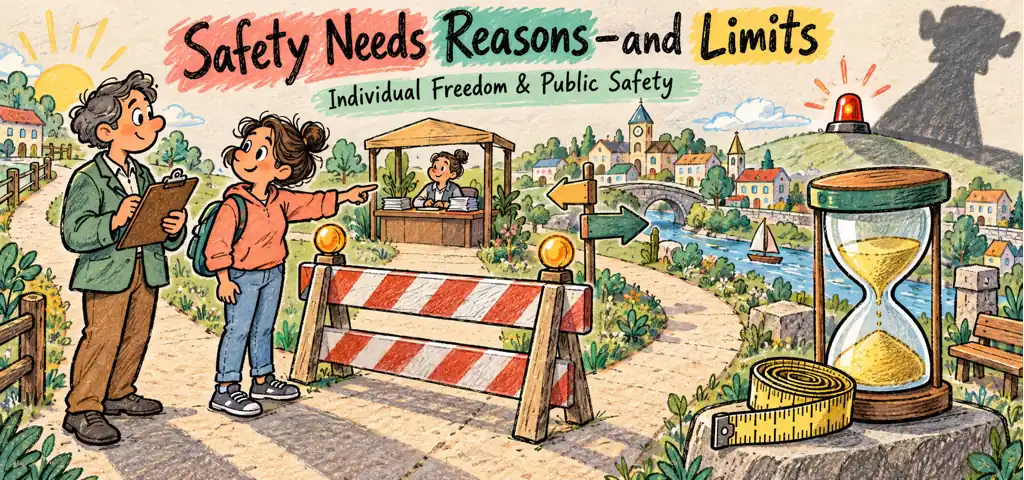
States possess broad police powers to protect health and safety, but the label “public safety” does not answer a constitutional claim. Begin with the government measure and the liberty it burdens. Isolation can restrict physical movement. Compulsory treatment can implicate bodily integrity. A closure order may affect property or expression. The source and test change with the right. A court therefore asks about legal authority, evidence, scope, duration, exceptions, and the procedure available to challenge an erroneous decision.
Emergencies can strengthen the government’s interest and change what is practical. Officials may need to act before a full hearing when delay would create immediate danger, provided prompt and meaningful review follows when the Constitution requires it. Temporary action based on current individualized evidence differs from indefinite confinement maintained after the factual basis has disappeared. A rule tied to actual exposure differs from one aimed at a disfavored group without evidence that group creates the asserted risk. Context affects the analysis. It does not erase it.
Balancing Individual Freedom and Public Safety in practice
Substance and procedure can fail separately. An isolation order issued with no notice or opportunity for review may create a procedural defect. An order that continues indefinitely without current medical justification can also impose an unjustified substantive burden. Better procedure would reduce factual error, but it would not automatically supply evidence or statutory authority that the government lacks. Remedies should match the problem: a prompt hearing, updated findings, narrower conditions, release, or invalidation of an unlawful rule may be appropriate depending on the claim.
Balancing Individual Freedom and Public Safety: where the analysis gets complicated
for a practice scenario, resist both absolute answers. “Safety always wins” treats emergency authority as a blank check. “Liberty always wins” ignores government’s responsibility to prevent serious harm. Identify the actor, source, precise liberty, factual basis, duration, fit, and safeguards. Then determine whether the objection concerns how officials reached the decision, whether they may impose it at all, or both. The analysis is disciplined constitutional reasoning, not free-form balancing of whatever values sound important.
A concrete scenario for balancing individual freedom and public safety
Imagine a dispute about balancing individual freedom and public safety and decide which institution acts first, along with the legal or political constraint that shapes the outcome.
Video lesson: Balancing Individual Freedom and Public Safety
Heimler's History gives a focused explanation of this topic in Individual FREEDOM vs. PUBLIC SAFETY: 2nd, 4th, 8th Amendments.
If the player does not load, watch this lesson directly on YouTube.
Connect this lesson to the larger course
For a broader map connecting balancing individual freedom and public safety to civil liberties, civil rights, and equal protection, use the AP U.S. Government and Politics learning hub.

Related to This Article
More math articles
- Reading and Interpreting Line Plots for 4th Grade
- The Best Grade 7 Math Book for Rhode Island Students
- How to Read and Interpret Graphs: Bar, Line, Pie & Scatter
- Circle Area & Circumference Practice (Free)
- The Best Grade 6 ELA Practice Tests for Indiana Students
- How to Use Strip Models to Identify Equivalent Expressions?
- CLEP U.S. History I 081: Mexican-American War and the Treaty of Guadalupe Hidalgo
- Overview of the ISEE Middle-Level Mathematics Test
- How to Graph Solutions to One-step and Two-step Linear Inequalities
- Alaska AK STAR Grade 7 Math Worksheets: 95 Printable PDFs with Worked Examples & Answer Keys






















What people say about "Balancing Individual Freedom and Public Safety"?
No one replied yet.