YOUR ATI TEAS 7 STUDY COMPANION
ATI TEAS 7 Math FREE Sample Practice Questions
ATI TEAS 7 Math FREE Sample Practice Questions: work through realistic questions in the same format and difficulty as the real test, then check every answer against a full step-by-step solution so you can see where you lost marks and what to review next.
ATI TEAS 7 Math FREE Sample Practice Questions: work through realistic questions in the same format and difficulty as the real test, then check every answer against a full step-by-step solution so you can see where you lost marks and what to review next.
3- B
(C = frac{5}{9} (F -32))
(C = frac{5}{9} (104 -32)=40)
4- D
(frac{35}{100} × 20 = 7)
5- B
(13% +15% = 28%)
6- B
({20, 17, 14, 11, 8})
7- C
(22%) of (x = 20.42)
(x =frac{22}{100} x = 20.42)
(x = frac{22 × 20.42}{100}cong 92.82)
8- C
(frac{1}{3}+frac{2}{5}+frac{1}{2}=)
(frac{10+12+15}{30}=frac{37}{30}=1.23)
9- C
(864.56 – 631.08 = 233.48)
10- D
A. (frac{38}{4} = 9.5)
B. (frac{46}{4} = 11.5)
C.( frac{85}{4} = 21.25)
D. (frac{104}{4} = 26)
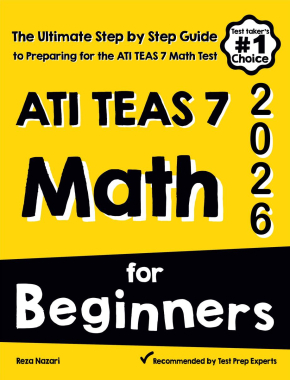
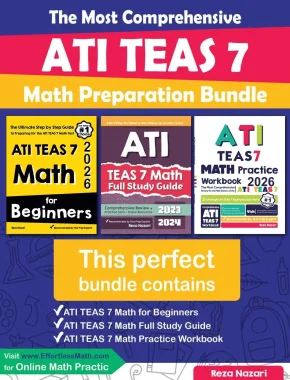
Looking for the best resource to help you succeed on the ATI TEAS 7 Math test?
The Best Books to Ace the ATI TEAS 7 Math Test
Introduction to ATI TEAS 6 Math Format and Structure
The ATI TEAS 6 (Test of Essential Academic Skills) is a comprehensive assessment required for nursing and health science programs. The math section tests your quantitative reasoning and problem-solving abilities in clinical contexts. Understanding the test structure and format helps you prepare efficiently. The TEAS 6 math section includes approximately 36 questions and you will have roughly 54 minutes.
Key Math Topics on TEAS 6
The TEAS 6 math section covers numbers and operations (percentages, decimals, fractions, ratios), measurements and data (basic statistics, interpreting data), and algebraic thinking (solving equations, word problems). Unlike standardized college entrance exams, TEAS 6 emphasizes practical applications relevant to healthcare settings. Calculations involving medication dosages, unit conversions, and interpreting numerical data appear frequently.
Sample Problem 1: Percentage Calculations in Healthcare
Question: A nurse administers 250 mg of medication. If this represents 50 percent of the daily dose, what is the total daily dose? Solution: If 250 mg is 50 percent of the total, then the total = 250 divided by 0.50 = 500 mg. The strategy for this type of problem is to identify the percentage relationship and work backward to find the whole.
Sample Problem 2: Unit Conversion
Question: Convert 1.5 liters to milliliters. Solution: 1 liter = 1,000 mL. Therefore, 1.5 liters = 1.5 times 1,000 = 1,500 mL. TEAS questions frequently include metric conversions, which are essential in healthcare settings.
Sample Problem 3: Ratio and Proportion
Question: A recipe calls for 2 parts medication A to 3 parts medication B. If you need 10 parts of medication A, how many parts of medication B do you need? Solution: Set up the proportion: 2/3 = 10/x. Cross multiply: 2x = 30, so x = 15. This demonstrates the proportional thinking essential in healthcare calculations.
Sample Problem 4: Interpreting Data
Question: A patient has body temperature measurements over four hours: 101.2 degrees F, 101.5 degrees F, 101.0 degrees F, 101.8 degrees F. What is the mean temperature? Solution: Sum = 101.2 + 101.5 + 101.0 + 101.8 = 405.5. Mean = 405.5 divided by 4 = 101.375, which rounds to 101.4 degrees F. TEAS questions require careful calculation and appropriate rounding.
Sample Problem 5: Solving Equations with Decimals
Question: If 0.5x + 3 = 8, what is x? Solution: Subtract 3: 0.5x = 5. Divide by 0.5: x = 10. Decimal manipulation is common on TEAS, especially in medication calculations.
Sample Problem 6: Word Problem with Practical Application
Question: A hospital supply order costs 450 dollars and includes a 10 percent discount. What is the final cost after the discount? Solution: Discount = 0.10 times 450 dollars = 45 dollars. Final cost = 450 dollars – 45 dollars = 405 dollars. TEAS often includes practical business math relevant to healthcare administration.
Sample Problem 7: Fractions with Medical Context
Question: If a patient receives 1/4 of a prescribed medication dose three times daily, what fraction of the total daily dose does the patient receive? Solution: Three doses of 1/4 each: 3 times (1/4) = 3/4 of the daily dose. This type of problem combines fraction multiplication with practical healthcare application.
TEAS 6 Study Strategies
Focus on accuracy over speed. Each question counts equally, so spending extra seconds to verify your calculation is worthwhile. Use the calculator provided for complex calculations, but practice mental math for simple operations. Estimate answers before calculating. For word problems, identify what you know and what you need to find before setting up your solution.
Practice calculations with decimals and percentages frequently. Review metric conversions thoroughly. Work on time management by completing practice sections under timed conditions. Remember that TEAS 6 is cumulative; problems often combine multiple concepts.
Common Pitfalls to Avoid
Do not round intermediate calculations; carry decimals through and round only your final answer. Do not confuse percentage increase and percentage of a whole. With decimals, be careful with placement of the decimal point, especially in multiplication and division. When converting units, write out the conversion factor to visualize whether you should multiply or divide.
Confidence Building Through Practice
Work through sample problems systematically, starting with easier questions and progressing to more complex ones. After solving each problem, verify your answer by substituting back into the original problem or recalculating using an alternative method. Keep a list of problem types you find challenging. Remember that improvement comes from deliberate practice and learning from mistakes.
Additional Resources
Review the ATI TEAS 6 formula cheat sheet to ensure you know all necessary formulas and conversions. Explore specific topics through focused study materials. Take full-length practice tests under timed conditions.
Introduction to ATI TEAS 6 Math Format and Structure
The ATI TEAS 6 (Test of Essential Academic Skills) is a comprehensive assessment required for nursing and health science programs. The math section tests your quantitative reasoning and problem-solving abilities in clinical contexts. Understanding the test structure and format helps you prepare efficiently. The TEAS 6 math section includes approximately 36 questions and you will have roughly 54 minutes.
Key Math Topics on TEAS 6
The TEAS 6 math section covers numbers and operations (percentages, decimals, fractions, ratios), measurements and data (basic statistics, interpreting data), and algebraic thinking (solving equations, word problems). Unlike standardized college entrance exams, TEAS 6 emphasizes practical applications relevant to healthcare settings. Calculations involving medication dosages, unit conversions, and interpreting numerical data appear frequently.
Sample Problem 1: Percentage Calculations in Healthcare
Question: A nurse administers 250 mg of medication. If this represents 50 percent of the daily dose, what is the total daily dose? Solution: If 250 mg is 50 percent of the total, then the total = 250 divided by 0.50 = 500 mg. The strategy for this type of problem is to identify the percentage relationship and work backward to find the whole.
Sample Problem 2: Unit Conversion
Question: Convert 1.5 liters to milliliters. Solution: 1 liter = 1,000 mL. Therefore, 1.5 liters = 1.5 times 1,000 = 1,500 mL. TEAS questions frequently include metric conversions, which are essential in healthcare settings.
Sample Problem 3: Ratio and Proportion
Question: A recipe calls for 2 parts medication A to 3 parts medication B. If you need 10 parts of medication A, how many parts of medication B do you need? Solution: Set up the proportion: 2/3 = 10/x. Cross multiply: 2x = 30, so x = 15. This demonstrates the proportional thinking essential in healthcare calculations.
Sample Problem 4: Interpreting Data
Question: A patient has body temperature measurements over four hours: 101.2 degrees F, 101.5 degrees F, 101.0 degrees F, 101.8 degrees F. What is the mean temperature? Solution: Sum = 101.2 + 101.5 + 101.0 + 101.8 = 405.5. Mean = 405.5 divided by 4 = 101.375, which rounds to 101.4 degrees F. TEAS questions require careful calculation and appropriate rounding.
Sample Problem 5: Solving Equations with Decimals
Question: If 0.5x + 3 = 8, what is x? Solution: Subtract 3: 0.5x = 5. Divide by 0.5: x = 10. Decimal manipulation is common on TEAS, especially in medication calculations.
Sample Problem 6: Word Problem with Practical Application
Question: A hospital supply order costs 450 dollars and includes a 10 percent discount. What is the final cost after the discount? Solution: Discount = 0.10 times 450 dollars = 45 dollars. Final cost = 450 dollars – 45 dollars = 405 dollars. TEAS often includes practical business math relevant to healthcare administration.
Sample Problem 7: Fractions with Medical Context
Question: If a patient receives 1/4 of a prescribed medication dose three times daily, what fraction of the total daily dose does the patient receive? Solution: Three doses of 1/4 each: 3 times (1/4) = 3/4 of the daily dose. This type of problem combines fraction multiplication with practical healthcare application.
TEAS 6 Study Strategies
Focus on accuracy over speed. Each question counts equally, so spending extra seconds to verify your calculation is worthwhile. Use the calculator provided for complex calculations, but practice mental math for simple operations. Estimate answers before calculating. For word problems, identify what you know and what you need to find before setting up your solution.
Practice calculations with decimals and percentages frequently. Review metric conversions thoroughly. Work on time management by completing practice sections under timed conditions. Remember that TEAS 6 is cumulative; problems often combine multiple concepts.
Common Pitfalls to Avoid
Do not round intermediate calculations; carry decimals through and round only your final answer. Do not confuse percentage increase and percentage of a whole. With decimals, be careful with placement of the decimal point, especially in multiplication and division. When converting units, write out the conversion factor to visualize whether you should multiply or divide.
Confidence Building Through Practice
Work through sample problems systematically, starting with easier questions and progressing to more complex ones. After solving each problem, verify your answer by substituting back into the original problem or recalculating using an alternative method. Keep a list of problem types you find challenging. Remember that improvement comes from deliberate practice and learning from mistakes.
Additional Resources
Review the ATI TEAS 6 formula cheat sheet to ensure you know all necessary formulas and conversions. Explore specific topics through focused study materials. Take full-length practice tests under timed conditions.
Official source: the ATI TEAS exam format, the number of questions in each section and the time allowed are published by ATI, the organization that writes and administers the test, at atitesting.com/teas.

Related to This Article
More math articles
- The Best Grade 3 ELA Practice Tests for Maine Students
- Colorado CMAS Grade 4 Math Free Worksheets: Printable Grade 4 Math Practice with Full Solutions
- How to Solve and Graph One-Step Inequalities with Rational Numbers?
- 5th Grade FSA Math Worksheets: FREE & Printable
- Donating money
- What’s A Good ACT Score?
- A Step into The World of Calculus: Rules of Differentiation
- Full-Length ISEE Lower Level Math Practice Test
- Difference Quotient Calculator (Free)
- How to Write and Solve Direct Variation Equations











What people say about "ATI TEAS 7 Math Free Sample Questions"?
No one replied yet.