Due Process and the Constitutional Right to Privacy
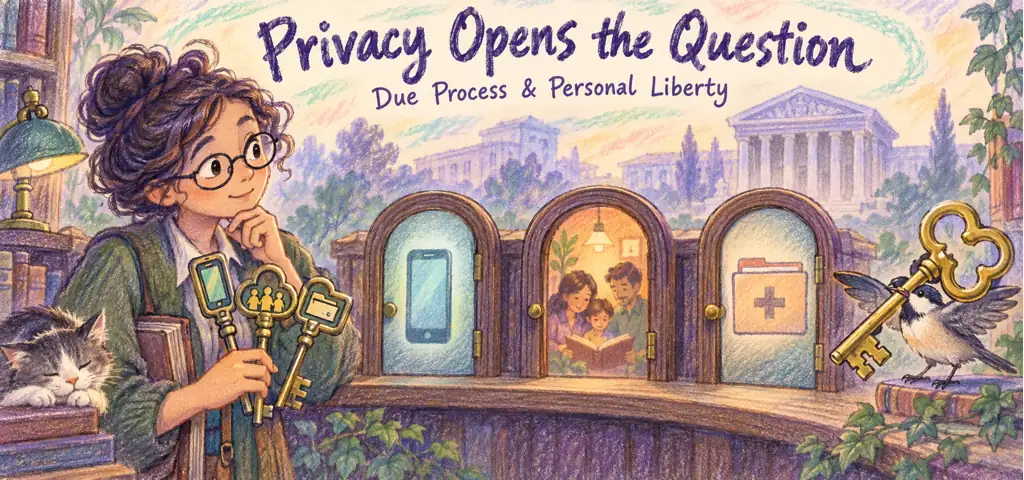
The Constitution does not contain one clause labeled “right to privacy.” Instead, several provisions protect different interests that people commonly call private. The Fourth Amendment limits government searches. The First Amendment can protect private association. And the Due Process Clauses protect certain personal decisions from unjustified government interference. Equal protection may matter when government distributes access to a protected choice unequally. A careful answer names the actor, the interest, and the doctrinal source rather than treating privacy as an unlimited general right.
Decisional privacy developed through cases involving contraception, marriage, family relationships, and intimate life. In Griswold v. Connecticut, the Court invalidated a ban on contraceptive use by married couples. Later decisions connected personal decision making more directly to Fourteenth Amendment liberty. Those precedents do not create one test for every personal choice. Marriage, parental direction, private consensual intimacy, and abortion have distinct holdings and histories, and current law must be read case by case.
The governing rule for due process and the constitutional right to privacy
Protection of a personal decision does not mean government can never regulate around it. Courts first define the asserted liberty, then determine whether current precedent protects it, and finally apply the appropriate review. Framing matters: “the freedom to choose” is too broad to identify the relevant history or rule. A description crafted so narrowly that no earlier case could match it can be misleading in the other direction. The legally useful level identifies the concrete practice, relationship, government burden, and source of protection.
Due Process and the Constitutional Right to Privacy: the legal or political boundary
Police obtain data from a private phone: the Fourth Amendment search framework is central. a state dictates which language fit parents may teach their children: family liberty under due process is more relevant. a legislature creates medical-confidentiality rules: the statute may protect information even when no federal constitutional claim exists. Informational privacy, freedom from search, and liberty to make a personal decision reflect related values, but they are not interchangeable legal tests. “Privacy” should open the inquiry, never end it.
Reason through an example of due process and the constitutional right to privacy
Contrast the historical Roe and Casey rule with the current federal baseline after Dobbs. Then separate that substantive question from a complaint about unfair procedures.
Check your reasoning
The Constitution does not use the word privacy as a single broad guarantee, but Supreme Court doctrine has protected certain intimate decisions through liberty and other provisions. The scope of that protection has changed across cases. Roe and Casey recognized federal constitutional protection for abortion, but Dobbs overruled those decisions and held that the Constitution does not confer a right to abortion.
Video lesson: Due Process and the Constitutional Right to Privacy
Khan Academy gives a focused explanation of this topic in Due process and the right to privacy | AP US Government & Politics | Khan Academy.
If the player does not load, watch this lesson directly on YouTube.
Connect this lesson to the larger course
For a broader map connecting due process and the constitutional right to privacy to civil liberties, civil rights, and equal protection, use the AP U.S. Government and Politics learning hub.

Related to This Article
More math articles
- Identifying patterns in turnout and party support
- How to Multiply and Divide Integers? (+FREE Worksheet!)
- Beating Baccarat: What a Million-Hand Simulation Actually Shows
- Secularization, Religious Change, and Civil Religion
- Popular vote versus electoral vote
- Use a four-step process for a single shift
- South Dakota Smarter Balanced Grade 7 Math Worksheets: 95 Free Printable PDFs
- Modern Environmentalism, the EPA, and the Regulatory State
- Top 10 Free Websites for ISEE Math Preparation
- 10 Most Common 7th Grade Common Core Math Questions





















What people say about "Due Process and the Right to Privacy"?
No one replied yet.