How to Divide Polynomials Using Long Division?

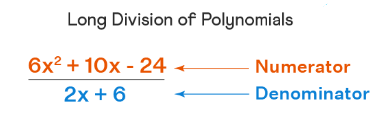
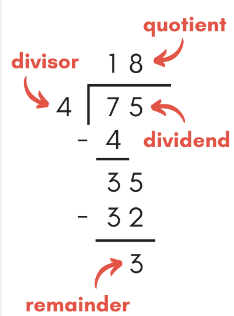
The following are the steps for the long division of polynomials:
Tutor-style math help
Divide Polynomials Using Long Division: what to notice and how to work it
Polynomials skill
Polynomial problems reward structure. Before expanding, look for degree, leading term, common factors, and familiar products.
What to notice first
Put the polynomial in standard form when possible. The leading term tells end behavior, and factors reveal zeros.
Common student mistake
Do not cancel or combine unlike terms. (x^2), (x), and constants are different kinds of terms.
Key formulas and cues
(a^2-b^2=(a-b)(a+b))
((a+b)^2=a^2+2ab+b^2)
(P(c)=0Rightarrow (x-c)text{ is a factor})
A reliable path
- Organize by degreeWrite terms from highest power to lowest power.
- Look for structureTry GCF, special products, grouping, or division depending on the expression.
- Check with featuresZeros, multiplicity, and end behavior should agree with your algebra.
Worked examples
Combine like terms
Example: (3x^2+5x-x^2+2x)
- Group x squared terms.
- Group x terms.
- Combine each group.
Answer: (2x^2+7x)
Factor a difference of squares
Example: (x^2-25)
- Recognize a squared term minus a squared term.
- Use a^2 – b^2.
- Write conjugate factors.
Answer: ((x-5)(x+5))
Try one before moving on
Try: Factor (x^2+7x+12).
Answer: ((x+3)(x+4)).
Next step: do the matching worksheet or quiz while the method is still fresh, then come back and explain the first step in your own words.
x
Divide Polynomials Using Long Division: pop-up practice
Answer these quick questions, then use the feedback to decide which part of the lesson to review.
Choose an answer to begin.
1. (2x+3x=)
2. (x^2-16=)
3. The degree comes from the:
- Step 1. Sort the terms in decreasing order of their indices (if needed). Write the missing terms with a coefficient of zero.
- Step 2. For the first term of the quotient, divide the first term of the dividend by the first term of the divisor.
- Step 3. Multiply this quotient statement by the divisor to get the product.
- Step 4. Subtract this product from the dividend and drop the next term (if any). The difference and the brought-down term will form the new dividend.
- Step 5. Follow this process until you get a remainder, which can be zero or an index less than the divisor.

Original price was: $109.99.$54.99Current price is: $54.99.

Original price was: $109.99.$54.99Current price is: $54.99.

Related to This Article
More math articles
- Take GED Test Online for Free
- Full-Length 6th Grade GMAS Math Practice Test-Answers and Explanations
- The Best School Supplies for Learning Math
- Top 10 4th Grade ACT Aspire Math Practice Questions
- The Best Grade 4 ELA Practice Tests for Vermont Students
- 5 Tips on How to Score Higher on SAT Math
- Digital Platforms: Revolutionizing Math Education
- Wilmot Proviso and Free-Soil Politics: Expansion, Labor and Policy
- Fifth Amendment
- Front-Loading
What people say about "Divide Polynomials Using Long Division"?
No one replied yet.