How to Find the Volume of Cones and Pyramids? (+FREE Worksheet!)

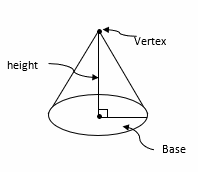
Volume of Cones: \(\frac{1}{3}\)\(\times\)area of base\(\times\)height
Type the problems from this lesson and check each step.
This relation, based on mathematical symbols, will be as follows:
\(V=\frac{1}{3}\times B\times h=\frac{1}{3}πr^2h\)
Note that in the above relation, \(V\) is the symbol of volume, \(r\) and \(h\) represent the radius of the cone and its height.
A pyramid is a three-dimensional geometric figure that has a polygon base and triangular faces pointed towards the top point, called the vertex. The height of a pyramid is a line that is from the top of the pyramid to its base and is perpendicular to the surface of the base.
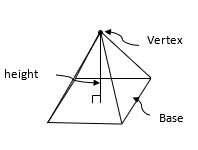
To calculate the volume of a pyramid, we must first find the area of the base surface and then multiply it by its height. Divide the resulting value by 3, and finally, the volume of the pyramid is obtained. Therefore, the formula for calculating the volume of the pyramid will be as follows:
Volume of a pyramid: \(\frac{1}{3}\)\(\times\)area of base\(\times\)height
The above formula is based on mathematical symbols as follows:
\(V=\frac{1}{3}\times B\times h\)
Note that the above formula \(V\) symbolizes the volume of the pyramid, \(b\) is the area of the base surface, and \(h\) is the height of the pyramid.
Finding Volume of Cones and Pyramids, Example 1:

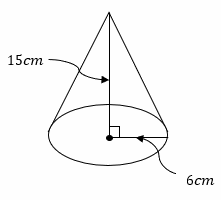
Find the volume of the following cone. \((π=3.14)\)
Solution:
Use the formula for the volume of cones\(=\frac{1}{3}πr^2h\)
Substitute \(6\) for \(r\) and \(15\) for \(h\):
\(=\frac{1}{3}πr^2h=\)\(\frac{1}{3} \times 3.14 \times (6)^2 \times (15)=565.2 {cm}^3\)
Finding Volume of Cones and Pyramids, Example 2:
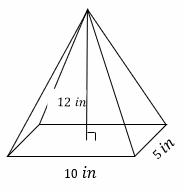
Find the volume of the pyramid.
Solution:
The volume of a pyramid\(=\frac{1}{3}\times B\times h\)
\(B=10\times 5=50\)
Substitute \(50\) for \(B\) and \(12\) for \(h\):
\(=\frac{1}{3}\times B\times h=\frac{1}{3}\times 50\times 12=200 {in}^3\)
Finding Volume of Cones and Pyramids, Example 3:
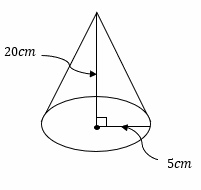
Find the volume of the following cone. \((π=3.14)\)
Solution:
Use the formula for the volume of cones\(=\frac{1}{3}πr^2h\)
Substitute \(5\) for \(r\) and \(20\) for \(h\):
\(=\frac{1}{3}πr^2h=\)\(\frac{1}{3} \times 3.14 \times (5)^2 \times (20)=523.33 {cm}^3\)
Finding Volume of Cones and Pyramids, Example 4:
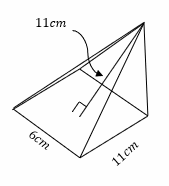
Find the volume of the pyramid.
Solution:
The volume of a pyramid\(=\frac{1}{3}\times B\times h\)
\(B=6\times 11=66\)
Substitute \(66\) for \(B\) and \(11\) for \(h\):
\(=\frac{1}{3}\times B\times h=\frac{1}{3}\times 66\times 11=242 {cm}^3\)
Exercises for Volume of Cones and Pyramids
Try these 10 questions one at a time. After each answer you will see a step-by-step explanation, so you can learn from every question, right or wrong.
Question 1 of 10
1. What is the volume formula for a cone?
- V = (1/3)πr²h
- V = πr²h
- V = (4/3)πr³
- V = 2πrh
Show the answer and explanation
Answer: A. V = (1/3)πr²h
A cone has one third the volume of a cylinder with the same base and height.
Cylinder: πr²h, so cone: (1/3)πr²h.
The same one-third rule applies to pyramids: V = (1/3) × base area × height.
2. A cone has radius 3 and height 4. What is its exact volume? Write the number in front of π.
Type your answer.
Show the answer and explanation
Answer: 12π
V = (1/3)π × 3² × 4.
= (1/3)π × 36.
= 12π cubic units. Leaving π as a symbol keeps the answer exact.
3. A square pyramid has base edge 6 and height 5. What is its volume?
- 60
- 180
- 30
- 90
Show the answer and explanation
Answer: A. 60
Base area = 6 × 6 = 36.
V = (1/3) × 36 × 5 = 12 × 5.
= 60 cubic units. Choice B forgets the ⅓.
4. A rectangular pyramid has base 4 by 9 and height 10. What is its volume?
Type your answer.
Show the answer and explanation
Answer: 120
Base area = 4 × 9 = 36.
V = (1/3) × 36 × 10.
= 12 × 10 = 120 cubic units. The base of a pyramid can be any shape; you just need its area.
5. A cone has radius 2 cm and height 9 cm. Using π ≈ 3.14, what is its volume?
- 37.68 cm³
- 113.04 cm³
- 18.84 cm³
- 56.52 cm³
Show the answer and explanation
Answer: A. 37.68 cm³
V = (1/3) × 3.14 × 2² × 9.
2² × 9 = 36, and 36 ÷ 3 = 12.
3.14 × 12 = 37.68 cm³. Dividing by 3 before multiplying by π made the numbers easier.
6. A cone has volume 50π and radius 5. What is its height?
Type your answer.
Show the answer and explanation
Answer: 6
(1/3)π(25)h = 50π. Divide by π: (25/3)h = 50.
Multiply by 3: 25h = 150.
h = 6. Check: (1/3) × 25 × 6 = 50.
7. A cylinder holds 90 cm³. A cone with the same radius and height holds…
- 30 cm³
- 45 cm³
- 90 cm³
- 270 cm³
Show the answer and explanation
Answer: A. 30 cm³
A cone holds one third of the matching cylinder.
90 ÷ 3 = 30.
So the cone holds 30 cm³.
8. A triangular pyramid has a base area of 15 cm² and a height of 8 cm. What is its volume in cm³?
Type your answer.
Show the answer and explanation
Answer: 40 cm³
Any pyramid: V = (1/3) × base area × height.
(1/3) × 15 × 8 = 5 × 8.
= 40 cm³. The shape of the base does not change the one-third rule.
9. If you double the height of a cone but keep the radius, the volume…
- doubles
- quadruples
- stays the same
- is multiplied by 8
Show the answer and explanation
Answer: A. doubles
V = (1/3)πr²h depends on h to the first power.
Doubling h doubles V.
Doubling r instead would multiply V by 4.
10. A square pyramid has volume 48 and height 4. What is the length of one base edge?
Type your answer.
Show the answer and explanation
Answer: 6
48 = (1/3) × base area × 4, so base area = 48 × 3 ÷ 4 = 36.
The base is a square, so edge × edge = 36.
The edge is 6.

Related to This Article
More math articles
- How to Divide Polynomials Using Synthetic Division?
- How to Classify Polygons: A Step-by-Step Guide to Shape Identification
- 7th Grade Math Worksheets for Ohio (OST): 95 Free Printable PDFs
- Sequence and Chronology
- 45 Minute Timer
- Voter Turnout: Who Votes, Why and How to Measure It
- The Best Grade 5 ELA Practice Tests for Wyoming Students
- What Is e in Math? Euler’s Number 2.718 Explained
- 7th Grade ISASP Math Worksheets: FREE & Printable
- Civic duty

What people say about "How to Find the Volume of Cones and Pyramids"?
No one replied yet.