CLEP U.S. History I 022: Rival Empires, Native Diplomacy, and the Ohio Valley
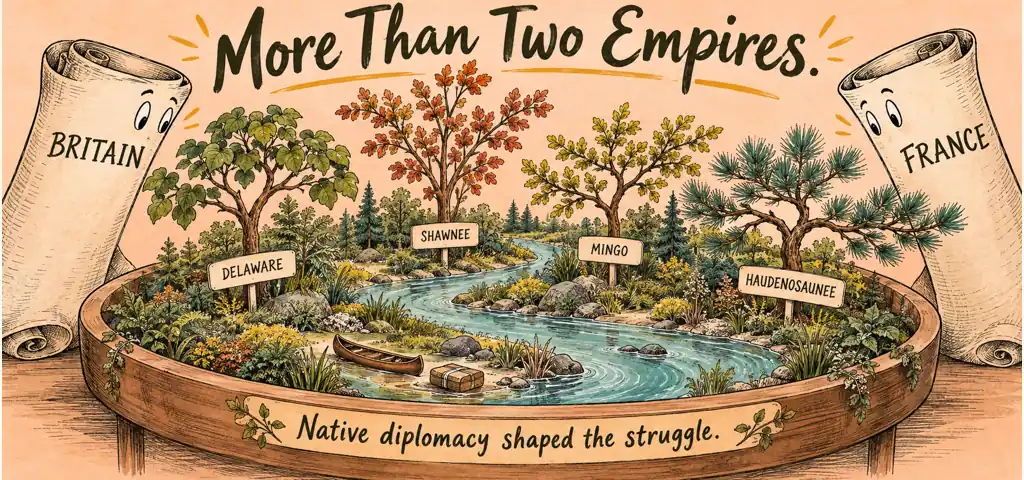
Lesson 5.1 of Chapter 5 of the U.S. History to 1877 study guide on Effortless Math covers CLEP U.S. History I 022: Rival Empires, Native Diplomacy, and the Ohio Valley: the key terms, the core ideas, and worked examples showing how this topic is tested on the exam.
U.S. History to 1877 | Chapter 5 | Lesson 5.1
The Ohio Valley was not empty ground between Britain and France. Native nations lived, hunted, traded, and negotiated there. Haudenosaunee diplomats claimed influence, while Delaware, Shawnee, Mingo, and other communities pursued their own security. France linked Canada and Louisiana through forts and waterways. British land companies and settlers pressed west from the seaboard. The resulting conflict was multipolar.
In 1754, a young George Washington led Virginia forces into the region. At Jumonville Glen, Washington’s party and Native warriors led by Tanaghrisson struck a French detachment. Exactly how the wounded Jumonville died and whether the French party was diplomatic, military, or both remain contested. Washington later surrendered at Fort Necessity. The fighting widened into the French and Indian War, the North American theater of the Seven Years’ War. Early French success depended on forts, Native allies, and familiarity with interior routes. Britain eventually committed more troops and resources under William Pitt, captured Quebec in 1759, and defeated France in North America.
The Albany Congress of 1754 attempted to coordinate colonial defense and relations with the Haudenosaunee. Benjamin Franklin’s proposed Albany Plan of Union failed because colonial assemblies and imperial officials guarded their authority. Its failure shows that shared danger did not yet produce durable political union.
Native nations made strategic alliance choices. They were not auxiliary troops without goals. Some hoped to balance empires and restrain settlers. Britain’s victory removed France as a continental counterweight, leaving Native communities more exposed to Anglo-American expansion. Pontiac’s War in 1763, a broad resistance involving multiple Native groups, demonstrated that the Treaty of Paris between European powers did not settle sovereignty on the ground.
See the history take shape
Heimler's History offers a visual route through this topic. As you watch, compare its explanation with the source limits in the written lesson.
Video: The French and Indian War (Seven Years' War), Explained [APUSH Review], Heimler's History.
Check your understanding
- Rivalry in the Ohio Valley centered on
- only the boundary between Spanish and British mission districts
- competition over coastal manufacturing centers
- imperial claims, Native sovereignty, trade, and settlement
- a vacant interior without established communities
- a dispute confined to European treaty law
- The Albany Plan failed mainly because
- colonial assemblies feared losing local power while British officials distrusted a union with substantial colonial control
- colonial assemblies approved the plan but royal governors prevented them from recording ratification votes
- delegates gave Haudenosaunee representatives final authority over taxation by the proposed Grand Council
- the plan required colonists to elect the president-general instead of allowing Crown appointment
- Parliament replaced the proposal by granting the colonies voting representatives in the House of Commons
- Select all that apply. Native alliances could provide
- intelligence
- fighters
- trade routes
- automatic acceptance of settler claims
- diplomatic influence
- Explain why Britain’s defeat of France could threaten Native nations.
Write a brief response using a named fact from the lesson.
Open the answers and reasoning
Independent preparation. CLEP is a registered trademark of the College Board, which does not endorse this lesson.

Related to This Article
More math articles
- Introduction to Matrix Inverse
- How to Master the Intricacies of the Coordinate Plane
- The Best Grade 5 Math Book for Utah Students
- Top 10 Tips to ACE the Praxis Core Math Test
- 4th Grade NYSE Math FREE Sample Practice Questions
- Sweepstakes Casinos Decoded: Gold Coins, Sweeps Coins, and Real Probability
- Binomial Probability Calculator — P(X = k) & Cumulative (Free)
- ACT Math- Test Day Tips
- Top 10 Tips to Create a HiSET Math Study Plan
- District courts












What people say about "Rival Empires and the Ohio Valley"?
No one replied yet.