CLEP U.S. History I 024: Sugar and Stamp Acts and Constitutional Protest
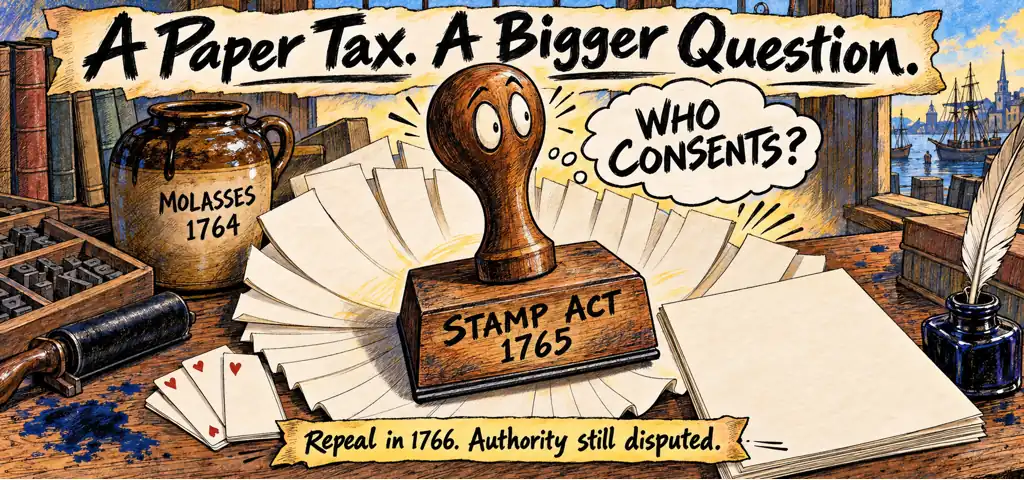
Lesson 5.3 of Chapter 5 of the U.S. History to 1877 study guide on Effortless Math covers CLEP U.S. History I 024: Sugar and Stamp Acts and Constitutional Protest: the key terms, the core ideas, and worked examples showing how this topic is tested on the exam.
U.S. History to 1877 | Chapter 5 | Lesson 5.3
The Sugar Act of 1764 revised duties on molasses and strengthened customs enforcement. It aimed to collect revenue more effectively, including through vice-admiralty courts without colonial juries. Merchants objected to enforcement and economic burden, but the Stamp Act of 1765 reached a much wider public. It required paid stamps on newspapers, legal documents, licenses, playing cards, and other paper. Because it was an internal tax visibly encountered in daily business, it provoked a coordinated backlash.
Colonists argued that taxes required consent through their own elected representatives. Parliament answered with “virtual representation”: members represented the whole empire, their local voters. Colonists did not generally deny Parliament’s authority over imperial trade at first. Many distinguished external regulation from internal revenue. The distinction became harder to maintain as Britain insisted on parliamentary supremacy.
Resistance operated at several levels. Colonial assemblies passed resolves. The Stamp Act Congress petitioned the crown and Parliament. Merchants organized nonimportation. Crowds associated with the Sons of Liberty intimidated stamp distributors, destroyed property, and made the act nearly impossible to enforce. Artisans and laborers thereby entered constitutional politics, though elite writers did not always welcome their methods.
Parliament repealed the Stamp Act in 1766 after commercial pressure and enforcement failure, but passed the Declaratory Act asserting power to legislate for the colonies “in all cases whatsoever.” Each side could claim a partial victory: colonists had defeated the tax. Parliament had restated sovereignty. The underlying constitutional question remained unresolved.
Watch the topic in context
This Mr. Chet Laubach lesson supplies a second explanation of the same period. Note where chronology, cause, and perspective connect.
Video: Mr. L APUSH – The Stamp Act (Lead up to RW part 1), Mr. Chet Laubach.
Check your understanding
- “Virtual representation” was Parliament’s claim that
- a member represented only the voters of the borough that elected him
- colonial assemblies selected American members of the House of Commons
- the House of Lords represented the colonies collectively on questions of taxation
- members of Parliament represented all British subjects, including nonvoters and colonists
- colonial agents in London exercised voting rights when Parliament considered American revenue
- The Declaratory Act
- recognized exclusive colonial authority over taxation
- asserted parliamentary authority after repeal
- repealed Parliament’s power to regulate trade
- limited future laws to external customs duties
- accepted the Stamp Act Congress as an imperial legislature
- Select all that apply. Stamp resistance included
- petitions
- nonimportation
- crowd action
- a congress
- immediate declaration of independence
- Explain how ordinary crowd action and elite constitutional argument reinforced one another.
Write a brief response using a named fact from the lesson.
Open the answers and reasoning
Independent preparation. CLEP is a registered trademark of the College Board, which does not endorse this lesson.

Related to This Article
More math articles
- Utah Algebra 1 Free Worksheets: Printable Algebra 1 Practice, Answers Included
- A Comprehensive Collection of Free TSI Math Practice Tests
- The Best Grade 4 ELA Practice Tests for New Hampshire Students
- Population, Urbanization, and the Environment
- Private Maths Tutoring: A Personalized Approach to Learning
- Work, Pay, and Occupational Segregation
- What Are Functions in Math? A Plain-English Guide
- Top 10 Tips You MUST Know to Retake the CHSPE Math
- The Ultimate MTTC Mathematics (Elementary) (089) Course (+FREE Worksheets & Tests)
- The Best Grade 2 English Worksheets for Illinois Kids










What people say about "The Sugar and Stamp Acts and Constitutional Protest"?
No one replied yet.