Free Grade 7 English Worksheets for Indiana Students

A seventh grader in Lafayette comes home from school with a paper-thin Chromebook under one arm and a YouTube video playing in his ear from the moment the front door closes. Two minutes in, a comments section is open in a second tab. Three minutes later there is an ad embedded inside a news clip that looks like a news clip. By the time he opens an actual reading assignment for English, he has already evaluated twenty pieces of media in twenty minutes, most of them without realizing he was doing it. Indiana’s Grade 7 ELA standards include a full Media Literacy strand, and that strand is asking the same thing of him in class that the after-school feed is asking of him at home, figure out who made this, what they want you to do, and how they are trying to make you do it.
The rest of Indiana Grade 7 ELA does the familiar middle-grade thing, but with more bite than Grade 6 had. Inference now requires several pieces of evidence stitched together, not one quote dropped at the end. Argument writing now requires a counterclaim. Vocabulary work expects allusions caught in context. Grammar starts counting dangling modifiers and the new compound-complex sentence structure. The Indiana Academic Standards for English/Language Arts at Grade 7 are very clear about all of it.
This page collects forty-three free printable worksheets, every one aligned to one Indiana Grade 7 ELA standard, every one printable at home without a signup, a paywall, or an email collected at the door.
What’s on this page
Every worksheet uses a three-page shape. A Quick Review on page one in language a seventh grader can read on their own. Practice items in the middle that mirror the kinds of questions ILEARN’s computer-adaptive system actually delivers. A student-facing answer key at the end that walks through the why behind the correct choice and explains how the wrong choices were designed to be tempting.
Print the ones that line up with this week’s classroom focus. Save the rest for the long evenings.
Reading: Literature
- Citing Several Pieces of Textual Evidence, [RL.7.1] stack two or three quotes so the inference is genuinely supported
- Theme and Its Development Over the Text, [RL.7.2] state the theme as a complete sentence and trace where the text builds it
- How Setting, Character, and Plot Interact, [RL.7.3] how setting bends a character and how character drives plot
- Word Choice, Figurative Language, and Tone, [RL.7.4] denotation, connotation, and the mood one word can set
- How Form Shapes Meaning in Drama and Poetry, [RL.7.5] sonnet, soliloquy, stanza, line break, stage direction as meaning
- Developing and Contrasting Points of View, [RL.7.6] analyze two perspectives deliberately put in tension
- Comparing a Story to Its Audio, Film, or Stage Version, [RL.7.7] what each medium can do that the others cannot
- Comparing Fictional and Historical Portrayals, [RL.7.9] sort real history from the novelist’s invention
Reading: Informational Text
- Citing Several Pieces of Evidence in Nonfiction, [RI.7.1] gather two or three article details that point to one conclusion
- Two or More Central Ideas and Their Development, [RI.7.2] track an article teaching more than one thing at once
- How Individuals, Events, and Ideas Interact, [RI.7.3] how a person shapes an idea and how an idea reshapes a person
- Word Meaning in Nonfiction: Figurative, Connotative, Technical, [RI.7.4] three different jobs one nonfiction word can do
- How Text Structure Develops the Author’s Ideas, [RI.7.5] problem-solution, compare-contrast, chronological, and why the choice matters
- Author’s Point of View and How They Distinguish It, [RI.7.6] find the position and the moves that mark it as the author’s
- Comparing a Text to Its Audio or Video Version, [RI.7.7] what the print emphasizes vs. What the broadcast emphasizes
- Evaluating an Argument: Reasoning and Evidence, [RI.7.8] sort strong evidence from filler and weigh the logic in between
- How Two Authors Shape Their Presentation of the Same Topic, [RI.7.9] same subject, different facts emphasized, different angles taken
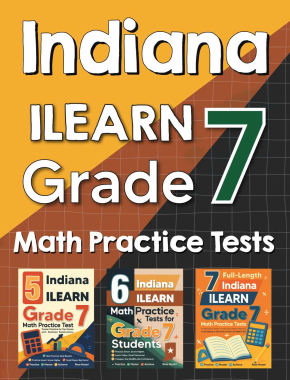
Working on Math Too? Try the Indiana ILEARN Grade 7 Math Bundle
Many third graders are getting ready for the ILEARN in both subjects. If your child also needs math practice that matches the same standards, this companion bundle is the shortest path, workbook, study guide, and full practice tests in one download.
Writing
- Argument Writing: Claims, Reasons, Evidence, and Counterclaims, [W.7.1] Grade 7 makes the counterclaim non-negotiable
- Informative and Explanatory Writing, [W.7.2] teach a reader with a thesis, ordered sections, and clean transitions
- Narrative Writing, [W.7.3] pacing, dialogue, sensory description, and an ending that lands
- Coherent Writing for Task, Purpose, and Audience, [W.7.4] same idea written three ways for three readers
- Planning, Revising, and Editing, [W.7.5] sometimes the right revision is starting a paragraph over
- Short Research Projects: Question and Refocus, [W.7.7] let early findings rewrite the question
- Gathering, Evaluating, and Citing Sources, [W.7.8] author, date, publisher, and the basic citation an Indiana teacher actually expects
Speaking & Listening
- Collaborative Discussions, [SL.7.1] come prepared, listen first, and disagree without dismissing
- Analyzing Information in Diverse Media, [SL.7.2] read a chart, a clip, and a photograph as one combined argument (Indiana’s Media Literacy strand lives here)
- Evaluating a Speaker’s Argument, [SL.7.3] find the claim, the reasons, the evidence, and the gaps
- Presenting Claims with Focus and Coherence, [SL.7.4] open with the point, preview the order, hold to it
- Adapting Speech to Context, [SL.7.6] friend-talk and presentation-talk are different registers
Grammar
- Phrases and Clauses: Placement and Function, [L.7.1a] what each piece of a sentence is doing and where it belongs
- Sentence Structures: Simple, Compound, Complex, Compound-Complex, [L.7.1b] count clauses, then name the structure (compound-complex is new this year)
- Avoiding Dangling and Misplaced Modifiers, [L.7.1c] the small error that quietly makes a paragraph absurd
Conventions: Punctuation, Spelling
- Commas with Coordinate Adjectives, [L.7.2a] when two adjectives need a comma and when they do not
- Spelling Grade-Appropriate Words, [L.7.2b] homophones, doubled letters, and the words seventh graders miss most
Knowledge of Language and Style
- Precise and Concise Language, [L.7.3a] cut wordiness, replace vague verbs, pick the exact noun
Vocabulary and Word Study
- Using Context Clues, [L.7.4a] name the kind of clue and use it on purpose
- Greek and Latin Roots and Affixes, [L.7.4b] one root unlocks ten unrelated words
- Using Reference Materials Effectively, [L.7.4c] dictionary, thesaurus, glossary, match the tool to the question
- Verifying Word Meaning, [L.7.4d] confirm the guess before committing to it
- Allusions and Figures of Speech, [L.7.5a] myth, Bible, and literary references the Grade 7 reader is now expected to catch
- Word Relationships: Synonyms, Antonyms, Analogies, [L.7.5b] name the relationship before picking the answer
- Connotation and Denotation, [L.7.5c] same fact, different feeling, different word
- Academic and Domain-Specific Vocabulary, [L.7.6] words that travel across subjects and words tied to one field
How to use these worksheets at home
Indiana weeknights have their own rhythm. A family in Indianapolis might be running between an evening shift at the hospital and an after-school program at the library. A family in Bloomington might be juggling IU graduate-student schedules. A family near Fort Wayne might be working out homework time between a 4-H meeting and a high-school sibling’s volleyball practice. The honest premise of this page is that practice that fits in fifteen minutes beats practice that requires a clean evening, because the clean evening rarely shows up.
Pull one PDF per sitting. Twelve focused minutes is enough. When your seventh grader misses an item, ask them to read the answer-key explanation out loud, speaking the reasoning aloud lodges it faster than silent rereading. Then stop. Wednesday is another day.
Across a week, three or four short sessions add up to roughly an hour of focused practice, more than most full-evening homework sessions actually produce. ILEARN’s adaptive engine rewards students who have practiced the underlying moves many times across the year, not students who attempted the moves for the first time the week before testing.
A note about Indiana’s ILEARN in ELA
ILEARN, Indiana Learning Evaluation Assessment Readiness Network, is given each spring, typically across a window that runs from late April through mid-May depending on the district. The Grade 7 ELA portion is aligned to the Indiana Academic Standards for English/Language Arts, which means everything your seventh grader has been studying since August is on the table.
Two features set ILEARN apart from neighboring states’ tests. First, the test is computer-adaptive. The platform adjusts question difficulty as your seventh grader works, get a few right and the next item gets harder; miss a few and the next item eases off. The adaptive design produces a more precise estimate of where your student actually reads than a fixed-form test does. Tell your child that a hard-feeling question often signals strong performance, not a problem, the platform is reaching up to find the ceiling.
Second, Indiana’s Grade 7 ELA standards include a formal Media Literacy strand. That strand sits under the broader Speaking & Listening expectations but it asks distinctive things: identifying source credibility, recognizing bias, evaluating how visual and audio choices influence a viewer, and analyzing how information is shaped differently in print, video, and audio. The Analyzing Information in Diverse Media worksheet and the Evaluating a Speaker’s Argument worksheet on this page directly rehearse Media Literacy work. The Comparing a Text to Its Audio or Video Version worksheet and the Comparing a Story to Its Audio, Film, or Stage Version worksheet extend the same muscle to fiction and nonfiction.
ILEARN writing tasks ask for an extended response, multi-paragraph, scored on idea development, organization, and conventions. Counterclaim writing (W.7.1), precise language (L.7.3a), and modifier placement (L.7.1c) all show up in those scores.
Want everything in one bundle?
Some Indiana families would rather work from a single book than a long page of standalone PDFs. The Grade 7 ELA Preparation Bundle pulls the rehearsal together, full-length tests structured like the ILEARN adaptive interface, Media Literacy items, extended-response writing practice, and answer keys with complete explanations.
Indiana Grade 7 ELA Preparation Bundle, four practice-test books, 26 unique full-length tests, complete answer keys with explanations.
A short closing
The Chromebook on the kitchen table in Lafayette is doing the Media Literacy work whether anyone is watching or not. Bookmark this page, print one PDF on the easy nights, and let your seventh grader sit with the slower, intentional version of the same evaluation the feed has been demanding all afternoon. Indiana readers grow on one short session at a time.
Best Bundle to Ace the Indiana ILEARN Grade 7 ELA
Looking for the best resource to help your kid ace the Indiana ILEARN? Try this bundle, four full practice-test books (5 + 6 + 7 + 8 tests) covering the same Grade 7 reading, writing, and language skills your child is already learning. Instant PDF download, answer keys included.


Related to This Article
More math articles
- Group Types, Boundaries, Dyads, and Triads
- Acronyms, IFUs, Standards, and Records
- Elasticity uses percentage changes
- Intelligent Math Puzzle – Challenge 90
- How to Master the Intricacies of the Coordinate Plane
- Understanding and Mastering Perpendicular Lines and How to Draw Them
- Find the economic decision
- Relevance of Evidence
- Question order
- The Best Teacher Desks in 2026








What people say about "Free Grade 7 English Worksheets for Indiana"?
No one replied yet.