Cartels face an incentive to cheat
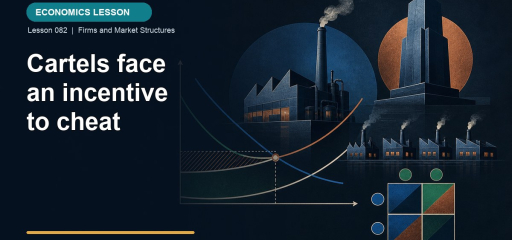
Cartels face an incentive to cheat: this Effortless Math guide explains the topic in plain language, shows how it works through solved examples, and gives you free practice to try immediately, so the idea sticks instead of staying abstract.
Collective monopoly profit conflicts with individual gain.
Why is a cartel often unstable?
- Its members have no market power.
- The cartel price equals marginal cost.
- Entry is legally impossible.
- A member can profit by cheating while others comply.
- Joint profit is lower than competitive profit.
A member can profit by cheating while others comply. Once rivals maintain the high cartel price, one member can often increase its own profit by selling extra units, undermining the agreement.
Two firms repeatedly interact and can observe past behavior. Compared with a one-shot game, repetition may
- support cooperation through credible future punishment
- eliminate the incentive to cheat under all conditions
- turn the market into perfect competition
- guarantee the joint-profit maximum
- make each firm’s payoff independent of the other
support cooperation through credible future punishment Future retaliation can make today’s cheating less attractive, although repeated interaction does not guarantee cooperation.
Which condition makes tacit cooperation harder to sustain?
- Frequent interaction among the same firms
- Easy observation of rivals’ prices
- A credible punishment for cheating
- Stable market demand
- Many firms and difficulty detecting secret price cuts
Many firms and difficulty detecting secret price cuts Numerous firms and hidden discounts make deviations harder to detect and punishment less reliable.
Watch the idea in action
A focused video lesson from CrashCourse.
A cartel restricts combined output to raise price and joint profit. At the cartel price, however, an individual member can often sell extra units and gain if others maintain restraint. This prisoner’s-dilemma structure makes collusion unstable.
Collectively, cartel members behave like a monopolist: choose combined output where industry MR equals MC and divide production among members. The high price creates a margin for cheating. One member can secretly expand sales at that price and capture additional profit, while the resulting price effect is shared across the cartel.
If every member cheats, total output rises and price falls, eroding the cartel gain. The contradiction is between the group optimum and each member’s unilateral incentive. An agreement alone does not remove that incentive. Monitoring and punishment must make deviation unattractive.
Cooperation becomes easier when firms are few, products and costs are similar, orders are observable, demand is stable, entry is difficult, and interaction repeats. Punishment strategies can deter cheating when firms value future profit. Antitrust law also changes expected cost by penalizing explicit agreements.
Repeated interaction changes the payoff from one-time cheating. A firm may gain today but lose future cooperative profit if rivals punish it. Cooperation is more sustainable when firms expect to remain in the market, can detect deviations quickly, and value future earnings. Anonymous, volatile demand makes cheating harder to distinguish from ordinary sales changes.
Entry weakens a cartel because outsiders can sell at the elevated price and because more members make monitoring difficult. Differing costs create conflict over production quotas: low-cost members want larger shares. Product similarity makes price comparisons easier, while differentiated terms can conceal discounts.
Game questions sometimes ask what happens after a payoff changes. Recompute best responses rather than carrying the old equilibrium forward. A subsidy to one strategy, a penalty for collusion, or a change in future profit can remove a dominant strategy or create a different Nash equilibrium. The labels “cooperate” and “defect” do not determine the answer. The displayed payoffs do.
Cheating against a fixed quota
Two firms agree to produce 40 units each at a high cartel price. If Firm A alone adds 10 units while B keeps its quota, A gains sales before price falls much. If both add 10, market output rises enough to cut price and both earn less than under restraint. Secret expansion is individually attractive yet collectively destructive.
Explicit price fixing is not required for all parallel conduct. Firms may independently respond to the same demand and cost information. Antitrust analysis distinguishes agreement from conscious but independent behavior. A economics exam item usually states communication or a cartel when collusion is intended.
Do not assume a cartel eliminates deadweight loss. Its monopoly-like restriction usually creates underproduction. Successful coordination raises joint profit but lowers total surplus relative to competitive output under standard cost assumptions.
When a question asks why cartels collapse, select the incentive to deviate or entry mechanism rather than a vague claim that firms “dislike cooperation.” The economic reason is the payoff available from expanding while others restrain output.

Reza is an experienced Math instructor and a test-prep expert who has been tutoring students since 2008. He has helped many students raise their standardized test scores--and attend the colleges of their dreams. He works with students individually and in group settings, he tutors both live and online Math courses and the Math portion of standardized tests. He provides an individualized custom learning plan and the personalized attention that makes a difference in how students view math.
Related to This Article
More math articles
- Convert Between Decimals and Mixed Numbers
- Best Free Apps That Solve Math Problems for You
- Properties of Addition
- The Best Grade 3 Math Book for Hawaii Students
- Relating Fractions and Decimals for 4th Grade
- Free Grade 6 English Worksheets for Washington, D.C. Students
- Free Grade 8 English Worksheets for Hawaii Students
- Wisconsin Grade 2 Math Worksheets — Free Printable PDFs
- Theories of Aging
- Alternating Series




















What people say about "Why Cartels Face an Incentive to Cheat"?
No one replied yet.