Is There a Trick to Simplifying Radicals?
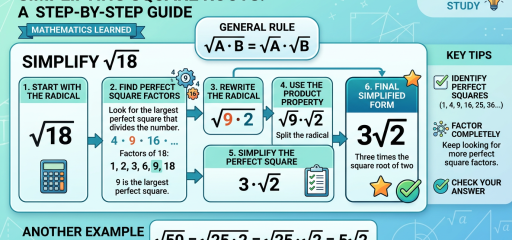
Simplifying radicals can feel tedious, but several tricks make the process faster and more reliable. Whether you’re working with square roots, cube roots, or higher roots, these strategies help you simplify correctly every time. Master these and you’ll save time on tests and avoid common errors.
The Absolute Best Book to Ace Your Math Test
Our Best Seller Books

The Factor Tree Trick
Break the number under the radical into its prime factors. For √45: 45 = 9 × 5 = 3² × 5. Every pair of identical factors comes out as one factor: √(3² × 5) = 3√5. For √72: 72 = 2³ × 3² = 2² × 2 × 3², so √72 = √(4 × 18) = 2√18 = 2√(9×2) = 2×3√2 = 6√2. For more practice, see our algebra worksheets.
Look for Perfect Square Factors
Instead of full prime factorization, look for the largest perfect square that divides the radicand. √72: 72 = 36 × 2, so √72 = √36 × √2 = 6√2. √200: 200 = 100 × 2, so √200 = 10√2. Common perfect squares to know: 4, 9, 16, 25, 36, 49, 64, 81, 100, 121, 144.
The “Pull Out Pairs” Rule
For √(a² × b) where b has no perfect square factors: √(a² × b) = a√b. Example: √(4 × 7) = 2√7. √(9 × 5) = 3√5. The rule: one pair of identical factors → one factor outside the radical. Two pairs → two factors outside: √(4 × 9 × 3) = 2 × 3√3 = 6√3. Visit Effortless Math for more radical practice.
Simplifying Fractions Under Radicals
Our Top Picks for This Month
Recommended Math Practice Resource
√(a/b) = √a/√b. Simplify the fraction first if possible: √(50/2) = √25 = 5. √(18/8) = √(9/4) = 3/2. If the fraction doesn’t simplify to a perfect square, use the quotient rule and simplify each part, then rationalize if needed.
Rationalizing the Denominator
Never leave a radical in the denominator in final form. Multiply top and bottom by the radical: a/√b = a√b/b. For √a/√b, multiply by √b/√b to get √(ab)/b. For denominators like √2 + √3, use the conjugate: multiply by (√2 − √3)/(√2 − √3) to clear the radicals.
Adding and Subtracting Radicals
Only like radicals combine: 3√5 + 2√5 = 5√5. Unlike radicals stay separate: 3√5 + 2√3 cannot be combined. Always simplify first so you can spot like radicals: √12 + √27 = 2√3 + 3√3 = 5√3.
Quick Checklist
- Factor out perfect squares (or perfect cubes for ∛)
- Reduce fractions under the radical
- Rationalize the denominator
- Combine like radicals when adding or subtracting
- Ensure no perfect square factors remain under the radical
Common Mistakes to Avoid
Don’t add radicands: √a + √b ≠ √(a + b). Don’t forget to simplify completely, √8 should become 2√2, not stay as √8. When rationalizing, multiply both numerator and denominator by the same expression.
Frequently Asked Questions

Recommended Resources
What is the simplest form of √48?
√48 = √(16 × 3) = 4√3.
Do these tricks work for cube roots?
Yes, but pull out triples instead of pairs. ∛54 = ∛(27 × 2) = 3∛2. ∛24 = ∛(8 × 3) = 2∛3.
What about fourth roots?
Same idea, pull out groups of four identical factors. ∜16 = 2, ∜80 = ∜(16 × 5) = 2∜5.
How do I simplify √(50) + √(18)?
√50 = 5√2, √18 = 3√2. So √50 + √18 = 5√2 + 3√2 = 8√2.

Related to This Article
More math articles
- Converting Units of Weight/Mass for 4th Grade
- Dealignment
- Impeachment and removal
- Plant Structures and Their Jobs
- Citizenship and Immigration: Family, Rights and U.S. History
- Controlled Variables and the Control Group
- Issue positions
- Ohio OST Algebra 1 Free Worksheets: Printable OST-Ready Algebra 1 Worksheets with Step-by-Step Keys
- New York Grade 6 Math Worksheets: 72 PDF Links
- Tax revenue is a rectangle










What people say about "Is There a Trick to Simplifying Radicals?"?
No one replied yet.