CLEP U.S. History I 020: Enlightenment and Print Culture
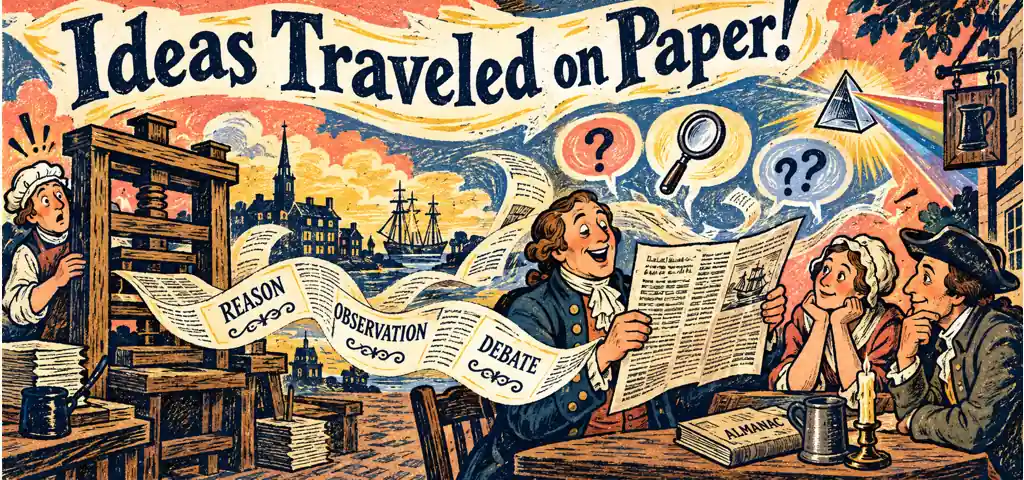
Lesson 4.5 of Chapter 4 of the U.S. History to 1877 study guide on Effortless Math covers CLEP U.S. History I 020: Enlightenment and Print Culture: the key terms, the core ideas, and worked examples showing how this topic is tested on the exam.
U.S. History to 1877 | Chapter 4 | Lesson 4.5
The Enlightenment encouraged people to investigate nature and government through reason, observation, and debate. Thinkers such as John Locke argued that government rested on consent and existed to protect rights, while natural philosophers sought discoverable laws in the physical world. Colonial readers did not accept a single Enlightenment program. They combined new arguments with inherited Protestant, classical, and English constitutional ideas.
Benjamin Franklin embodied a practical colonial Enlightenment. His experiments with electricity, civic projects, almanac, and transatlantic correspondence joined useful knowledge to public reputation. Learned societies and libraries created spaces for inquiry, though participation favored educated people with time and resources. Medicine and science still included serious error. Enlightenment confidence in reason should not be confused with modern knowledge.
Printing expanded the audience for argument. Newspapers, pamphlets, sermons, almanacs, and books circulated among colonies. Taverns and households extended their reach through shared reading. Literacy remained unequal by region, gender, race, and status, and oral communication remained fundamental. Printers could also face prosecution. The 1735 trial of New York printer John Peter Zenger, whose lawyer persuaded a jury to acquit him of seditious libel, became a symbol of resistance to official censorship even though it did not establish modern press law.
Great Awakening preachers and Enlightenment writers sometimes criticized one another, yet both relied on print and encouraged audiences to assess authority. Religious feeling and reason were not simple opposites: Edwards analyzed revival experience systematically, and many natural philosophers understood investigation as revealing God’s order. The most useful comparison focuses on method and authority, not a false war between faith and thought.
Watch the topic in context
Tom Richey traces the people and chronology behind this lesson. Listen for the evidence that sharpens the written account, then try the questions below.
Video: The American Enlightenment, Tom Richey.
Check your understanding
- John Locke is most closely associated with arguments about
- hereditary political authority
- unconditional obedience to rulers
- church membership as the sole source of civil rights
- parliamentary sovereignty without natural limits
- consent and rights
- The Zenger trial became a symbol of
- legislative control over juries in criminal prosecutions
- the formal abolition of seditious-libel law in the colonies
- resistance to official censorship and the political power of a jury
- a newspaper exemption from civil liability for damaging claims
- equal access to printing presses for competing political factions
- Select all that apply. Colonial print included
- newspapers
- universal access
- sermons
- pamphlets
- almanacs
- Compare how the Awakening and Enlightenment encouraged audiences to evaluate authority.
Write a brief response using a named fact from the lesson.
Open the answers and reasoning
Independent preparation. CLEP is a registered trademark of the College Board, which does not endorse this lesson.

Related to This Article
More math articles
- How to Decode Complexity: A Comprehensive Guide to Utilizing Bar Charts in Calculus and Beyond
- The Best Grade 4 Math Book for Wyoming Students
- Overview of the PSAT / NMSQT Mathematics Test
- How to Multiply a Matrix by a Scalar?
- Spinning the Numbers: The Hidden Math Inside Slot Games
- Establishment Clause
- Top 10 PERT Math Prep Books (Our 2023 Favorite Picks)
- Sequence Calculator (Arithmetic & Geometric — nth Term & Sum)
- Sterile Processing: The Dirty-to-Clean Flow
- Free Printable Grade 2 English Worksheets for Washington









What people say about "Enlightenment and Print Culture in the Colonies"?
No one replied yet.