CLEP U.S. History I 019: The First Great Awakening
Lesson 4.4 of Chapter 4 of the U.S. History to 1877 study guide on Effortless Math covers CLEP U.S. History I 019: The First Great Awakening: the key terms, the core ideas, and worked examples showing how this topic is tested on the exam.
U.S. History to 1877 | Chapter 4 | Lesson 4.4
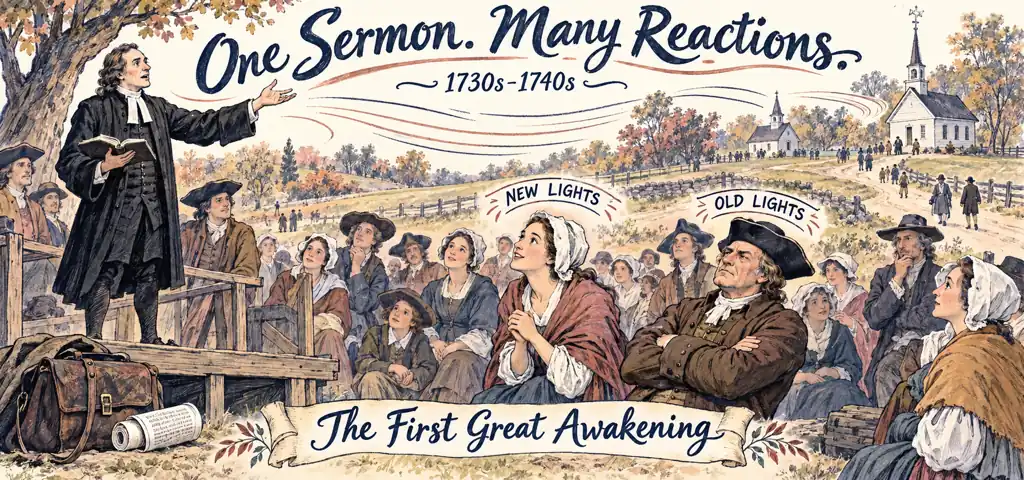
During the 1730s and 1740s, revivals swept through parts of British North America. Preachers urged listeners to experience a “new birth” rather than rely on formal membership or respectable behavior. Jonathan Edwards combined rigorous theology with accounts of revival in Massachusetts. George Whitefield, an English itinerant, traveled from colony to colony, speaking dramatically to enormous crowds. Print reports amplified both enthusiasm and controversy.
The Great Awakening was not one centrally organized event. Revivals varied by region and denomination. Supporters called “New Lights” defended emotional preaching and converted ministers. “Old Lights” worried about disorder, false enthusiasm, and disrespect for educated clergy. Congregations divided, and new colleges trained revival-friendly ministers. The movement increased competition among denominations and created shared experiences that crossed some colonial boundaries.
Revival language could equip ordinary hearers to judge a minister’s spiritual condition. Women, young people, poor colonists, and some Black and Native listeners participated, sometimes gaining new religious voice. Yet revivalists did not generally advocate social equality. Whitefield preached to enslaved people and supported their conversion while also owning enslaved workers and promoting slavery in Georgia. Spiritual inclusion could coexist with material oppression.
It is tempting to call the Awakening a direct cause of the American Revolution because it challenged authority and linked colonies. The connection is indirect. Revival habits may have made some people more willing to evaluate leaders and join intercolonial networks, but religious disputes did not automatically become a theory of independence. The movement belongs in the Revolution’s cultural background, not as a single trigger.
Watch, then test the claim
This Adam Norris lesson supplies a second explanation of the same period. Note where chronology, cause, and perspective connect.
Video: APUSH Review: The First Great Awakening, Adam Norris.
Check your understanding
- George Whitefield was best known as
- an Old Light critic of itinerancy
- a Congregational minister who preached only in one town
- a colonial printer tried for seditious libel
- an itinerant revival preacher
- a deist critic of evangelical conversion
- New Lights and Old Lights disagreed chiefly about
- emotional conversion, itinerant preaching, and the authority of settled ministers
- whether Congregational churches should retain infant baptism as a membership practice
- whether colonial ministers needed Anglican ordination obtained in England
- whether revival churches should end formal membership requirements after conversion
- whether civil officials could collect taxes for locally established churches
- Select all that apply. The Awakening contributed to
- denominational competition
- intercolonial communication
- challenges to some clergy
- immediate universal suffrage
- new colleges
- Explain one way the Awakening widened participation and one limit to that change.
Write a brief response using a named fact from the lesson.
Open the answers and reasoning
Independent preparation. CLEP is a registered trademark of the College Board, which does not endorse this lesson.

Related to This Article
More math articles
- How to Understand the Key Properties of Trapezoids
- The Slot Bonus Buy Trap: Math Behind Paying for the Feature
- The Best Algebra 1 Book for Idaho Students
- How to Convert Repeating Decimals to Fractions? (+FREE Worksheet!)
- Race as a Social Construction
- Congressional oversight
- The Best Grade 4 ELA Practice Tests for Tennessee Students
- Grade 2 English Practice for West Virginia Second Graders
- Delegates
- The Secrets of Venn Diagrams: Your Guide to Visualizing Mathematical Relationships
















What people say about "The First Great Awakening"?
No one replied yet.