CLEP U.S. History I 018: Enslaved Community, Culture, and Resistance
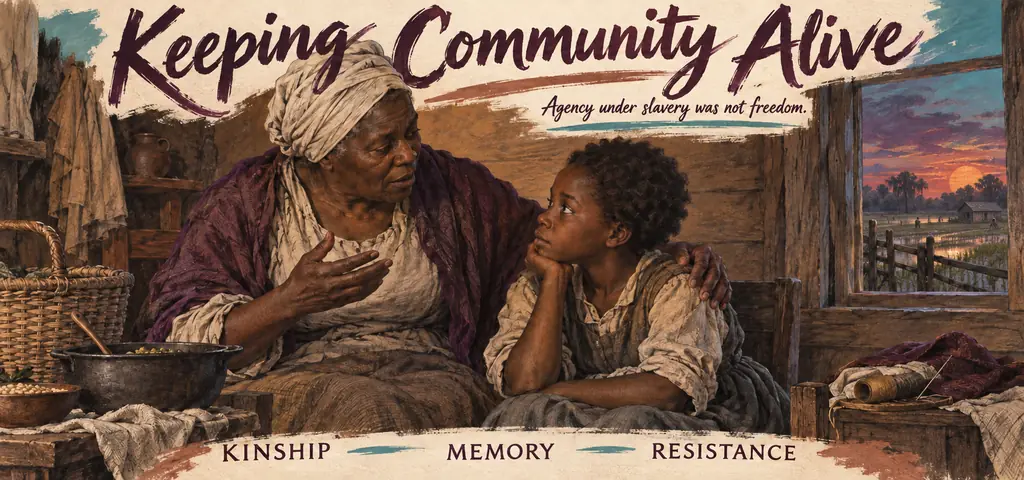
Lesson 4.3 of Chapter 4 of the U.S. History to 1877 study guide on Effortless Math covers CLEP U.S. History I 018: Enslaved Community, Culture, and Resistance: the key terms, the core ideas, and worked examples showing how this topic is tested on the exam.
U.S. History to 1877 | Chapter 4 | Lesson 4.3
Slavery sought to control labor, movement, family, and identity, but enslaved people built lives that exceeded an owner’s design. Community began with kinship. Marriages often lacked legal protection, and sale could separate partners and children. People nevertheless sustained extended families, adopted orphaned or separated children, visited relatives across plantations when possible, and remembered kin over long distances. Naming practices and oral history preserved connection.
African cultures did not survive unchanged or disappear. People from different societies combined languages, agricultural knowledge, music, foodways, healing, spiritual practices, and craft traditions under new conditions. In South Carolina and Georgia, concentrated African populations contributed to Gullah Geechee language and culture. Christianity could be imposed by missionaries and owners, yet enslaved worshipers reinterpreted biblical stories around deliverance, justice, and community.
Resistance ranged from daily negotiation to armed rebellion. Slowing work, breaking tools, feigning illness, stealing food understood as the product of one’s own labor, escaping temporarily, and preserving forbidden gatherings all limited an owner’s control. Permanent flight was difficult but possible, sometimes producing maroon communities. The Stono Rebellion of 1739 in South Carolina was a major armed uprising. Colonial authorities killed participants and tightened slave laws afterward.
It is a mistake to count only rebellion as resistance, because that adopts the state’s definition of visible danger. It is equally mistaken to romanticize every action or imply that resistance made bondage bearable. Enslavers held overwhelming legal and physical power. Agency means purposeful action within constraint, not freedom from constraint. The historian’s task is to show domination and human initiative in the same frame.
See the history take shape
Watch this account from Heimler's History with one question in mind: which evidence makes the lesson's strongest claim hold up?
Video: Colonial SOCIETY and CULTURE [APUSH Review Unit 2 Topic 7 (2.7)] Period 2 to 1607-1754, Heimler's History.
Check your understanding
- Gullah Geechee culture developed especially in
- the tobacco Chesapeake
- urban New England
- the Hudson Valley
- the Carolina-Georgia lowcountry
- the Pennsylvania backcountry
- Which action best illustrates day-to-day resistance?
- petitioning an assembly as an enfranchised constituent
- slowing work deliberately
- negotiating an enforceable wage contract
- participating in a slave patrol
- purchasing legal title to plantation land
- Select all that apply. Enslaved communities sustained themselves through
- kin networks
- worship
- legally guaranteed family unity
- oral memory
- foodways
- Explain the difference between agency under slavery and freedom.
Write a brief response using a named fact from the lesson.
Open the answers and reasoning
Independent preparation. CLEP is a registered trademark of the College Board, which does not endorse this lesson.

Related to This Article
More math articles
- Integrals: Everything You Need To Know
- 10 Most Common ATI TEAS 7 Math Questions
- 8th Grade RISE Math Worksheets: FREE & Printable
- How to Score 800 on SAT Math?
- Separation of church and state
- Getting Better at Math: Realistic Tips and Suggestions
- 3rd Grade MAP Math FREE Sample Practice Questions
- Selective exposure
- Employing the Limit Comparison Test to Analyze Series Convergence
- Free GED Math Practice Test and 20 Sample Questions

















What people say about "Enslaved Community, Culture and Resistance"?
No one replied yet.