The Water Cycle and Weather
The water on Earth today is the same water that has been here for billions of years — it just keeps moving in a loop called the water cycle. This cycle drives our weather, so understanding it explains a lot about clouds, rain, and storms. It is also one of the most testable earth-science topics.
The Steps of the Water Cycle
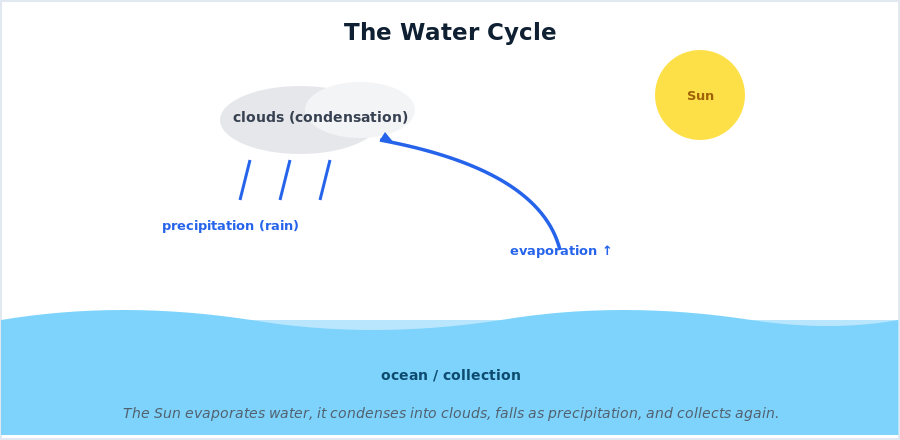
The water cycle has a few main steps. Evaporation is when the Sun heats water in oceans and lakes, turning it into invisible water vapor that rises into the air. Condensation is when that vapor cools high up and forms tiny droplets that gather into clouds. Precipitation is when the droplets grow heavy and fall as rain, snow, or hail. Finally, collection is when that water gathers in oceans, lakes, and rivers — ready to start the cycle again.
The Water Cycle and Weather
Weather is really the water cycle in action. Clouds form by condensation; rain and snow are precipitation. Warm, moist air rising and cooling is what builds storm clouds. When a question describes clouds forming or rain falling, you can connect it to the step of the water cycle involved. The Sun provides the energy that drives the whole thing.
Keeping the Steps Straight
The two steps people mix up are evaporation and condensation. Remember: evaporation is liquid becoming vapor (going up), and condensation is vapor becoming liquid droplets (forming clouds). One is the reverse of the other. Precipitation is simply water falling back down, and collection is where it lands and pools.
Watch: A Short Video Lesson
Lessons Made Easy – Teacher Belle walks through this skill clearly in a few minutes. It is a helpful companion to the reading above:
A Routine for Water Cycle Questions
- Evaporation: the Sun turns liquid water into vapor that rises.
- Condensation: vapor cools into droplets that form clouds.
- Precipitation: droplets fall as rain, snow, or hail.
- Collection: water gathers in oceans and lakes to begin again.
Practice
- What step turns liquid water into vapor?
- What step forms clouds?
- What is precipitation?
- What provides the energy for the water cycle?
- Which step is the reverse of evaporation?
- Where does water collect at the end of the cycle?
Answers
- Evaporation.
- Condensation.
- Water falling as rain, snow, or hail.
- The Sun.
- Condensation.
- Oceans, lakes, and rivers.
Where This Fits in Your Science Prep
The water cycle connects to climate and the greenhouse effect and to the atmosphere, oceans, and Earth systems. See all topics on the Science Topics Hub.

Related to This Article
More math articles
- Which Test Is Better for You; GED, TASC, or HiSET? Find Out Now
- Top 10 Tips to Create a TABE Math Study Plan
- Subject-Verb Agreement
- DNA Replication Enzymes: Roles and Worked Examples
- Top 10 5th Grade STAAR Math Practice Questions
- Research Ethics and Participant Protection
- Using a Dictionary, Thesaurus, and Glossary
- Reciprocals
- What “Provably Fair” Actually Proves (And What It Doesn’t)
- Voting-Age Population





















What people say about "The Water Cycle and Weather"?
No one replied yet.