Kansas KAP Grade 4 Math Free Worksheets: 72 Free Printable Worksheets with Step-by-Step Keys

TL;DR: 72 free printable Grade 4 math worksheets for Kansas with step-by-step keys, covering multi-digit multiplication, long division, fractions, decimals, measurement, and geometry aligned with the Kansas Mathematics Standards tested by the Kansas Assessment Program (KAP).
Key takeaways:
- Kansas’s KAP (Kansas Assessment Program) tests grades 3-8 each spring.
- All 72 worksheets are free PDFs with step-by-step answer keys.
- Aligned with the Kansas Mathematics Standards at grade 4 (Kansas’s adoption of the Common Core).
- Coverage spans operations, base ten, fractions, measurement, geometry, and data.
- Short, daily practice (15-20 minutes) is more effective than long weekend sessions.
There is a moment in fourth grade when a student stops counting and starts calculating. Up to now, a number like 3,000 was something you said. In fourth grade it becomes something you take apart, three thousands, or thirty hundreds, or three hundred tens, and that flexibility is the door to everything else the year asks for. A child who can bend a number that way can multiply it, divide it, compare it, and round it without losing the thread.
Fourth grade is a building year. Students learn to multiply two- and three-digit numbers, to divide with remainders that mean something, to see that 2/4 and 1/2 name the same amount, and to read their first decimals to the hundredths place. They measure angles, convert kilometers to meters, and untangle word problems that take more than one step. None of it is flashy. All of it matters, because fifth grade and beyond quietly assume a student has it.
What makes the year hard is rarely any single skill. It is the volume of them, arriving steadily over nine months. A child can understand equivalent fractions perfectly on Tuesday and still need it solid in April, when comparing fractions leans on it. The cure is not pressure; it is steady, low-stakes practice that returns to each skill often enough that it never quite fades.
From a wheat farm outside Salina to a classroom in Wichita, Overland Park, Kansas City, or Topeka, the work is the same, and so is the goal: one clear skill at a time, practiced until it holds.
What’s on this page
You will find 43 single-skill PDFs, each aligned to the Kansas Mathematics Standards at Grade 4. Every file is built around exactly one skill, so a student practicing long division is not also being quizzed on line plots, and a student comparing fractions is not pulled sideways into angle measurement. The focus is the point.
Each PDF starts with a one-page Quick Review that explains the skill in plain words and walks through a worked example. Then come 20 practice problems, ordered from gentle to genuinely challenging, followed by 4 word problems that drop the skill into a real situation. The last page is a student-facing answer key, not bare answers, but short, friendly explanations a nine- or ten-year-old can read on their own and learn from.
Place Value & Multi-Digit Numbers
- Understanding Place Value Relationships, [4.NBT.A.1] each place is ten times the one to its right
- Reading and Writing Multi-Digit Numbers, [4.NBT.A.2] standard form, word form, and expanded form
- Comparing and Ordering Multi-Digit Numbers, [4.NBT.A.2] use place value and the symbols >, <, and =
- Rounding Multi-Digit Numbers, [4.NBT.A.3] round to any place from tens to hundred-thousands
Multi-Digit Arithmetic
- Adding Multi-Digit Whole Numbers, [4.NBT.B.4] the standard addition algorithm, with regrouping
- Subtracting Multi-Digit Whole Numbers, [4.NBT.B.4] the standard subtraction algorithm, including across zeros
- Multiplying by a One-Digit Number, [4.NBT.B.5] multiply up to four digits by a single digit
- Multiplying Two Two-Digit Numbers, [4.NBT.B.5] the area model and the standard algorithm side by side
- Dividing with Remainders, [4.NBT.B.6] divide and name the leftover as a remainder
- Finding Factors and Multiples, [4.OA.B.4] list every factor of a number and its first multiples
- Prime and Composite Numbers, [4.OA.B.4] exactly two factors means prime; more means composite
Operations & Problem Solving
- Multiplicative Comparisons, [4.OA.A.1] read ‘4 times as many’ as a multiplication statement
- Multiplicative Comparison Word Problems, [4.OA.A.2] solve ‘times as many’ stories with multiplication or division
- Multi-Step Word Problems, [4.OA.A.3] two or more operations in one real-world problem
- Interpreting Remainders, [4.OA.A.3] decide what the leftover means, round up, drop it, or use it
- Number and Shape Patterns, [4.OA.C.5] follow a rule and find the next terms in a pattern
Fractions
- Equivalent Fractions, [4.NF.A.1] the same amount written with different numbers
- Comparing Fractions, [4.NF.A.2] compare fractions with unlike denominators using benchmarks
- Adding Fractions with Like Denominators, [4.NF.B.3a] add the numerators, keep the denominator
- Subtracting Fractions with Like Denominators, [4.NF.B.3a] subtract the numerators, keep the denominator
- Decomposing Fractions, [4.NF.B.3b] break a fraction into a sum of unit fractions
- Adding and Subtracting Mixed Numbers, [4.NF.B.3c] work with the whole and fraction parts, including regrouping
- Multiplying a Fraction by a Whole Number, [4.NF.B.4b] repeated addition of a fraction, written as multiplication
- Fraction Word Problems, [4.NF.B.3d] real-world stories that call for adding or subtracting fractions
Decimals
- Fractions with Denominators 10 and 100, [4.NF.C.5] rename tenths as hundredths and add the two
- Decimal Notation for Fractions, [4.NF.C.6] write tenths and hundredths as decimals, and back
- Comparing Decimals to Hundredths, [4.NF.C.7] line up the place values and compare with >, <, =
- Adding Decimal Fractions, [4.NF.C.5] add decimals to the hundredths place
Measurement & Data
- Converting Measurement Units, [4.MD.A.1] change from a larger unit to a smaller one
- Measurement Word Problems, [4.MD.A.2] length, weight, volume, and time in real situations
- Area of Rectangles, [4.MD.A.3] length times width, the space inside a rectangle
- Perimeter of Rectangles, [4.MD.A.3] the distance all the way around a rectangle
- Area and Perimeter Word Problems, [4.MD.A.3] decide whether a problem needs area or perimeter
- Line Plots with Fractions, [4.MD.B.4] read and use a line plot of fraction measurements
Angles
- Angles as Fractions of a Circle, [4.MD.C.5] a full turn is 360 degrees, find a fraction of it
- Measuring Angles with a Protractor, [4.MD.C.6] name angles acute, right, or obtuse by their measure
- Drawing Angles with Given Measures, [4.MD.C.6] know what a given degree measure should look like
- Adding and Subtracting Angles, [4.MD.C.7] an angle split into parts, find the missing part
Geometry
- Points, Lines, Rays, and Angles, [4.G.A.1] the building blocks of geometry and how to tell them apart
- Parallel and Perpendicular Lines, [4.G.A.1] lines that never meet, and lines that cross at a square corner
- Classifying Triangles, [4.G.A.2] sort triangles by their angles and their sides
- Classifying Quadrilaterals, [4.G.A.2] name four-sided shapes by their sides and angles
- Lines of Symmetry, [4.G.A.3] find the lines that fold a shape onto itself
How to use these worksheets at home
The trick with fourth graders is to keep each sitting short. Fifteen minutes is plenty, one PDF, one skill, then done. A child who knows the work has a clear finish line will actually start it, and starting is most of the battle.
Pair worksheets that lean on each other and the second one feels like a step instead of a wall. Do “Adding Multi-Digit Whole Numbers” one afternoon and “Subtracting Multi-Digit Whole Numbers” the next, since they share the same regrouping habits. Spend a session on place value before “Multiplying by Two-Digit Numbers,” because the partial products only make sense if a child knows the 4 in 46 is really 40. Run “Equivalent Fractions” before “Comparing Fractions,” since comparing is easier once a student can rename, and follow both with “Mixed Numbers.” Do “Multiplying by One-Digit Numbers” and then “Dividing with Remainders” close together, so a child sees division as multiplication run backward, with the remainder as the part that did not fit.
The pairing works for measurement and geometry too. Try “Area of Rectangles” and then “Perimeter of Rectangles” back to back, so the difference between covering a space and walling it in stops being a guessing game. Put “Measuring Angles” before “Classifying Shapes,” because once a child can size up an angle, naming a right triangle or a parallelogram becomes a matter of looking. And let “Decimals to the Hundredths” sit next to fraction work, a quick conversation about how 0.25 and one-quarter are the same number does more than a page of drills.
And let the answer key do its job. Whether you are at a kitchen table in Topeka or working through a packet on a long drive across the state, the routine is the same: the student does the page, then checks it themselves, then reads the explanation for anything they missed. That last step is where the understanding settles in. It is worth circling back, too, pull a worksheet your child finished a month ago and have them try a few problems cold. If it still flows, you both get the proof that it stuck; if it has slipped, you have found out with time to fix it.
A note about KAP at Grade 4
Kansas students take the Kansas Assessment Program (KAP) Mathematics assessment in the spring. It is built on the Kansas Mathematics Standards, which means the skills on these worksheets and the skills on the test come from the same well. There is no gap between what you practice here and what the state asks for.
At Grade 4, KAP wants more than quick computation. It asks students to explain place-value reasoning, to choose an operation that fits a multi-step problem, to compare fractions and justify the answer, to interpret a remainder, and to work with decimals, angles, area, and the classification of shapes. The questions are often layered, so the calm, one-skill-at-a-time practice on these pages is exactly the groundwork those layered questions stand on. Because every PDF on this page targets a single standard, you can treat the spring window as a checklist: find the skills that wobble, work just those, and leave the solid ones alone.
A short closing
Fourth-grade math is not a single leap; it is a long, steady walk, taken one skill and one short afternoon at a time. No single page makes or breaks the year, but a page today, and another in a few days, adds up to a child who walks into fifth grade already steady on its foundation. Bookmark this page, print a single PDF tonight, and let your student begin somewhere small. Kansas kids handle hard things just fine when the next step is plain, and a worksheet on the table is about as plain as it gets.
Best Bundle to Ace the Kansas KAP Grade 4 Math Test
Want the fastest path through Kansas KAP Grade 4 math? This bundle pulls it together, four full practice-test books with complete, step-by-step answer keys, instant PDF download.
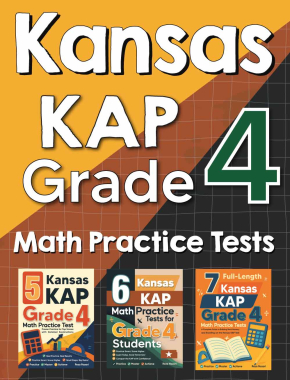
Recommended EffortlessMath Books
For a workbook that pairs neatly with these printable practice pages, Mastering Grade 4 Math walks your child through every fourth-grade topic with clear examples and lots of try-it-yourself problems. For extra word-problem practice (the part many fourth graders find hardest), see Mastering Grade 4 Math Word Problems.
Frequently Asked Questions
What topics are covered in these Kansas Grade 4 worksheets?
Multi-digit multiplication, long division with one-digit divisors, place value through millions, equivalent and comparing fractions, adding and subtracting fractions with like denominators, multiplying fractions by whole numbers, decimals to hundredths, area and perimeter, measurement conversions, classifying angles and shapes, and multi-step word problems.
How do I print these worksheets?
Click any worksheet to open the PDF, then print from your browser (Ctrl/Cmd + P). Use 100% scale on letter paper so the layout stays clean. Most pages are one or two sheets – easy to staple into a focused weekly packet.
Are the worksheets free?
Yes – every worksheet is a free PDF download. No login, no email, no paywall. Print one copy at home or a class set. Please don’t repost the PDFs on other sites.
Are these aligned with Kansas Mathematics Standards?
Yes. The pages follow the Kansas Mathematics Standards at grade 4 (Kansas’s adoption of the Common Core), which the KAP uses as its blueprint. That covers Operations and Algebraic Thinking, Number and Operations in Base Ten, Number and Operations – Fractions, Measurement and Data, and Geometry.
What is the KAP?
The Kansas Assessment Program (KAP) is the state’s spring test for grades 3-8 and high school in math, English, and science. Results report a scale score plus a performance level (Levels 1-4, with 3 meeting the standard).
How often should my fourth grader practice?
For most fourth graders, 15-20 minutes a day, four or five days a week, is plenty. If KAP testing is a few weeks away, add a timed Saturday page so your child gets used to working under a clock. Don’t push through fatigue.
What should I do if my child struggles?
Pause and walk through one problem together. If a whole topic is too hard, drop a level – multiplication facts before long division, equivalent fractions before fraction addition. Rebuilding the missing prerequisite is faster than pushing through frustration.
Is there an answer key?
Yes – every worksheet PDF includes a step-by-step answer key. For fourth graders, walking through the answers together teaches more than just marking a page right or wrong.
Any tips for Kansas parents?
Three habits help most: (1) daily 2-minute multiplication-fact drills, (2) talking about fractions and decimals while cooking or shopping at Dillons, and (3) reading word problems aloud before your child writes anything. Hearing the story usually helps the math click.
Where can we find more grade 4 practice?
EffortlessMath has more grade 4 worksheets organized by topic, the Mastering Grade 4 Math workbook, and a focused Grade 4 Math Word Problems book. The Related Lessons section below links to clear step-by-step explanations of the biggest fourth-grade skills.
Related EffortlessMath Lessons
If a topic on this page feels rusty, these short lessons go deeper:
- How to multiply multi-digit numbers
- How to divide multi-digit numbers
- How to add and subtract fractions with like denominators
- How to find equivalent fractions
- How to solve multi-step word problems

Related to This Article
More math articles
- Factoring Trinomials Worksheet with Answers
- FREE CHSPE Math Practice Test
- Second Amendment
- 5th Grade Common Core Math FREE Sample Practice Questions
- How to Solve Rational Exponents?
- Using Models to Represent Decimal Number Place Value
- How to Solve the Frequency Distribution Table?
- Marginal revenue product combines productivity and output value
- Minerals and Their Identification
- The Best TSI Math Worksheets: FREE & Printable










What people say about "Kansas KAP Grade 4 Math: Free Worksheets"?
No one replied yet.