Government Responses to Social Movements
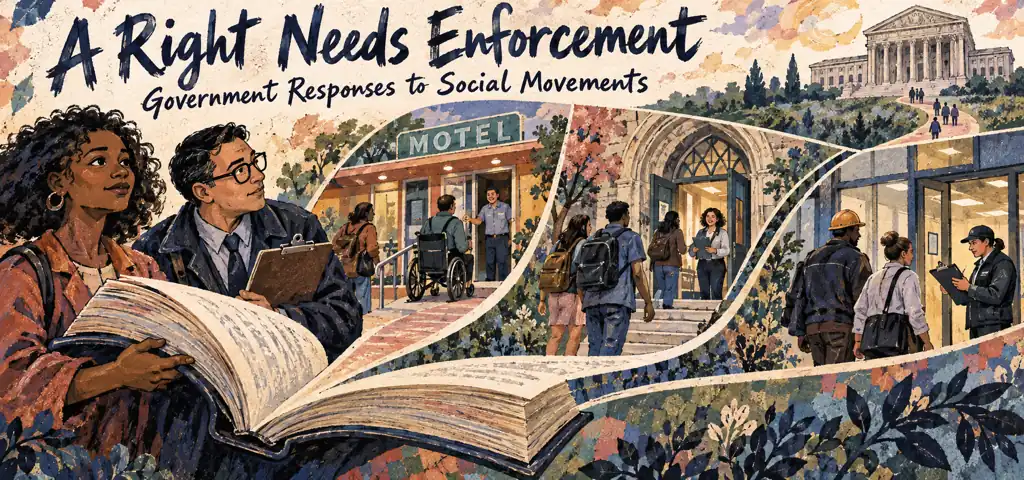
Constitutional rights primarily restrain government, but discrimination often occurs through private institutions. The Civil Rights Act of 1964 reaches important parts of that gap. Title II prohibits specified discrimination in covered places of public accommodation. Title VI addresses discrimination in programs receiving federal financial assistance. And Title VII prohibits covered employment discrimination because of race, color, religion, sex, or national origin. Each title has its own coverage and enforcement rules, so “the Civil Rights Act” is not one undifferentiated command.
Congress relied on more than one source of constitutional power. The Commerce Clause supported regulation of private public accommodations whose operations affect interstate commerce, as the Court recognized in Heart of Atlanta Motel v. United States. Spending power supports conditions attached to federal funds, while the Reconstruction Amendments authorize enforcement legislation within constitutional boundaries. This allocation of power matters because the Fourteenth Amendment by itself targets state action rather than every private discriminatory choice.
A closer look at government responses to social movements
Enforcement occurs through a mix of private lawsuits, agency investigation, funding consequences, and Department of Justice action. A claimant still must establish jurisdiction, coverage, standing, and the elements of the particular violation. Available remedies can include injunctions, reinstatement, damages, or loss of federal funds, depending on the law. Legal effectiveness also depends on resources, access to evidence, and institutional compliance. Declaring a right and enforcing it are separate stages.
Government Responses to Social Movements: what the rule leaves unsettled
A privately owned interstate motel refuses guests because of race. The direct Equal Protection Clause claim encounters the state-action requirement, but Title II can regulate the covered private business. If a public university discriminates, state action is present and statutes may add protection. If a private employer fires a worker because she is a woman, Title VII is central. First identify government or private action, then choose the constitutional provision or statutory title that reaches it.
Check your understanding of government responses to social movements
Write two sentences about government responses to social movements: one for the governing rule and another for the fact that triggers it.
Video lesson: Government Responses to Social Movements
Carey LaManna gives a focused explanation of this topic in Government Response to Social Movements AP Government.
If the player does not load, watch this lesson directly on YouTube.
Connect this lesson to the larger course
For a broader map connecting government responses to social movements to civil liberties, civil rights, and equal protection, use the AP U.S. Government and Politics learning hub.

Related to This Article
More math articles
- Systems of Linear Inequalities Worksheet with Answers
- Michigan M-STEP Grade 8 Math Free Worksheets: Free Standards-Aligned Worksheets, Answers Included
- How to Overcome Praxis Core Math Anxiety?
- Word Problems Involving Rates and Ratios
- From Tables and Graphs to Equations: How to Master Proportional Relationships
- 6th Grade FSA Math Practice Test Questions
- Full-Length 6th Grade GMAS Math Practice Test
- 49 Free SBAC Grade 3 Math Worksheets for South Dakota Students (One Skill Per Page)
- NREMT EMT Options Table vs. Build List: How to Spot the Difference (2027 Prep)
- Three-Fifths Compromise
















What people say about "Government Responses to Social Movements"?
No one replied yet.