Michigan M-STEP Grade 8 Math Free Worksheets: Free Standards-Aligned Worksheets, Answers Included

Talk to a Michigan eighth grader partway through the year and you will hear it: math feels different now. The shift is real, and it is supposed to happen. The earlier grades were mostly arithmetic, practicing operations, getting clean answers, moving along. Eighth grade asks for the harder, more interesting thing: an understanding of the structure that sits behind the answer.
Slope turns into a rate of change you can spot in a real situation. A function becomes a rule that returns exactly one output for every input you give it. An equation might have one solution, none at all, or infinitely many, and knowing which is now part of the work. Geometry turns the same corner: the Pythagorean theorem arrives, figures begin sliding and turning and reflecting across the coordinate plane, and volume comes to mean cylinders, cones, and spheres instead of plain boxes. None of it is meant to be memorized cold. It is meant to be reasoned through. And beneath the whole year sits a new fluency with the real number system: irrational numbers, scientific notation, and the laws of exponents.
These worksheets were made for that exact part of the journey. Whether your student is in Detroit, Grand Rapids, Warren, or Ann Arbor, the idea holds steady: one clear skill at a time, with practice enough to make it stick.
What’s on this page
This page holds seventy-two single-skill PDFs, each aligned to the Michigan Mathematics Standards for Grade 8. Every file stays on one skill and leaves the rest alone. A student deep in systems of equations is not simultaneously being quizzed on scientific notation; a student on volume is not being pulled toward scatter plots. That focus is the point. It gives a kid the room to go deep rather than wide.
The layout is identical in every file, so there is nothing new to figure out each time. A PDF opens with a one-page Quick Review that explains the skill in plain language and works one example all the way through. Twenty practice problems follow, rising from gentle warm-ups to problems that will genuinely make a student think, and then four word problems set the skill in a real situation. The closing page is a student-facing answer key, short, friendly explanations a student can read alone and actually understand, not just a list of answers.
Real Numbers
- Rational and Irrational Numbers, [8.NS.A, 8.NS.A.1] tell a fraction-able number from one whose decimal never repeats
- Turning Repeating Decimals into Fractions, [8.NS.A, 8.NS.A.1] the algebra trick that turns 0.272727.. Into a clean fraction
- Estimating Irrational Numbers, [8.NS.A, 8.NS.A.2] pin a root like √20 between two whole numbers, then closer
- Estimating Expressions with Irrational Numbers, [8.NS.A, 8.NS.A.2] approximate whole expressions that mix roots and π
- Personal Financial Literacy, [8.PFL.1] real-money math: budgets, balances, and simple percent work
- Prime Factorization with Exponents, [8.NS.1] break a number all the way down and write it with exponents
- Density of Real Numbers, [8.NS.1] there is always another number between any two, find it
Exponents, Roots & Scientific Notation
- Properties of Integer Exponents, [8.EE.A, 8.EE.A.1] product, quotient, power, zero, and negative-exponent rules
- Square Roots and Cube Roots, [8.EE.A, 8.EE.A.2] undo a square or a cube, including the ± on x² equations
- Understanding Scientific Notation, [8.EE.A, 8.EE.A.3] move the decimal the right way for huge and tiny numbers
- Operations with Scientific Notation, [8.EE.A, 8.EE.A.4] multiply, divide, add, and subtract without losing the exponent
- Order of Operations with Radicals, [8.EE.2] where the radical bar fits in PEMDAS. It groups like parentheses
Linear Equations and Inequalities
- Graphing Proportional Relationships, [8.EE.B, 8.EE.B.5] read the unit rate straight off a proportional graph
- Slope as a Rate of Change, [8.EE.B, 8.EE.B.5] slope is just rise over run, a real-world rate
- Slope and the Equations of a Line, [8.EE.B, 8.EE.B.6] build y = mx + b from a slope and a point
- Solving Linear Equations in One Variable, [8.EE.C.7a, 8.EE.C.7b, 8.EE.C.8b] multi-step solving: distribute, combine, isolate
- Solving Systems of Two Equations, [8.EE.C.8a, 8.EE.C.8b] find the point two lines share by substitution or elimination
- Solving Real Problems with Systems, [8.EE.C, 8.EE.C.8, 8.EE.C.8c] turn a word problem into two equations and solve it
- Solving Linear Inequalities, [8.EE.7] solve like an equation, but flip the sign when you divide by a negative
- Multiplying Linear Expressions and Factoring, [8.EE.C.7b] distribute to expand, pull out a common factor to undo it
- Graphing Linear Inequalities in Two Variables, [8.EE.8] boundary line, solid or dashed, then shade the right side
- Parallel and Perpendicular Lines, [8.EE.6] equal slopes for parallel, negative reciprocals for perpendicular
- Point-Slope and Standard Form, [8.EE.6] two more ways to write a line, and when each one helps
- Literal Equations, [8.EE.7] solve a formula for a different letter
- Absolute Value Equations and Inequalities, [8.EE.7] split into two cases, and read ‘and’ vs ‘or’ correctly
- Equations with Special Solutions, [8.EE.7] spot ‘no solution’ and ‘all real numbers’ before you waste time
Functions and Sequences
- What Is a Function?, [8.F.A, 8.F.A.1] every input gets exactly one output, and how to check
- Reading Function Values, [8.F.A, 8.F.A.1] evaluate f(x) and read values from tables and graphs
- Comparing Two Functions, [8.F.A, 8.F.A.2] compare functions given as equations, tables, and graphs
- Linear vs. Nonlinear Functions, [8.F.A, 8.F.A.3] constant rate of change means linear, everything else does not
- Building Linear Functions, [8.F.B, 8.F.B.4] write the function from a description, a table, or two points
- Sketching and Describing Function Graphs, [8.F.B, 8.F.B.5] match a graph’s shape to a story: increasing, flat, falling
- Domain and Range of a Function, [8.F.1] the inputs you may use and the outputs you get back
- Arithmetic Sequences, [8.F.4] add the same step each time, and find the nth term
- Geometric Sequences, [8.F.4] multiply by the same ratio each time, and find the nth term
Geometry
- Rotations, Reflections, and Translations, [8.G.A.1a, 8.G.A.1b, 8.G.A.1c] the three rigid motions and what each does to a figure
- Congruent Figures, [8.G.A, 8.G.A.2] same size and shape, and the moves that prove it
- Transformations on the Coordinate Plane, [8.G.A, 8.G.A.3] apply transformation rules to coordinates
- Similarity and Dilations, [8.G.A, 8.G.A.4] scale a figure up or down and keep its shape
- Angles in Triangles and Parallel Lines, [8.G.A.5] the angle sum and the parallel-line angle pairs
- Pythagorean Theorem, [8.G.B, 8.G.B.6, 8.G.B.7] a² + b² = c² for any right triangle
- Distance with the Pythagorean Theorem, [8.G.B, 8.G.B.8] find the distance between two points on the plane
- Volume of Cylinders, Cones, and Spheres, [8.G.C, 8.G.C.9] the three curved-solid volume formulas, side by side
- Angle Relationships, [8.G.B, 8.G.B.7] complementary, supplementary, vertical, and adjacent angles
- Surface Area of Prisms, Cylinders, and Pyramids, [8.G.9] add up every face, nets make it visible
- Volume of Pyramids, [8.G.9] one-third of the matching prism
- Composite Figures: Area and Perimeter, [8.G.9] break an odd shape into shapes you already know
- Interior Angles of Polygons, [8.G.A.5] the (n − 2) × 180° rule for any polygon
- Triangle Inequality Theorem, [8.G.5] which three lengths can actually close into a triangle
- Surface Area of Spheres, [8.G.9] the 4πr² formula and where it shows up
- Arc Length and Area of Sectors, [8.G.9] a slice of a circle. Its curved edge and its area
- Cross Sections of 3D Figures, [8.G.9] the 2D shape you get when you slice a solid
- Parallel Lines and Transversals, [8.G.A.5] name and use every angle pair a transversal creates
- Applying the Pythagorean Theorem, [8.G.7] real-world right-triangle problems: ladders, ramps, diagonals
- Volume of Cones and Spheres, [8.G.C, 8.G.C.9] focused practice on the two trickiest volume formulas
Statistics and Probability
- Scatter Plots, [8.SP.A, 8.SP.A.1] read clustering, outliers, and the direction of a trend
- Fitting a Line to Data, [8.SP.A, 8.SP.A.2] draw a trend line and find its slope and intercept
- Using a Linear Model, [8.SP.A, 8.SP.A.3] use the trend line to predict and to interpret slope
- Two-Way Tables, [8.SP.A, 8.SP.A.4] organize categorical data and read relative frequencies
- Mean Absolute Deviation, [8.SP.4] measure how spread out a data set really is
- Probability: Simple and Compound, [8.SP.4] single-event probability and combining events
- Counting Principle and Permutations, [8.SP.4] count outcomes by multiplying, and when order matters
- Box Plots and IQR, [8.SP.4] the five-number summary, the box, and the spread of the middle
- Random Sampling, [8.SP.4] why a fair sample beats a biased one, and how to scale up
- Effect of Data Changes, [8.SP.4] what adding or scaling values does to mean, median, and range
- Probability of Compound Events, [8.SP.4] and/or events, with and without replacement
Financial Literacy
- Simple Interest, [8.PFL.1] I = Prt, interest that grows on the original amount only
- Compound Interest, [8.PFL.2] interest that earns interest, period after period
- Percents: Tax, Discount, and Markup, [8.PFL.3] the everyday percent problems behind every receipt
- Cost of Credit and Loans, [8.PFL.4] what borrowing really costs once interest is counted
- Payment Methods, [8.PFL.5] cash, debit, credit, and checks, the math and the trade-offs
- Saving for College, [8.PFL.6] set a goal, plan a monthly amount, and let growth help
How to use these worksheets at home
You do not need an elaborate system. You need a rhythm. Pick two afternoons a week, maybe one after school midweek and one on an unhurried weekend morning, and treat one PDF as one sitting. Most run fifteen to twenty minutes, brief enough that even a tired eighth grader will sit down and finish without a standoff.
Here is a pairing habit that pays off: do a skill, then do the skill that leans on it. Run Properties of Integer Exponents one day and Operations with Scientific Notation the next, and the harder worksheet feels like a logical continuation instead of a fresh wall. The same goes for Scatter Plots before Fitting a Line to Data, or Pythagorean Theorem before Applying the Pythagorean Theorem. Stacking related skills back to back is how the connections quietly form.
Michigan homework happens in every kind of place, at a kitchen table in a Detroit neighborhood, in a lake cottage up north on a cold evening, in the quiet half hour before practice in a small town in the Thumb. Print what you need the night before, keep the answer key set aside until the work is done, and then let your student check their own reasoning against the explanations. Reading why an answer works, after the fact, is where a great deal of the genuine learning takes place.
A note about M-STEP at Grade 8
Michigan students take the M-STEP, the Michigan Student Test of Educational Progress, in mathematics during the spring. It is built on the Michigan Mathematics Standards, so the skills these worksheets drill and the skills the test measures come from one shared framework. What your student practices is what the test is asking about.
The Grade 8 M-STEP expects more than fast computation. It asks a student to interpret a graph, build an equation out of a word problem, reason carefully about a geometric figure, and decide which of several methods actually fits the question in front of them. It uses a mix of question types and leans hard on the algebra-and-functions strand that gives eighth-grade math its shape.
Since every PDF here is tied to one Michigan standard, the weeks before the spring window can work like a checklist. If your student is wobbly on functions, or the Pythagorean theorem has not fully landed, that shows up plainly, and you can spend time on just those PDFs rather than re-covering ground that is already solid.
A short closing
Eighth-grade math is a real climb, but it is a steady one, and a student gets there one skill and one afternoon at a time. Bookmark this page, print a single PDF tonight, and let your student begin somewhere small. Michigan kids do hard things well when the next step is clear in front of them, and a worksheet on the table is about as clear as it gets.
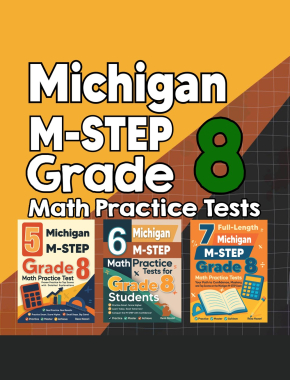
Best Bundle to Ace the Michigan M-STEP Grade 8 Math Test
Want the fastest path through Michigan M-STEP Grade 8 math? This bundle pulls it together, four full practice-test books with complete, step-by-step answer keys, instant PDF download.

Related to This Article
More math articles
- TSI Math Test: Complete Preparation Guide
- Rounding Numbers
- Immediate-Use Steam Sterilization
- Quotient Conundrums: How to Estimate Division Using Inequalities
- Double jeopardy
- Other Topics Puzzle – Challenge 99
- Top Calculator for the PSAT 10 Math Test: Quick Review
- The Ultimate NM-MSSA Algebra 1 Course (+FREE Worksheets)
- Inference, Purpose, Assumptions, and Arguments
- Equivalent Rates








What people say about "Michigan M-STEP Grade 8 Math: Free Worksheets"?
No one replied yet.