Fermentation and NAD+ Recycling: How Glycolysis Continues
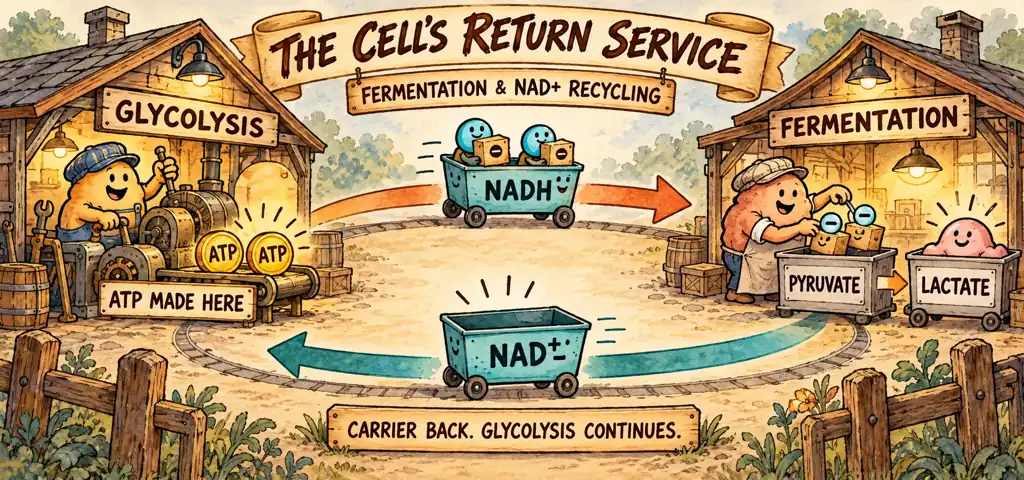
Fermentation recycles NADH to NAD+ so glycolysis can continue. In the lactate and ethanol pathways below, glycolysis supplies the net two ATP per glucose; the later reduction reactions restore the electron carrier. Follow the carrier, the carbon products and the ATP-producing steps separately.
During intense exercise, ATP demand rises rapidly and glycolysis can supply ATP at a high rate. Converting pyruvate to lactate regenerates the NAD\(^+\) needed to sustain that pathway. Oxygen limitation can increase reliance on this route, but lactate is also produced when oxygen is available. Neither a burning sensation nor lactate alone identifies an oxygen shortage. Follow the electron carrier to understand the mechanism.
Watch the process
Fermentation
Look again at glycolysis and find the bottleneck. Glycolysis oxidizes its intermediates by handing electrons to \(\text{NAD}^+\), and a cell holds only a limited pool of this coenzyme. If NADH is not reoxidized, available NAD+ becomes depleted and the NAD+-dependent step of glycolysis cannot continue. During aerobic respiration, electrons from cytosolic NADH reach the mitochondrial electron transport chain through shuttle systems. Oxygen accepts electrons at the end of the chain, and \(\text{NAD}^+\) returns. Oxygen’s role at the end of the chain therefore supports continued carrier recycling.
Remove oxygen and the chain backs up. Fermentation is the cell’s workaround: an anaerobic pathway that reoxidizes NADH to \(\text{NAD}^+\) by handing the electrons to an organic molecule instead of to oxygen. Distinguish the ATP-producing reactions from the carrier-recycling reactions. In these examples, glycolysis makes the ATP. The fermentation reduction steps regenerate \(\text{NAD}^+\) so that glycolysis can keep making it.
In lactic acid fermentation, pyruvate itself accepts the electrons from NADH and is reduced to lactate. Vertebrate muscle does this when oxygen delivery falls behind demand, and so do the bacteria that turn milk into yogurt. In alcoholic fermentation, pyruvate is first decarboxylated to acetaldehyde, releasing \(\text{CO}_2\), and the acetaldehyde is then reduced to ethanol. Yeast does this, which is why bread rises and why fermented beverages contain alcohol. Both pathways yield the same net 2 ATP per glucose that glycolysis alone provides; their carbon products also differ.
Organisms sort by how they use these options. An obligate anaerobe does not grow using oxygen and may be harmed by exposure; a facultative anaerobe such as yeast can respire with oxygen or ferment; some yeasts also ferment abundant sugar while oxygen is present; an obligate aerobe cannot sustain itself on fermentation alone.
Lactate can leave muscle and be used elsewhere. The liver can convert it through pyruvate back to glucose, which can return to muscle. This recycling costs ATP. Recovery after exercise also involves other processes, so continued heavy breathing cannot be attributed to lactate recycling alone.
How Much Faster Does a Fermenting Cell Burn Glucose?
A model muscle-tissue sample needs \(3.0\) mmol of ATP per second. Calculate its glucose requirement when running full aerobic respiration at 30 ATP per glucose, and when limited to glycolysis plus lactic acid fermentation at 2 ATP per glucose. Then calculate the rate of lactate production in the second case.
Step 1: aerobic glucose demand. Divide the ATP required by the ATP available per glucose. \[\frac{3.0\ \text{mmol ATP/s}}{30\ \text{ATP per glucose}} = 0.10\ \text{mmol glucose/s}.\]
Step 2: anaerobic glucose demand. Use the same ATP demand with the lower yield. \[\frac{3.0}{2} = 1.5\ \text{mmol glucose/s}.\]
Step 3: compare. \(1.5 \div 0.10 = 15\). Meeting the same demand without oxygen takes fifteen times as much fuel per second, for the same assumed ATP demand and glucose source. Actual depletion times also depend on exercise intensity, fuel stores, and other fuels.
Step 4: lactate. Each glucose becomes two pyruvates, and in this pathway each pyruvate is reduced to one lactate, so lactate is produced at twice the glucose rate: \[2 \times 1.5 = 3.0\ \text{mmol lactate/s}.\] The numbers make the trade-off concrete. Fermentation keeps ATP coming when oxygen cannot, and it charges fifteen times the fuel and produces more lactate under the stated model. Lactate formation itself consumes a proton; do not equate lactate production with directly releasing acid.
Answer
\(0.10\) mmol glucose per second aerobically, \(1.5\) mmol per second anaerobically, a fifteen-fold difference, producing \(3.0\) mmol of lactate per second.
Distinctions to keep clear
Distinguish a pathway’s ATP-producing step from the name of the overall process. In the lactic and alcoholic fermentation systems studied here, glycolysis makes the net two ATP per glucose; the subsequent reduction reactions regenerate NAD\(^+\). Some sources call the combined process fermentation and report its two-ATP yield. Explain where the ATP is made rather than treating that broader usage as automatically wrong.
Fermentation is not the same thing as anaerobic respiration. Some prokaryotes run a full electron transport chain in the absence of oxygen, using sulfate or nitrate as the final electron acceptor. That is respiration, it is chemiosmotic, and its ATP yield depends on the pathway and terminal electron acceptor. The lactic and alcoholic fermentation routes here regenerate NAD+ without an electron transport chain, using organic electron acceptors.
Lactate production is not itself the direct acid-releasing cause of muscle burning; lactate accumulation indicates a balance between production and removal. It tells you that pyruvate is accepting electrons, which tells you that \(\text{NAD}^+\) is being regenerated, but does not by itself prove an oxygen shortage. Lactate can be produced while oxygen is available when glycolytic flux and cytosolic redox balance favor it.
Review: Fermentation and the NAD+ Problem
Fermentation regenerates \(\text{NAD}^+\) so that glycolysis can keep running when the electron transport chain is unavailable.
The final electron acceptor changes from oxygen to an organic molecule, pyruvate in muscle, acetaldehyde in yeast, and the ATP yield stays at the 2 that glycolysis alone provides.
Locate the ATP production in glycolysis and the NADH reoxidation in the later fermentation steps, and do not call it anaerobic respiration; respiration requires an electron transport chain.
Two Flasks of Yeast
Two identical yeast cultures receive equal glucose under conditions where aerated cells are known to respire predominantly and unaerated cells ferment. Flask A is aerated continuously. Flask B is sealed and becomes anaerobic. After two hours, Flask B has consumed nearly all its glucose while Flask A still has glucose left, yet Flask A’s cells have produced far more ATP. Explain both observations.
Start with the yield per glucose. Flask A runs the full pathway and gets roughly 30 ATP per glucose. Flask B is limited to glycolysis plus fermentation and gets 2. That is a fifteen-fold difference in ATP yield per glucose in this simplified model. Total ATP production also depends on the amount of glucose each culture uses; the yield ratio alone does not prove a ratio of total ATP.
Now explain the glucose. If ATP demand is held equal and adequate glucose is available, the lower-yield pathway requires faster glucose use. Real cells can also alter growth and ATP demand when supply is limited. To produce a given amount of ATP on a yield of 2 per glucose instead of 30, Flask B must run roughly fifteen times as much glucose through glycolysis. Fast consumption of fuel is therefore a symptom of a low-yield pathway, not evidence of a high-yield one. This is the Pasteur effect, and the calculation applies only when comparing the same ATP demand; real exercise also differs in intensity and fuel use.
Answer
With the assumed yields, Flask A produces fifteen times as much ATP per glucose. At equal ATP demand, Flask B needs fifteen times the glucose-use rate. The observed total ATP amounts cannot be calculated without knowing how much glucose each culture consumed.
Fermentation
Practice question 1
The primary function of fermentation in a cell deprived of oxygen is to
-
produce a large amount of ATP without using mitochondria
-
break down lactate into pyruvate and carbon dioxide
-
regenerate \(\text{NAD}^+\) so that glycolysis can continue
-
pump protons across the plasma membrane to build a gradient
Practice question 2
Alcoholic fermentation differs from lactic acid fermentation in that alcoholic fermentation
-
produces ATP directly while lactic acid fermentation does not
-
releases carbon dioxide before the electron acceptor is reduced
-
regenerates \(\text{NAD}^+\) while lactic acid fermentation regenerates \(\text{NADP}^+\)
-
oxidizes \(\text{NAD}^+\) rather than reducing it
Practice question 3
A muscle cell working beyond its oxygen supply accumulates lactate. The accumulation indicates that
-
the electron transport chain has been permanently damaged
-
glycolysis has stopped and lactate is being used as an alternative fuel
-
the Krebs cycle is running faster than usual to compensate
-
pyruvate is being reduced so that \(\text{NAD}^+\) is available for glycolysis
Practice answer key
1. C; 2. B; 3. D.
Practice answer explanations
-
Fermentation, Question 1. Choice C is correct. Fermentation’s function is to reoxidize NADH to \(\text{NAD}^+\) so that glycolysis has an electron acceptor and can keep running. Choice A credits fermentation with an ATP yield that actually comes from glycolysis. Choice B reverses the direction of the lactate reaction. Choice D imports chemiosmosis, which fermentation does not use.
-
Fermentation, Question 2. Choice B is correct. Alcoholic fermentation decarboxylates pyruvate to acetaldehyde, releasing \(\text{CO}_2\), and only then reduces acetaldehyde to ethanol; lactic acid fermentation reduces pyruvate directly with no carbon dioxide. Choice A is false, since neither pathway makes ATP itself; glycolysis makes the two ATP in both cases. Choice C swaps the two carrier pools, because both fermentations return \(\text{NAD}^+\) to glycolysis and \(\text{NADP}^+\) belongs to the biosynthetic pool. Choice D reverses the redox change, because \(\text{NAD}^+\) is the product of the oxidation of NADH, and both fermentations do this.
-
Fermentation, Question 3. Choice D is correct. Lactate accumulates because pyruvate is accepting electrons from NADH, and that transfer is what returns \(\text{NAD}^+\) to glycolysis. Choice A treats a reversible metabolic switch as permanent damage. Choice B has the pathway backward: lactate formation helps sustain glycolysis rather than proving that it has stopped. Choice C is unsupported: lactate accumulation does not show that the Krebs cycle has accelerated.
Continue your review at the AP Biology study hub.
Further review
For an educational reference on fermentation and anaerobic respiration, see OpenStax Biology 2e: Metabolism without Oxygen.

Related to This Article
More math articles
- Fourth Grade Writing: Opinion, Informative, and Narrative Expectations Explained
- Hawaii SBAC Third-Grade Math: 49 Free Printable Worksheets, Chapter by Chapter
- The European Theater and Allied Grand Strategy
- Calculus: Navigating the Pathways of Particles
- 10 Most Common 8th Grade PARCC Math Questions
- Converting Numbers Between Standard and Expanded Forms Up to a Billion
- How to Factor Polynomials by Taking a Common Factor?
- Intelligent Math Puzzle – Challenge 82
- 6th Grade Common Core Math FREE Sample Practice Questions
- The Best Grade 6 ELA Practice Tests for Indiana Students







What people say about "Fermentation and NAD+ Recycling: How Glycolysis Continues"?
No one replied yet.