Geometry Puzzle – Challenge 65
If a square's side increases by 20%, by what percent does the area increase? Areas scale by the square of the linear scale factor. New side = 1.2 times original. New area = (1.2)^2 = 1.44 times original. That is a 44% increase.
Key takeaways:
- For a square, area = side^2.
- If side scales by factor k, area scales by k^2.
- Side scaled by 1.20 (20% increase) gives area scaled by 1.44, a 44% increase.
- This is the general rule for 2D area; for 3D volume the factor is k^3.
- Always check the relationship between linear and area/volume scaling.
Who can solve this math puzzle? This is a great math and critical thinking challenge to help you develop your creative thinking! For additional educational resources
Challenge:
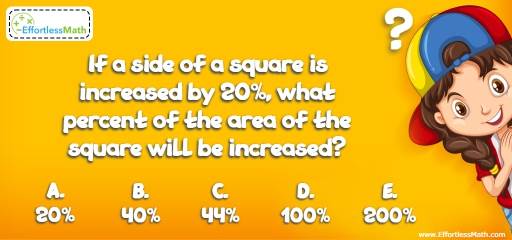
If a side of a square is increased by \(20\%\), what percent of the area of the square will be increased?
A- \(20\%\)
B- \(40\%\)
C- \(44\%\)
D- \(100\%\)
E- \(200\%\)
The Absolute Best Book to Challenge Your Smart Student!

The correct answer is C.
Original price was: $27.99.$17.99Current price is: $17.99.
Area of a square = side times side.
Let X be the side of a square. Then, the side of the square is \(X^2\).
If a side of a square is increased by \(20\%\), then the area of the square will be increased by 44 percent:
\(1.2X × 1.2X = 1.44X^2\)
\(1.44X^2\) is 0.44 or \(44\%\) bigger than \(X^2\)The Best Books to Ace Algebra
Frequently Asked Questions
Why does area scale by the SQUARE of the linear scale factor?
Because area depends on TWO dimensions (length and width). If you scale each by k, the product scales by k times k = k^2.
How do I compute the new area from a 20% side increase?
Let X be the original side. New side = 1.2X. New area = (1.2X)^2 = 1.44X^2. The increase factor is 1.44 – 1 = 0.44, or 44%.
Does this rule apply to any shape?
To any 2D shape scaled uniformly (same factor in all directions): yes. Triangle, circle, rectangle, all areas scale by k^2 when linear dimensions scale by k.
What happens to volume when sides scale?
Volume depends on THREE dimensions, so it scales by k^3. Side scaled by 1.2 means volume becomes 1.728 times original, a 72.8% increase.
Why is the answer not 40% (double the side change)?
Doubling the change-in-side and saying it equals the change-in-area is the most common wrong instinct. Area is a product of two scaled lengths, so the increase compounds rather than doubles.
What if the side DECREASES by 20%?
New side = 0.8X. New area = 0.64X^2, which is 36% less than the original. The decrease in area is more than double the decrease in side, for the same reason.
How does this connect to similar figures?
Similar figures share a scale factor k between all corresponding linear dimensions. Their areas are related by k^2 and volumes by k^3, exactly the same rule.
What real-life examples use this principle?
Map scaling (a 1:1000 map shows 1,000,000 times less area than the real region), photo enlargements (doubling print width quadruples the ink), and pizza pricing (a 16-inch pizza has 1.78 times the area of a 12-inch).
How would I check the answer for a specific number?
Take a square with side 10 (area 100). Increase side to 12 (20% increase). New area = 144. The increase is 44 out of 100 = 44%.
What standards does this exercise?
Middle school proportional reasoning (Grade 7 and 8) plus area formulas. Foundational for high school geometry, where the area/volume scaling rules are formalized.
Related Lessons You May Like
- How to find the area of rectangles
- How to find the perimeter of rectangles
- How to solve angles and angle measure
- How to solve percent of change
- How to find volume and surface area of cubes
If your student enjoys puzzles like this, Geometry for Beginners works the same kinds of relationships inside a full curriculum. Pre-Algebra for Beginners covers the algebraic foundations.

Related to This Article
More math articles
- Indiana Algebra 1 Free Worksheets: Free Skill-Targeted Algebra 1 Worksheets with Answer Keys
- Idaho ISAT Grade 8 Math Free Worksheets: 72 Free PDF Worksheets, One Skill at a Time
- Everything You Need to Know About Sketching Curves Using Derivatives
- Idaho ISAT Grade 6 Math Free Worksheets: 72 Free PDF Worksheets, One Skill at a Time
- Social Control and Sanctions
- The Best Grade 7 ELA Practice Tests for Florida Students
- Conclusions: What the Evidence Allows
- Free Grade 3 English Worksheets for Nebraska Students
- Surface Area Calculator (Cube, Cylinder, Sphere…)
- The Baby Boom, Marriage, Family Ideals, and Women’s Paid Work






What people say about "Geometry Puzzle: Challenge 65"?
No one replied yet.