Pyruvate Oxidation and Krebs Cycle: Carbon and ATP Counts
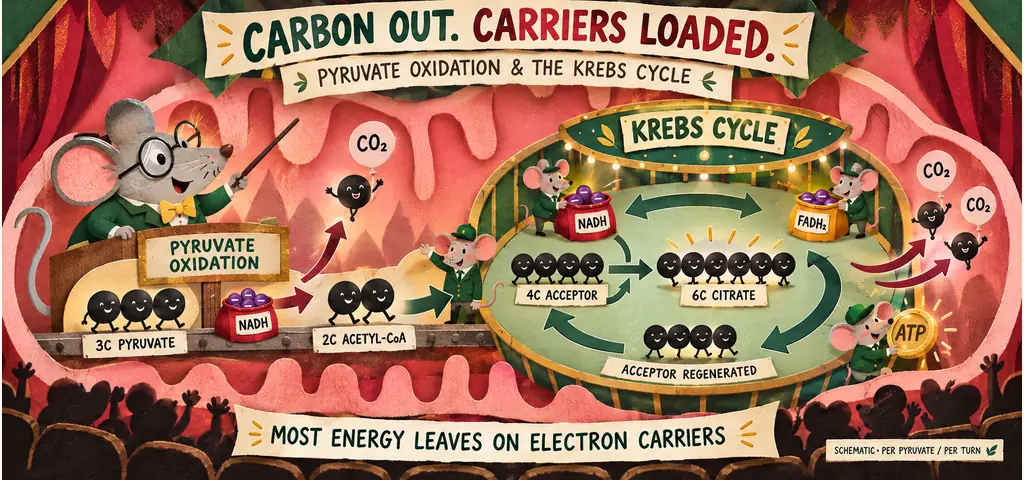
One glucose supplies two pyruvates and two acetyl-CoA entries into the Krebs cycle. Together, pyruvate oxidation and the cycle yield a net six CO2, eight NADH, two FADH2 and two ATP equivalents. Most reactions occur in the mitochondrial matrix; succinate dehydrogenase is embedded in the inner membrane.
Glycolysis converts glucose into pyruvate without releasing carbon dioxide. During aerobic respiration, carbon dioxide is released during pyruvate oxidation and the Krebs cycle in the mitochondrial matrix. Their net carbon balance accounts for six carbon dioxides per fully oxidized glucose, but newly entering acetyl carbons can remain in cycle intermediates for later turns. Much of the captured energy leaves these stages on reduced electron carriers.
Watch the process
Cellular Respiration (UPDATED)
Getting Pyruvate into the Matrix
Glycolysis ends in the cytosol with two molecules of pyruvate. The mitochondrion has two membranes, and pyruvate crosses both through transport proteins to reach the matrix, the innermost compartment enclosed by the inner membrane. Once there, a large enzyme complex performs three operations on each pyruvate in a single pass, which can be followed separately.
First, a carboxyl carbon is removed and released as \(\text{CO}_2\). This is a decarboxylation, the removal of a carbon as carbon dioxide, and it is the first carbon dioxide-producing stage in the standard aerobic pathway followed here; other metabolic pathways can release carbon dioxide too. Second, the remaining two-carbon fragment is oxidized, with the electrons handed to \(\text{NAD}^+\) to make NADH. Third, the oxidized two-carbon unit, an acetyl group, is attached to coenzyme A, a carrier that holds acetyl groups in a reactive form suitable for transfer, producing acetyl CoA.
Per pyruvate: one \(\text{CO}_2\), one NADH, one acetyl CoA, and no ATP. Two pyruvates come from each glucose, so double all of it. Prokaryotes have no mitochondria and run this stage in the cytosol, with their electron transport chain in the plasma membrane; this changes the locations of the reactions.
The Krebs Cycle, Step by Function
The Krebs cycle, also called the citric acid cycle, is a closed loop: the oxaloacetate acceptor used at the start is regenerated by the end, so the cycle can accept the next acetyl group. Start by tracking carbon, reduced carriers and regeneration of oxaloacetate, then connect those functions to the named reactions.
The two-carbon acetyl group is joined to a four-carbon acceptor, oxaloacetate, producing the six-carbon citrate that gives the cycle its other name. Two successive decarboxylations then release two molecules of \(\text{CO}_2\), taking the six-carbon compound back down to four carbons, and each of those steps is an oxidation that reduces \(\text{NAD}^+\) to NADH. One substrate-level phosphorylation produces ATP or GTP, depending on the enzyme form. Count either as one ATP equivalent in this energy ledger. The remaining steps rebuild oxaloacetate, and along the way one oxidation is energetically too weak to reduce \(\text{NAD}^+\) and instead reduces FAD to \(\text{FADH}_2\), while a third \(\text{NAD}^+\) reduction completes the loop.
Per turn: 2 \(\text{CO}_2\), 3 NADH, 1 \(\text{FADH}_2\), 1 ATP equivalent (ATP or GTP). Two turns per glucose, since two acetyl CoA arrive, so per glucose the cycle yields 4 \(\text{CO}_2\), 6 NADH, 2 \(\text{FADH}_2\), and 2 ATP equivalents.
| Stage and basis | Products counted here |
|---|---|
| Pyruvate oxidation, per pyruvate | 1 CO2, 1 NADH, 1 acetyl CoA; no ATP |
| Krebs cycle, per acetyl entry | 2 CO2, 3 NADH, 1 FADH2, 1 ATP equivalent |
| Both stages, per glucose | 6 CO2, 8 NADH, 2 FADH2, 2 ATP equivalents; glycolysis is excluded from these carrier totals |
Now do the carbon audit. Glucose brought in six carbons. Pyruvate oxidation released two, one from each pyruvate. The Krebs cycle released four, two per turn. Six released, six accounted for. This is a net stoichiometric balance, not a claim that every newly fed labeled carbon atom has already been released, and the first three stages together, including the two NADH from glycolysis, yield ten NADH and two \(\text{FADH}_2\) ready to donate electrons to the electron transport chain.
Tracking a Labeled Carbon Atom
A culture is fed glucose in which one specific carbon is radioactive. Determine the earliest stage at which the label can appear in released \(\text{CO}_2\), and distinguish the two acetyl-CoA entries per glucose from the time required to release every labeled carbon.
Follow the carbon through stage one. Glycolysis splits the six-carbon skeleton into two three-carbon pyruvates. No carbon leaves. Whatever the label was attached to, it is now in a pyruvate, so no labeled \(\text{CO}_2\) can be collected yet.
Stage two. Each pyruvate loses one carbon as \(\text{CO}_2\). If the label sat on the carbon that gets removed here, this is the earliest possible appearance. Pyruvate oxidation is the earliest possible stage, but the actual first appearance depends on which glucose carbon was labeled. A label retained in acetyl CoA appears later.
Count the carbons released per stage. \[\begin{aligned}\text{Glycolysis: }&0\\\text{Pyruvate oxidation: }&2\times1=2\\\text{Krebs cycle: }&2\times2=4\end{aligned}\] \[0 + 2 + 4 = 6\ \text{carbons, matching the six in glucose.}\]
Answer the turn count. Each glucose produces two acetyl CoA and therefore drives two turns. Two turns account for the net oxidation of two acetyl-group equivalents. They do not guarantee release of all four newly entering acetyl carbon atoms, which mix with the existing cycle-intermediate pool.
Distinguish net accounting from isotope tracing. The carbons released in a given turn are not the carbons that entered on that turn’s acetyl group. They come off the oxaloacetate portion of the citrate, and the acetyl carbons are released on later turns. Keep the net totals separate from isotope tracing: do not claim that the two carbon dioxides leaving a turn are the two that arrived on the acetyl group.
Answer
Labeled \(\text{CO}_2\) appears no earlier than pyruvate oxidation, and two acetyl-CoA entries give two turns in the net ledger, but tracing every labeled carbon requires following subsequent turns and the intermediate pool.
Oxygen dependence through carrier recycling
An oxygen-free mitochondrial model
No step of pyruvate oxidation or the Krebs cycle uses molecular oxygen as a reactant. Yet sustained activity depends on oxygen in this aerobic mitochondrial model. Explain why removing oxygen can reduce and eventually halt these stages even though oxygen is not a direct reactant.
Start with what each stage actually consumes. Every oxidation in these two stages requires an oxidized carrier, \(\text{NAD}^+\) or FAD, to accept the electrons. Those carriers are substrates as surely as pyruvate is.
Now count the pool. The available oxidized carriers are limited. NAD+ is reduced during these oxidation reactions, and enzyme-bound FAD is reduced during succinate oxidation. Continued flux requires their reoxidation; the duration of any transient activity depends on the experimental conditions.
Follow the chain of dependence. In the mitochondrial respiratory route considered here, NADH is reoxidized through complex I, while enzyme-bound FAD in succinate dehydrogenase transfers electrons through complex II. Sustained electron flow requires the terminal acceptor, oxygen. This is a pathway-specific dependency, not a claim that all organisms recycle carriers only this way. Remove oxygen and the chain fills up. Carriers stay reduced. The pool of \(\text{NAD}^+\) empties. Both matrix stages halt for want of an electron acceptor, without ever having touched an oxygen molecule.
The dependency illustrates a general principle: a pathway can depend on a molecule it never uses as a reactant, if that molecule is required to regenerate one of its substrates.
Answer
Neither stage consumes molecular oxygen directly. In this aerobic mitochondrial model, loss of oxygen impairs respiratory carrier reoxidation, causing oxidized carriers to become limiting and sustained pathway activity to decline. No universal stopping time follows from that mechanism.
Feedback regulation also applies here. High NADH and high ATP indicate abundant reducing power and energy and can reduce flux through enzyme regulation. The precise control differs between pyruvate dehydrogenase and individual cycle enzymes. The cycle is also a hub rather than a dead-end line: amino acid carbon skeletons and the two-carbon units from fatty acid breakdown enter it, which is how a cell burns fuels other than glucose using the same machinery.
Distinctions to keep clear
In aerobic respiration, the Krebs cycle depends indirectly on oxygen even though none of its reactions uses oxygen as a reactant. Use the carrier-recycling explanation above when an FRQ asks why the cycle stops after oxygen removal.
Reduced electron carriers account for most of the energy transferred from these stages to oxidative phosphorylation. The direct ATP-equivalent yield is small compared with the energy carried by the ten NADH and two \(\text{FADH}_2\) that the first three stages hand to the membrane. Reduced carriers from the first three stages deliver electrons to the transport chain, which supports oxidative phosphorylation.
Review: Inside the Matrix: Pyruvate Oxidation and the Krebs Cycle
Pyruvate oxidation and the Krebs cycle account for the remaining net carbon dioxide release after glycolysis and supply reduced carriers for oxidative phosphorylation.
In the net per-glucose ledger, these two stages release six \(\text{CO}_2\) and produce 8 NADH, 2 \(\text{FADH}_2\), and 2 ATP equivalents; individual labeled acetyl carbons may leave on later turns.
Per-turn numbers must be doubled for one glucose, and neither stage uses oxygen as a reactant even though both stop without it.
Pyruvate oxidation and the Krebs cycle
Practice question 1
Per molecule of glucose, the Krebs cycle turns twice because
-
each acetyl CoA must travel around the cycle twice before its carbons are released
-
glycolysis produces two pyruvates, which yield two acetyl CoA
-
oxaloacetate must be rebuilt between turns and the rebuilding takes one full turn
-
two turns are required to reduce a single molecule of \(\text{NAD}^+\)
Practice question 2
Isolated mitochondria with an adequate initial matrix NAD+ pool are supplied with pyruvate but no oxygen. Krebs cycle activity continues briefly and then stops. The best explanation is that
-
oxygen is a direct reactant in two Krebs cycle steps
-
the small pool of \(\text{NAD}^+\) becomes fully reduced and cannot be regenerated without the transport chain
-
carbon dioxide accumulates and reverses the cycle
-
acetyl CoA cannot form in the absence of oxygen
Practice question 3
The carbon atoms released as carbon dioxide during aerobic respiration of one glucose leave during
-
glycolysis only
-
pyruvate oxidation only
-
pyruvate oxidation and the Krebs cycle
-
the electron transport chain
Practice answer key
1. B; 2. B; 3. C.
Practice answer explanations
-
Pyruvate oxidation and the Krebs cycle, Question 1. Choice B is correct. One glucose yields two pyruvates in glycolysis, each of which becomes one acetyl CoA, and each acetyl CoA drives one turn. Choice A doubles the wrong quantity: one acetyl group is consumed per turn, and although the two carbon dioxides leaving a given turn come from the oxaloacetate portion rather than from that turn’s acetyl group, the turn count is still set by the number of acetyl groups. Choice C misdescribes regeneration, which happens within a single turn rather than requiring an extra one. Choice D confuses the number of turns with the stoichiometry of carrier reduction, since each turn reduces three \(\text{NAD}^+\).
-
Pyruvate oxidation and the Krebs cycle, Question 2. Choice B is correct. Neither stage uses oxygen as a reactant, but both depend on regeneration of oxidized carriers, which the oxygen-dependent transport chain normally supports in this mitochondrial model, so activity stops once the small pool is fully reduced. Choice A asserts a direct oxygen requirement that no Krebs step has. Choice C assigns the stoppage to carbon dioxide without evidence; the supplied loss of oxygen explains impaired carrier regeneration. Choice D is contradicted by the brief period of normal activity the question reports.
-
Pyruvate oxidation and the Krebs cycle, Question 3. Choice C is correct. Glycolysis releases no carbon dioxide; pyruvate oxidation releases one carbon per pyruvate and the Krebs cycle releases two per turn, accounting for all six carbons of glucose. Choices A and B each name only part of the answer, and Choice A names the one stage that releases none. Choice D names a stage that handles electrons and protons and produces water, not carbon dioxide.
Continue your review at the AP Biology study hub.
Source and connected review
For an educational reference on these reactions and their products, see OpenStax Biology 2e: Pyruvate Oxidation and the Citric Acid Cycle. Follow the reduced carriers into our electron transport and chemiosmosis lesson.

Related to This Article
More math articles
- Full-Length SAT Math Practice Test-Answers and Explanations
- Feminist Perspectives
- FREE 4th Grade FSA Math Practice Test
- CPA AUD: Tests of Controls vs Substantive Procedures (2027 Prep)
- Ethnocentrism, Relativism, and Cross-Cultural Encounters
- How to Find Rotation of Axes and General Form of Conic Sections
- Indiana Algebra 1 Free Worksheets: Free Skill-Targeted Algebra 1 Worksheets with Answer Keys
- Trust in government
- Multiplying Mixed Numbers Word Problems: Examples and Practice
- Free Grade 5 English Worksheets for South Carolina Students








What people say about "Pyruvate Oxidation and Krebs Cycle: Carbon and ATP Counts"?
No one replied yet.