Heating, Humidity, and Clouds

Clouds, rain, and humidity all come from one simple substance moving through the air: water. The sun’s heat drives water into the air, and as that air cools, clouds form and rain falls. Understanding this cycle explains everyday weather and answers a common set of earth science questions.
This lesson covers how heating, humidity, and cloud formation work together.
The sun heats water on Earth’s surface, causing it to evaporate into water vapor. Humidity is the amount of water vapor in the air. When moist air rises and cools, the vapor condenses into tiny droplets that form clouds, and when droplets grow large enough, they fall as precipitation.

How does heating start the process?
It all begins with the sun. The sun’s energy heats oceans, lakes, and land, causing surface water to evaporate, turning into invisible water vapor that rises into the air. Warm air can hold more water vapor than cold air, which is why hot, muggy days feel so humid. This evaporation is the first step of the water cycle in the atmosphere.
What is humidity, and how do clouds form?
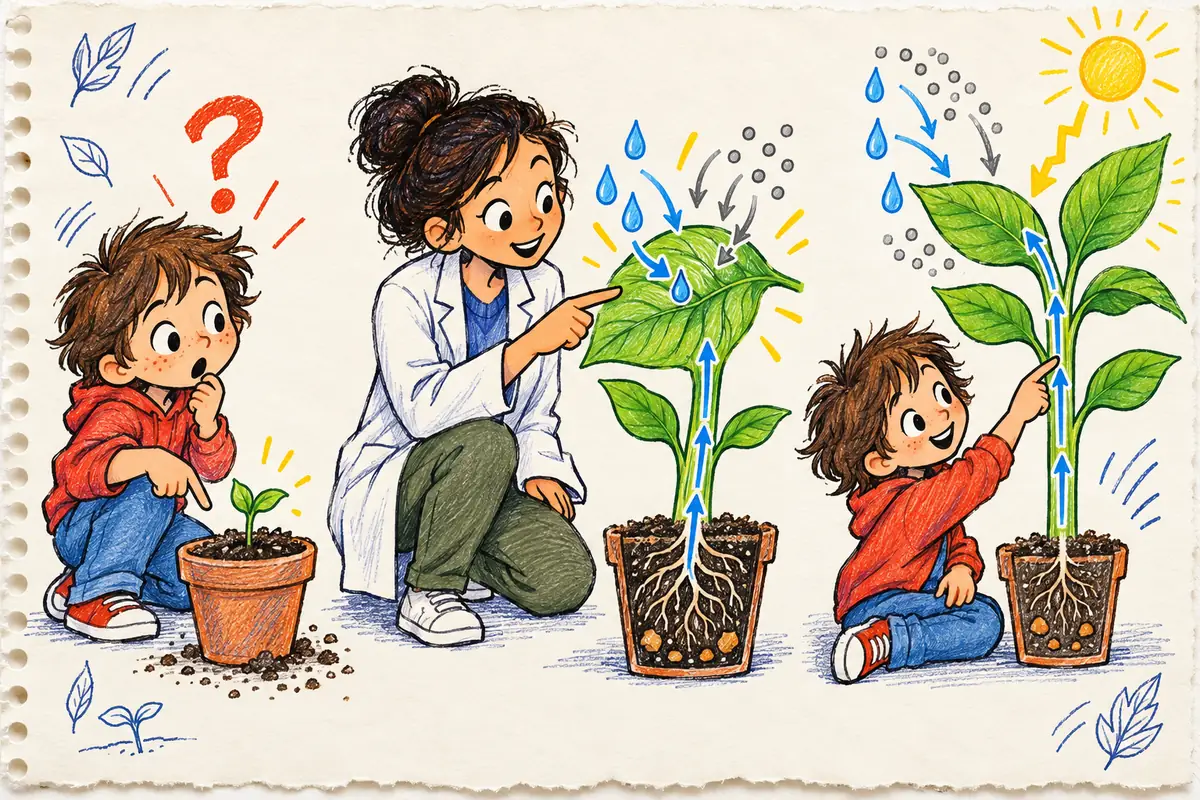
Humidity is the amount of water vapor in the air. As warm, moist air rises, it cools, and cool air cannot hold as much vapor. The extra vapor condenses onto tiny particles of dust to form microscopic water droplets. Billions of these droplets together make a cloud. When the droplets grow heavy enough, they fall as precipitation: rain, snow, sleet, or hail, depending on the temperature.
| Step | What happens |
|---|---|
| Evaporation | Sun turns water into vapor |
| Condensation | Rising air cools; vapor forms droplets |
| Precipitation | Droplets grow and fall as rain or snow |

Why does rising air cool?
As air rises, the pressure around it drops, so the air expands and cools. This is the key to cloud formation: warm, moist air rises, cools as it expands, and its water vapor condenses. That is why clouds often form over mountains, where air is forced upward, and why afternoon storms build on hot, humid days when strong updrafts lift moist air high into the sky.
Watch: A Short Video Lesson
Khan Academy walks through this skill clearly in a few minutes. It is a helpful companion to the reading above:

A routine for humidity and cloud questions
- Start with the sun heating water and causing evaporation.
- Recall humidity is the water vapor in the air.
- Rising air cools, so vapor condenses into droplets.
- Droplets form clouds; heavy droplets fall as precipitation.
- Remember warm air holds more moisture than cool air.
Practice questions
- What does the sun’s heat do to surface water?
- What is humidity?
- What happens to water vapor when air cools?
- What are clouds made of?
- Name two forms of precipitation.
- True or false: cold air can hold more water vapor than warm air.
Answers:
- It causes the water to evaporate into water vapor.
- The amount of water vapor in the air.
- It condenses into tiny water droplets.
- Billions of tiny water droplets (or ice crystals).
- Any two of: rain, snow, sleet, hail.
- False. Warm air holds more water vapor.
Where this fits
Cloud formation is part of the water cycle and weather and takes place in the atmosphere. It leads into the moving air masses of wind, fronts, and storms. Find all topics on the ASVAB General Science Learning Hub.
Recommended Prep Books
These study guides and practice books help you keep building momentum as you prepare:



Related to This Article
More math articles
- 10 Most Common HiSET Math Questions
- How to Graph Inverse of the Cosine Function?
- How to Use Area Models to Factor Variable Expressions?
- Marginal Analysis: Compare Extra Benefits and Costs
- Word Problems of Comparing and Ordering Rational Numbers
- How to Rearrange a Multi-Variable Equation
- How to Graph Absolute Value Inequalities?
- Free Grade 6 English Worksheets for Connecticut Students
- The Ultimate ISEE Lower-Level Math Course (+FREE Worksheets & Tests)
- Volume Calculation Method of Cross-Sections

















What people say about "Heating, Humidity, and Clouds: Definition & Examples"?
No one replied yet.