Fibonacci Calculator — nth Number & Sequence
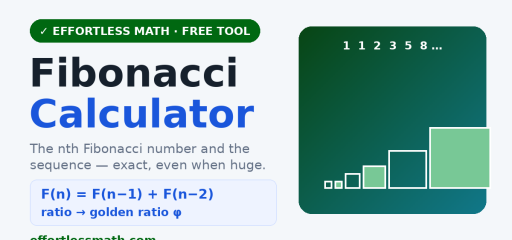
Each Fibonacci number is the sum of the two before it, starting from F(0) = 0 and F(1) = 1. The sequence runs 0, 1, 1, 2, 3, 5, 8, 13, 21, 34, 55, …, so F(10) = 34 + 21 = 55 and F(20) = 6,765. The Fibonacci calculator gives any term exactly, lists and adds terms, tests whether a number is Fibonacci and works through Binet’s formula.
Show steps (4)
- Definition F(0) = 0 and F(1) = 1. Every later term is the sum of the two before it: F(n) = F(n − 1) + F(n − 2).
- Add the two previous terms F(2) = 1 + 0 = 1; F(3) = 1 + 1 = 2; F(4) = 2 + 1 = 3; F(5) = 3 + 2 = 5; F(6) = 5 + 3 = 8; F(7) = 8 + 5 = 13; F(8) = 13 + 8 = 21; F(9) = 21 + 13 = 34; F(10) = 34 + 21 = 55; F(11) = 55 + 34 = 89; F(12) = 89 + 55 = 144; F(13) = 144 + 89 = 233; F(14) = 233 + 144 = 377; F(15) = 377 + 233 = 610; F(16) = 610 + 377 = 987; F(17) = 987 + 610 = 1,597; F(18) = 1,597 + 987 = 2,584; F(19) = 2,584 + 1,597 = 4,181; F(20) = 4,181 + 2,584 = 6,765.
- Check with Binet F(n) is the whole number nearest φn/√5, with φ = (1 + √5)/2 ≈ 1.618034. φ20/√5 ≈ 6,765, which rounds to 6,765 ✓
- Sum of the terms Adding F(0) through F(20) gives F(22) − F(1) = 17,711 − 1 = 17,710.
| n | F(n) |
|---|---|
| 17 | 1,597 |
| 18 | 2,584 |
| 19 | 4,181 |
| 20 | 6,765 |
| 21 | 10,946 |
| 22 | 17,711 |
| 23 | 28,657 |
How to use the Fibonacci calculator
- nth number: enter a position n from −50,000 to 50,000. You get the exact value of F(n), the terms on either side, the ratio to the previous term and the sum of the terms up to n.
- Sequence: enter a first and last index to list up to 1,000 terms with their sum.
- Is it Fibonacci?: enter any whole number to test it and find its position, or the Fibonacci numbers just below and above it.
- Golden ratio: enter n to see Binet’s formula worked out and a table of ratios closing in on φ.
- To use other starting values, change G(0) and G(1), or press Lucas (2, 1).
The Fibonacci sequence
The rule is F(n) = F(n − 1) + F(n − 2), with F(0) = 0 and F(1) = 1. Keep adding the last two terms to get the next one. Here are the first 22 terms:
| n | F(n) | n | F(n) |
|---|---|---|---|
| 0 | 0 | 11 | 89 |
| 1 | 1 | 12 | 144 |
| 2 | 1 | 13 | 233 |
| 3 | 2 | 14 | 377 |
| 4 | 3 | 15 | 610 |
| 5 | 5 | 16 | 987 |
| 6 | 8 | 17 | 1,597 |
| 7 | 13 | 18 | 2,584 |
| 8 | 21 | 19 | 4,181 |
| 9 | 34 | 20 | 6,765 |
| 10 | 55 | 21 | 10,946 |
F(0) or F(1)? Two ways to count
Most textbooks and this calculator use F(0) = 0, F(1) = 1 and F(2) = 1. Some classes start the list with 1, 1, 2, …, which gives the same values for F(1), F(2) and so on. If your list starts 0, 1, 1, … and calls 0 the first term, then the nth term is F(n − 1). The calculator shows that value as well.
How to find a Fibonacci number by hand
To find F(12), write the terms in order and add each pair: 0, 1, 1, 2, 3, 5, 8, 13, 21, 34, 55, 89, 144. So F(12) = 144. Write the index above each term so that you do not skip one, because off-by-one errors are the most common mistake.
For large n, adding one term at a time is slow. The calculator uses the fast doubling formulas F(2k) = F(k)[2F(k + 1) − F(k)] and F(2k + 1) = F(k)² + F(k + 1)². They take n from its binary digits in about log₂ n steps, so F(100) = 354,224,848,179,261,915,075 needs only 7 doublings. All digits are exact, even for answers with thousands of digits.
Binet’s formula and the golden ratio
Binet’s formula gives F(n) without adding up the earlier terms:
F(n) = (φⁿ − ψⁿ)/√5, where φ = (1 + √5)/2 ≈ 1.6180339887 and ψ = (1 − √5)/2 ≈ −0.6180339887.
φ is the golden ratio. Since |ψ| is less than 1, ψⁿ shrinks toward 0, so F(n) is the whole number nearest φⁿ/√5. For n = 10, φ¹⁰ ≈ 122.9919 and ψ¹⁰ ≈ 0.0081, and (122.9919 − 0.0081)/√5 ≈ 55.
Why the ratios approach 1.618
Divide each term by the one before it: 1/1 = 1, 2/1 = 2, 3/2 = 1.5, 5/3 ≈ 1.6667, 8/5 = 1.6, 13/8 = 1.625, 21/13 ≈ 1.6154, 34/21 ≈ 1.6190, 55/34 ≈ 1.6176. The ratios land above and below φ in turn, and each one is closer than the last. If the ratio settles at r, then r = 1 + 1/r, so r² = r + 1. The positive solution is φ. By n = 20 the ratio 6,765/4,181 already matches φ to seven decimal places.
Useful Fibonacci identities
- Sum of terms: F(0) + F(1) + … + F(n) = F(n + 2) − 1. For example, the terms up to F(10) add to 144 − 1 = 143.
- Even terms: every third Fibonacci number is even: F(0), F(3), F(6), F(9) and so on.
- Cassini’s identity: F(n − 1)F(n + 1) − F(n)² = (−1)ⁿ. For n = 10: 34 · 89 − 55² = 3,026 − 3,025 = 1.
- Negative indices: F(−n) = (−1)ⁿ⁺¹F(n), so F(−8) = −21 and F(−7) = 13.
- Fibonacci test: a whole number x is a Fibonacci number exactly when 5x² + 4 or 5x² − 4 is a perfect square. For 144, 5 · 144² + 4 = 103,684 = 322².
Lucas numbers and other starting values
Any two starting values give a Fibonacci-like sequence G(n) with the same adding rule. The Lucas numbers start with 2 and 1: 2, 1, 3, 4, 7, 11, 18, 29, 47, 76, 123. Every such sequence can be written using Fibonacci numbers:
G(n) = G(0) · F(n − 1) + G(1) · F(n).
For the Lucas number L(10): 2 · 34 + 1 · 55 = 123. The ratios of any such sequence also approach φ, unless both starting values are 0.
Common Fibonacci mistakes
- Mixing up the two counting conventions, so that every answer is one position off.
- Multiplying or doubling instead of adding the two previous terms.
- Rounding φ to 1.6 in Binet’s formula. The error grows quickly; with φ = 1.6, n = 20 gives about 5,406 instead of 6,765.
- Expecting a calculator with 10 to 16 significant digits to give exact large Fibonacci numbers. F(80) already has 17 digits.
Where Fibonacci numbers come from
Leonardo of Pisa, known as Fibonacci, described the sequence in his 1202 book Liber Abaci. He used a puzzle about breeding rabbits: each month, the number of pairs equals the counts from the last two months added together. Today the sequence appears in algebra and discrete math lessons on recursion, in computer science, and in counting problems. For example, the number of ways to climb n stairs taking 1 or 2 steps at a time is F(n + 1).
Fibonacci numbers practice quiz: 10 questions
Test yourself with 10 multiple-choice questions. Choose an answer and press Submit to see if you are right and why. Your score appears at the end.
The terms are 0, 1, 1, 2, 3, 5, 8, 13, 21, 34, so F(9) = 34. Answering 21 or 55 is an off-by-one slip.
233 = F(13). Its test value 5 · 233² − 4 = 271,441 = 521² is a perfect square.
The ratios 2, 1.5, 1.667, 1.6, 1.625, … close in on the golden ratio φ = (1 + √5)/2 ≈ 1.618.
ψ = (1 − √5)/2 is the second root of x² = x + 1. Note that ψ = −1/φ, so the sign matters.
F(−n) = (−1)ⁿ⁺¹F(n). With n = 6 the sign is negative, so F(−6) = −F(6) = −8.
The parity pattern is even, odd, odd, even, odd, odd, … because odd + odd = even.
Quiz complete
Frequently asked questions
How do you calculate the Fibonacci sequence?
Start with 0 and 1, then add the last two terms to get the next: 0 + 1 = 1, 1 + 1 = 2, 1 + 2 = 3, 2 + 3 = 5, and so on. For a single far-off term, use Binet’s formula or the fast doubling formulas.
What is the Fibonacci of a number?
“The Fibonacci of n” means the nth Fibonacci number F(n). With F(0) = 0, F(7) = 13 and F(12) = 144.
What is Fibonacci 3?
F(3) = F(2) + F(1) = 1 + 1 = 2. The next terms are F(4) = 3 and F(5) = 5.
How do you calculate the Fibonacci ratio?
Divide a Fibonacci number by the one before it, such as 55/34 ≈ 1.6176. As n grows the ratio approaches the golden ratio φ ≈ 1.6180339887. The reverse ratio, F(n)/F(n + 1), approaches 1/φ ≈ 0.618.
Is the Fibonacci sequence calculus?
No. The sequence itself belongs to algebra and discrete math, because it is defined by a recursion. It connects to calculus through limits: the limit of F(n + 1)/F(n) as n grows is φ.
How do you use a Fibonacci calculator?
Type the position n and read F(n) with its neighbors and the steps. Use the other tabs to list terms, test a number or see the golden ratio. For homework, work the first few terms by hand and use the calculator to check them.
Related calculators

Related to This Article
More math articles
- Volume for 5th Grade: Counting Unit Cubes and Formulas
- Kentucky KSA Grade 7 Math Worksheets: 95 Free Printable PDFs with Answer Keys
- Is Algebra 2 Harder Than Geometry? An Honest Comparison
- Political speech
- GACE Elementary Education Math Flashcards
- Affirmative Action and Equal Protection: Admissions Rules
- Best Digital Writing Pads for Online Teaching in 2024
- How to Perform Scalar Multiplication
- President pro tempore
- A Comprehensive Collection of FREE SAT Math Practice Tests



What people say about "Fibonacci Calculator: nth Number, Sequence & Golden Ratio"?
No one replied yet.