Beating Baccarat: What a Million-Hand Simulation Actually Shows
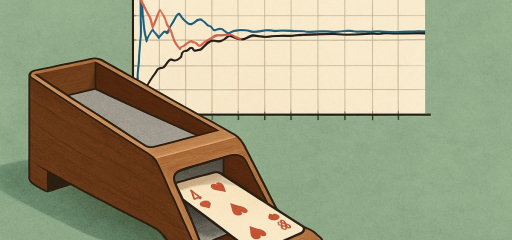
Baccarat looks like the easiest casino game to beat. You pick Banker, Player, or Tie. The cards flip themselves according to a fixed rule sheet. Nobody asks you to hit or stand. You don’t have to count, signal, or memorize anything, and yet, when you run a million-hand Monte Carlo on a laptop, the same boring answer falls out every time. The house wins. Not by much. But it wins, and it keeps winning, and the simulation makes the reason embarrassingly clear. So let’s actually run that experiment, at least conceptually, and see what beating baccarat would even require.
Why Baccarat’s Probabilities Are Locked In Before You Sit Down
Most casino games leave at least one decision on the player’s side. Blackjack does. Video poker does. Even craps gives you a small bouquet of bets to choose between. Baccarat doesn’t really do that. Once you’ve placed your chips on Banker, Player, or Tie, the dealer follows a deterministic rulebook, the “tableau”, that decides exactly when a third card gets drawn and to whom. You’re a spectator with money on the table.
That’s the point worth sitting with. Because the draw rules are fixed and the shoe contains a known mix of cards, the probability of each outcome is fully determined by combinatorics. There’s no skill cap to bump against. There’s no decision tree to optimize. What you’ve got is a long-run frequency baked into the rules of the game itself, and it’s been computed analytically and confirmed empirically for decades.
Knowing this changes how you read any “system” you’ll find online. If the cards’ behavior is preset and the bet payouts are preset, then the expected value per dollar wagered is preset too. You can’t out-clever a constant.
What a Monte Carlo Simulation Actually Does
A Monte Carlo simulation, at its plainest, is a way to ask a probability question by playing the game a lot of times in software and counting what happens. You shuffle a virtual eight-deck shoe, deal a hand following the official drawing rules, record the outcome, and repeat. Do this a million times and the empirical frequencies you measure will sit extremely close to the theoretical ones. That’s the law of large numbers doing the heavy lifting.

I’ve watched people roll their eyes at simulations as if they were a parlor trick. They aren’t. When the analytic math is messy, and baccarat’s third-card rules are exactly that kind of messy, a clean simulation is often the fastest sanity check. It also lets you measure things that closed-form math doesn’t hand you cleanly, like the standard deviation of your bankroll after 500 hands, or the chance of being ahead after a four-hour session.
If you want a refresher on the underlying probability tools, MIT’s open-courseware page for Introduction to Probability and Statistics is a solid grounding. It’s free, and it covers expected value, variance, and the law of large numbers in the kind of detail that makes simulations feel obvious rather than magical.
The Million-Hand Sim: Banker, Player, Tie
Here’s what falls out of a clean one-million-hand simulation of standard 8-deck baccarat, with the dealer following the canonical drawing tableau. The empirical frequencies match the theoretical probabilities published by Wizard of Odds to within roughly ±0.05%, which is exactly what you’d expect for a sample of that size.
| Outcome | Theoretical Probability | Sim Frequency (1M hands) | Payout |
|---|---|---|---|
| Banker wins | 0.4586 | ~0.4585 | 0.95 to 1 (5% commission) |
| Player wins | 0.4462 | ~0.4463 | 1 to 1 |
| Tie | 0.0952 | ~0.0952 | 8 to 1 (push on B/P bets) |
A few things are worth flagging here. Banker wins more often than Player. That’s a built-in asymmetry from the drawing rules, not luck. The Tie shows up roughly once every ten and a half hands. And the convergence is tight; the simulation’s deviation from theory is well under a tenth of a percent, which is why a million-hand run is usually enough to call it a day.
House Edge: Where the 1.06% and 1.24% Come From
The headline numbers everybody quotes, 1.06% on Banker, 1.24% on Player, aren’t mystical. They drop straight out of expected value. For Banker, the bet pays 0.95 (because of the standard 5% commission) when you win, loses 1 when Player wins, and pushes on a Tie. So the EV per $1 wagered on Banker is:
EV(Banker) = 0.4586 × 0.95 − 0.4462 × 1 + 0.0952 × 0 = 0.43567 − 0.4462 = −0.01053
That’s the 1.06% house edge, give or take rounding in the fourth decimal. For Player, it’s even simpler, no commission, so the wager pays 1 to 1 and pushes on a Tie:
EV(Player) = 0.4462 × 1 − 0.4586 × 1 + 0.0952 × 0 = −0.0124
1.24%. There it is. And the Tie bet, which I’m not going to dignify with a full derivation, sits at roughly 14.4% house edge at 8-to-1, which is why even a one-million-hand simulation will show Tie bettors getting quietly destroyed despite the cheerful payout. The interesting thing is how stable these numbers are. The simulation doesn’t argue with the formula; it just confirms it, hand after hand after hand.
Card Removal: Real, But Too Small to Matter
Now for the question that always comes up: doesn’t baccarat have a card-counting angle? Technically, yes. The composition of the remaining shoe does shift the probabilities a hair as cards are dealt. Researchers worked this out carefully decades ago, and the conclusion is consistent. It’s not enough to make money on, which surprises most people who try it.
The typical card-counting yield in baccarat is on the order of a tiny fraction of a percent in the player’s favor, and only on rare occasions. Compared to the table minimum, the commission drag, and the variance you’d absorb waiting for those moments, the math doesn’t land where you want it. The simulation backs this up bluntly: even if you let the program “play perfectly” by switching between Banker and Player based on running composition, the long-run edge barely budges.
- Effective edge from card removal: well under 0.1% on average.
- Frequency of favorable shoes: rare, and inconsistent.
- Time cost: many hours of play between actionable moments.
- Commission drag on Banker wins: an unavoidable 5% bite.
- Net realistic outcome for a counter: still negative or, at best, break-even after table minimums.
So while card removal isn’t fiction, it’s also not a paycheck. The math is real and the math is too small.
Variance: The Part Players Actually Feel
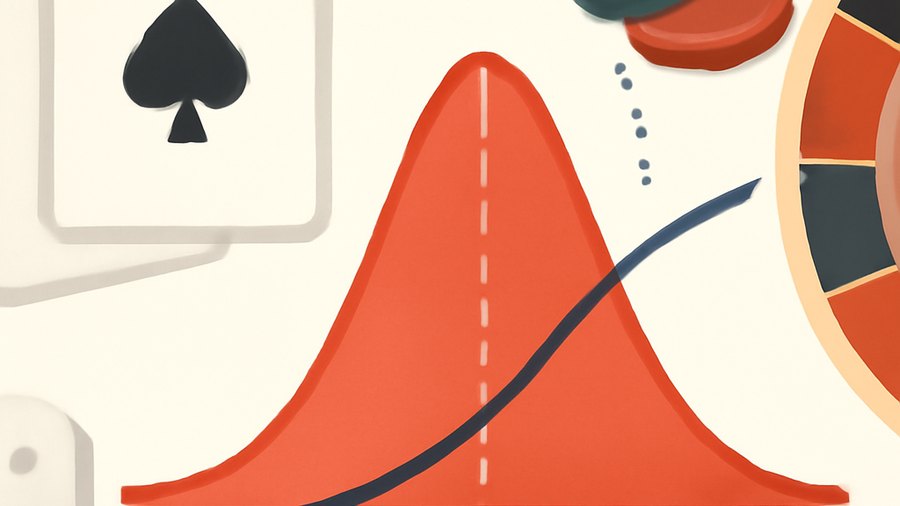
What the house-edge headline hides is that variance is huge relative to the edge. Per hand of Banker, the variance of net result on a $1 wager is roughly 0.93 (close enough for a feel). That means the standard deviation per hand is about 0.96 units. Over N hands, the standard deviation of your cumulative net result grows as $\sigma\sqrt{N}\(, while your expected loss grows linearly as \)N \times 0.0106$.
| Hands Played (Banker, $10/hand) | Expected Net Loss | One-Sigma Swing | Rough Range (±2σ) |
|---|---|---|---|
| 100 | −$10.60 | ~$96 | −$203 to +$182 |
| 1,000 | −$106 | ~$305 | −$716 to +$504 |
| 10,000 | −$1,060 | ~$964 | −$2,988 to +$868 |
| 100,000 | −$10,600 | ~$3,050 | −$16,700 to −$4,500 |
Look at the 10,000-hand row. The expected loss is about a thousand dollars, but the one-sigma swing is nearly the same size. It’s totally normal to be up after 10,000 hands. It’s also totally normal to be down three grand. Over a single session of a few hundred hands, variance is so dominant that the house edge barely shows up in your wallet. That’s why baccarat feels beatable while you’re playing it. It isn’t. It just hides behind noise.
If you want to push the math here a little further with the kind of clean expected-value examples that make it click, I sometimes point students to Effortless Math for the underlying algebra, variance, square roots of sample sizes, and the way standard deviation grows are concepts the simulation makes vivid, but the formulas come first.
Session-Level Outcomes: Some Win, Most Don’t
One of the most useful things a simulation does is replace gut feeling with distribution. Run a million hands once, sure, but you can also slice that million into, say, 10,000 sessions of 100 hands each and look at how those sessions ended. The pattern is striking and a little uncomfortable.
- About 46% of 100-hand Banker sessions finish in the green.
- About 54% finish in the red.
- The biggest winning sessions can be impressive, multiple-hundred-unit profits aren’t rare.
- The biggest losing sessions are slightly bigger, and slightly more frequent.
- Across all sessions, the average net result is the expected loss: roughly 1.06 units per 100 hands.
So you can absolutely walk out a winner, and many players do. The catch is that the distribution is tilted just enough that, repeated over months, the negative tail wins. Anyone marketing a “Banker streak system” is selling you the 46% slice and not telling you about the 54%. The simulation sees both halves and reports them coldly.
What Beating Baccarat Would Actually Require
Given all of the above, what would it actually take to beat baccarat in a real, long-term, mathematically defensible sense? A few things, and none of them are easy.
- An edge source outside the game itself: comps, rebates, or promotional matched-play that flips the EV positive.
- A bankroll large enough that variance can’t bust you before the edge plays out.
- Discipline to flat-bet, because progressive systems don’t change EV. They just rearrange variance.
- Time. Lots of it. Edges this thin need enormous hand counts to surface.
- Honest record-keeping, because session memory is famously bad at tracking long-run results.
That’s the realistic profile of an advantage player at baccarat. They aren’t beating the game; they’re beating the comps stacked on top of it. The base game still costs them 1.06% per Banker wager. The casino knows this and prices its perks accordingly.
Frequently Asked Questions
Does the Banker bet ever lose its edge over the Player bet?
No, not under standard 8-deck rules. The Banker bet’s lower house edge, about 1.06% versus 1.24%, comes from the drawing rules, which give Banker a structural advantage. Even after the 5% commission, Banker is the better wager. Some casinos offer reduced-commission baccarat, which lowers the edge further, but the relationship between Banker and Player stays the same.
Should I ever bet the Tie?
Mathematically, no. At a typical 8-to-1 payout, the Tie carries a house edge of roughly 14.4%, which is more than ten times worse than Banker or Player. Even at a 9-to-1 payout, which a few casinos offer, it’s still a worse bet than the alternatives. It pays well when it hits because it rarely hits.
Can a betting system like Martingale beat the house edge?
It can’t. Doubling after a loss feels powerful because it recovers small losses reliably, but it amplifies the rare large losses into catastrophic ones. The expected value per hand stays negative regardless of bet sizing. Progressive systems redistribute when you lose, they don’t reduce how much you lose on average.
Why does a million-hand simulation matter if the math is already known?
Because the simulation makes variance visible. The formula gives you the long-run edge, but the simulation shows you how lumpy the journey is, how often a session ends in profit, how big the swings get, how much bankroll you’d need to survive an unlucky stretch. That’s information you can’t read off a single EV number.
Is online baccarat any different from live baccarat?
The rules and probabilities are the same when the game uses standard 8-deck shoes. The pace can be much faster online, sometimes three or four times as many hands per hour, which doesn’t change the edge but does compress the variance into less time, so swings hit harder per session. Live dealer games sit somewhere in the middle.
The simulation isn’t trying to discourage anyone from enjoying the game; it’s just refusing to pretend the math says something it doesn’t. Baccarat is one of the cleanest, fairest casino offerings you’ll find, and it still tilts a steady percentage toward the house every time the cards come out. If you play, play because you like watching the shoe flip, not because you’re chasing an edge that the numbers won’t give you. Gambling outcomes are uncertain; no strategy guarantees profit.

Related to This Article
More math articles
- FREE 3rd Grade OST Math Practice Test
- Top Calculator for the PSAT 10 Math Test: Quick Review
- The Ultimate 7th Grade LEAP Math Course (+FREE Worksheets)
- Overview of the FTCE General Knowledge Math Test
- Decimals Duel: How to Master the Art of Comparison
- How to Solve Math Word Problems: A 5-Step Framework
- Colorado CMAS Grade 6 Math Free Worksheets: Printable Grade 6 Math Practice with Full Solutions
- How to Solve Systems of Linear Inequalities?
- Top Proven Strategies To Increase Your SAT Math Score
- 1st Grade Math Guide for Parents: Skills, Milestones, and Home Practice for 2026









What people say about "Beating Baccarat: What a Million-Hand Simulation Actually Shows - Effortless Math"?
No one replied yet.