Reaction Rates: Collisions, Activation Energy, and Catalysts
A crushed tablet can react faster than an intact tablet because more of its surface contacts the solution. Heating may also speed a reaction, but it acts through a different change in the collision process. Explain the mechanism behind the factor you name.
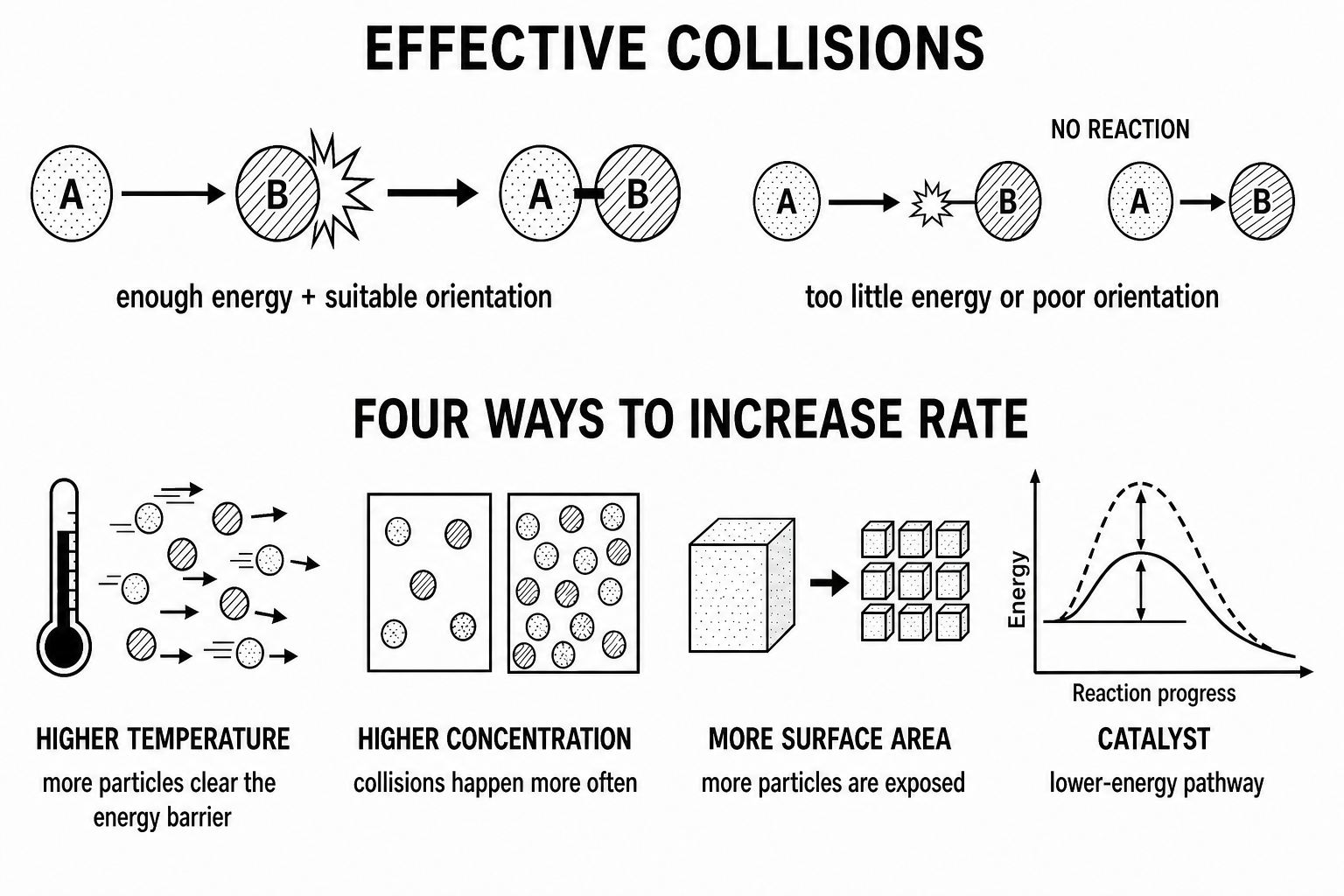
Reaction rate describes how quickly reactant or product amount or concentration changes. Collision theory relates reaction to encounters with suitable energy and orientation. Temperature, concentration, exposed surface area, and catalysts can influence rate. A catalyst provides an alternative reaction pathway and is regenerated during the catalytic process.
Why do only some collisions lead to reaction?
Particles must encounter one another in a suitable arrangement and with enough energy to reach the relevant transition state. Activation energy is the energy barrier associated with a pathway. Raising temperature changes the distribution of particle energies, increasing the fraction able to overcome a given barrier.
For many reactions, raising reactant concentration increases the frequency of relevant encounters. The actual concentration dependence is determined experimentally and expressed through a rate law.
Worked example: calculate an average disappearance rate
A reactant concentration decreases from 0.80 mol/L to 0.50 mol/L in 10.0 seconds. Its average disappearance rate is
\[ -\frac{\Delta[A]}{\Delta t}=-\frac{0.50-0.80}{10.0}=0.030\,\mathrm{mol\,L^{-1}\,s^{-1}}. \]
The concentration change is negative. The leading minus sign reports disappearance as a positive rate. When comparing different species in one reaction, account for their stoichiometric coefficients.
How does a catalyst differ from heating?
A catalyst changes the pathway and can lower the activation barrier. It does not change the reaction’s overall free-energy change or equilibrium constant at a fixed temperature. It speeds the approach to equilibrium by facilitating both forward and reverse processes.
Heating changes the system’s temperature and can affect both reaction rates and the equilibrium position. A catalyst and a heater therefore should not be treated as interchangeable explanations.
What would make a rate experiment convincing?
To test the effect of surface area, compare equal masses of the same solid with different particle sizes. Control temperature, solution concentration, volume, and mixing. Use the same measurable endpoint, such as gas volume collected over a specified interval.
- Change one intended factor.
- Define how rate will be measured.
- Hold competing factors steady.
- Repeat trials and report variation.
Cutting a solid changes exposed surface area. It does not change the chemical identity or the intrinsic activation energy of the uncatalyzed pathway.
Can you apply the idea?
-
What two features make a collision suitable in a basic collision model?
Check your answer
Enough energy and an appropriate orientation.
-
Why can crushing a solid increase its reaction rate?
Check your answer
It exposes more surface to the other reactant.
-
Does a catalyst increase the equilibrium constant at fixed temperature?
Check your answer
No. It changes the pathway and speeds the approach to equilibrium.
-
A concentration falls by 0.20 mol/L in 5.0 s. Find its average disappearance rate.
Check your answer
\(0.040\,\mathrm{mol\,L^{-1}\,s^{-1}}\).
-
Why should temperature be controlled when testing concentration effects?
Check your answer
A temperature difference can change rate and confound the comparison.
-
Does a faster reaction necessarily give a larger equilibrium product amount?
Check your answer
No. Reaction speed and equilibrium composition are different properties.
Watch the idea explained
Kinetics: Chemistry's Demolition Derby – Crash Course Chemistry #32, CrashCourse.
This selected excerpt runs from 0:00 to 1:30. Collision energy and orientation as introductory factors in reaction rates.
Where does this fit?
Use the chemistry learning hub to choose a lesson or practice test. Connect this topic with calorimetry and heat, chemical equilibrium, stoichiometry and limiting reactants, gas laws and states of matter.
Continue with a chemistry study guide

Related to This Article
More math articles
- Triangles
- Simplifying Radicals Practice — Simplest Radical Form (Free)
- First Amendment Freedom of Religion
- Necessary and Proper Clause
- The Crash and the Causes of the Great Depression
- How to define Polar Coordinates
- Purpose of the Bill of Rights
- Florida FAST Grade 4 Math Free Worksheets: Printable B.E.S.T.-Aligned Practice with Answer Keys
- Hawaii SBAC Grade 4 Math Free Worksheets: Printable Practice Worksheets with Worked Solutions
- The Ultimate 7th Grade KAP Math Course (+FREE Worksheets)

















What people say about "Reaction Rates: Examples and Practice"?
No one replied yet.