Genetic Variation, Common Ancestry, and Cladograms

Living things are related to one another, some closely and some distantly, because they share common ancestors. Scientists show these relationships with a branching diagram called a cladogram (also called a phylogenetic tree). Being able to read one is a skill the test rewards, and it ties together variation, ancestry, and evolution.
Genetic Variation and Ancestry
Within any species there is genetic variation — differences among individuals. Over long times, populations accumulate different changes, and groups that once shared an ancestor become distinct species. The more recently two species shared a common ancestor, the more closely related they are, and usually the more DNA they share. This is the core idea behind “common ancestry”: similar organisms often descend from the same ancestor.
Reading a Cladogram
A cladogram is a tree. Each branch point (called a node) represents a common ancestor, and each tip is a species. To judge how closely two species are related, find where their branches meet: the more recent that shared point, the closer the relationship.
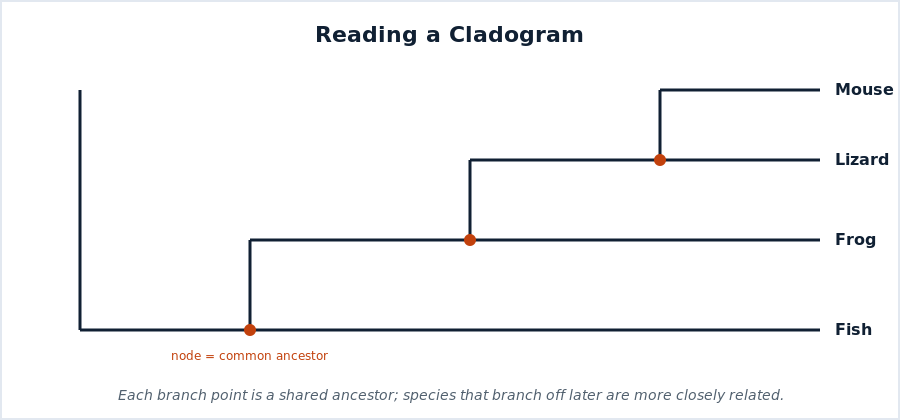
In the tree above, the mouse and lizard share a more recent common ancestor with each other than either does with the fish, so they are more closely related. Reading a cladogram is mostly about locating shared branch points — not memorizing the animals.
What the Branches Tell You
Species that branch off close together are more closely related; species separated by many branch points are more distantly related. A common test question gives a cladogram and asks which two organisms are most closely related — the answer is the pair that shares the most recent common ancestor. Shared traits also line up with the branches: features that appear at a branch point are usually shared by everything above it.
Watch: A Short Video Lesson
Khan Academy walks through this skill clearly in a few minutes. It is a helpful companion to the reading above:
A Routine for Cladogram Questions
- Each branch point (node) is a common ancestor; each tip is a species.
- To compare two species, find where their branches meet.
- A more recent shared branch point means a closer relationship.
- More recent common ancestor = more closely related.
Practice
- What does a branch point (node) on a cladogram represent?
- How do you tell if two species are closely related on a cladogram?
- What is genetic variation?
- Two species share a very recent common ancestor. Are they closely or distantly related?
- What does “common ancestry” mean?
- On a cladogram, what is found at each tip?
Answers
- A common ancestor.
- Find where their branches meet; a more recent point means closer.
- Differences among individuals within a species.
- Closely related.
- Similar organisms descend from the same ancestor.
- A species.
Where This Fits in Your Science Prep
Cladograms build on evolution and natural selection and on the DNA that species share. See all topics on the Science Topics Hub.

Related to This Article
More math articles
- How to Find the Area and Circumference of Circles? (+FREE Worksheet!)
- Free Mississippi MAAP Grade 3 Math Practice: 49 Printable PDFs for Classrooms, Tutors, and Parents
- Free Grade 5 English Worksheets for Kentucky Students
- Enhanced ACT Composite Score: Read Your English, Math and Reading Results (2027 Prep)
- Multiplying & Dividing Fractions Practice — Free Drills
- How to Build a Personal Budget: Step-by-Step (2026)
- CLEP U.S. History I 095: Lincoln-Douglas Debates, Election of 1860, and Secession
- Research Ethics and Participant Protection
- Virginia SOL Algebra 1 Worksheets: 64 Free Printable PDFs
- Cycles, Biomes, and Human Effects





















What people say about "Genetic Variation, Ancestry, and Cladograms"?
No one replied yet.